
Archived decisions
HAMPSHIRE COUNTY COUNCIL
Decision Report
Decision Maker: |
Cabinet | ||||
Date of Decision: |
21 December 2009 | ||||
Decision Title: |
2009/10 Budget Monitoring Update | ||||
Decision Reference: |
1084 | ||||
Report From: |
County Treasurer | ||||
Contact name: |
Nick Gibbins | ||||
Tel: |
01962 847544 |
Email: |
|||
1. Executive Summary
1.1. This report reviews the latest budget monitoring reports for 2009/10 submitted to Executive members together with monitoring high risk/demand led budgets, overall employee budgets, savings plans and financial health indictors at the end of the second quarter to provide an overall corporate context to budget monitoring.
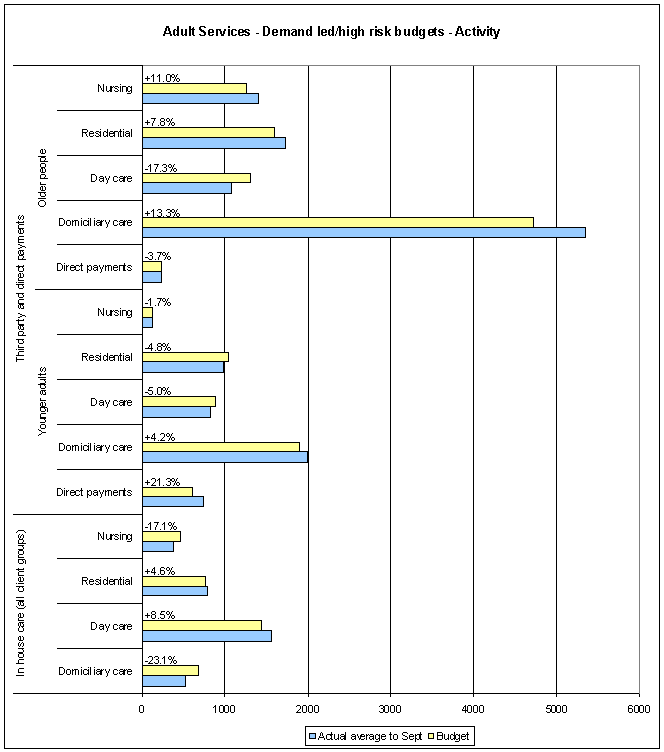
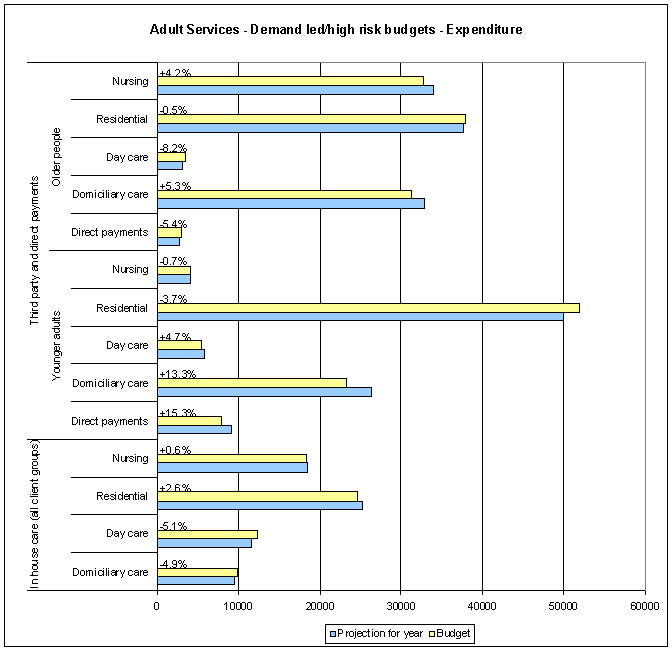
1.2. At the end of the first quarter's budget monitoring, there were clear indications that management of the Children's Services and Adult Services' budgets was likely to be more challenging in 2009/10 than in the previous year, mainly because of increased social care client numbers. This remains the position based on quarter two data, particularly in respect of Children's Services. Action is also being taken to manage budget pressures in the library service particularly as a result of the continuing decline in income from hiring out DVDs and from fines. Both Environment and Policy and Resources spending should be contained within cash limits and the scope for carry forward of planned underspendings to 2010/11 is being explored.
1.3. Higher spending than budgeted on high risk/demand led budgets represents a key factor in the budget pressures being experienced by Adult and Children's Services. Overall spending projected on employee budgets at the end of the second quarter is marginally below budget, assisted by the settlement of the 2009 pay award at 1%, 0.2% lower than budgeted. Good progress is also being achieved in implementing plans to achieve budgeted savings.
1.4. The County Council applied to Communities and Local Government (CLG) for a capitalisation direction of £4m in 2009/10 towards the cost of equal pay claims, as the initial tribunal cases could be resolved at the end of 2009/10. A capitalisation direction enables a local authority to capitalise expenditure and so finance that spending over a number of years, when the nature of the expenditure would not justify capitalisation in accordance with accounting standards. CLG rejected the County Council's capitalisation request and though this is not a problem in 2009/10, it could be in 2010/11 or 2011/12, if the Treasury were to be very restrictive over the issue of capitalisation directions.
2. Contextual information
Adult Services
2.1. The Executive member for Adult Social Care considered a budget monitoring report in October, which indicated that pressures on the budget were being generated by three factors:
· increased client numbers and more complex care needs
· the impact of the different rules for determining which local authority is responsible for funding social care, where a home is classified as non-residential as opposed to residential
· a back log of cases lodged with the National Health Service (NHS) in Hampshire seeking approval for NHS funding of continued health care needs.
2.2. Nonetheless the projected overspending on demand led care budgets has stabilised in the second quarter, at £4.7m (1.8%), compared with £4.6m in the first quarter. After allowing for additional income, savings on non-demand led budgets and the impact of management action, the overall projected overspending at the end of the second quarter is £1.4m or 0.5%, lower than the £2.1m projected at the end of month 4.
Children's Services
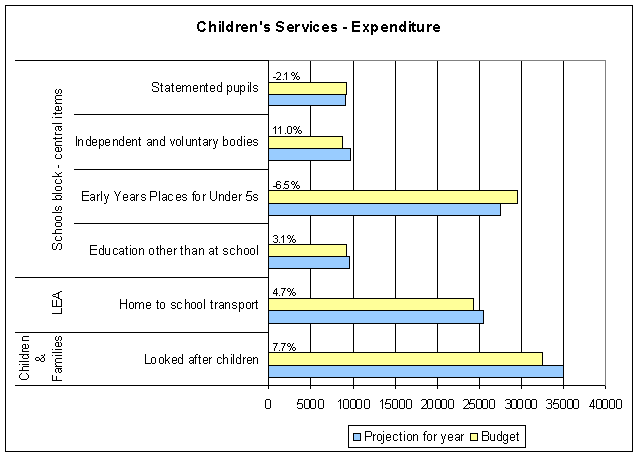
2.3. The overall projected overspending on demand led budgets has reduced from £3.6m at the end of the first quarter to £2.8m at the end of the second quarter. However the improved position is primarily the result of anticipated savings in early years' spending within the schools block, and the forecast overspending on the non-schools' budget has increased from £2.4m to £3.6m - £2.5m on looked after children and £1.1m on home to school transport.
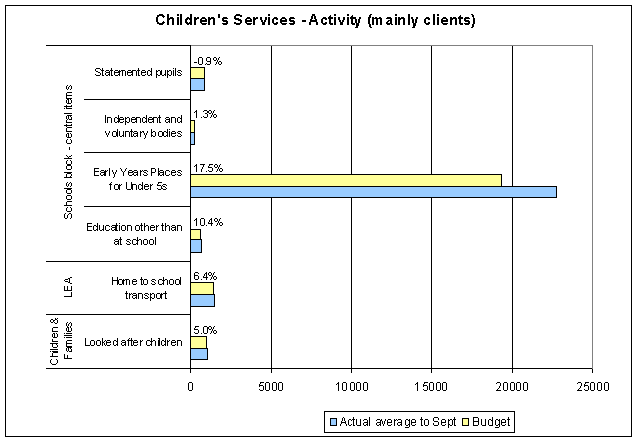
2.4. Increased spending on looked after children is mainly the result of the upward trend in numbers, which at the end of the second quarter was 5% higher than budgeted. This reflects a national trend from both heightened concerns about child safety and the effects of the economic downturn.
2.5. Spending pressures relating to home to school transport also reflect increased activity levels, particularly in the number of pupils in either special schools or other non-mainstream arrangements, who are eligible for home to school transport. Management action being taken to deal with the pressures on the non-schools budget has resulted in the identification of savings of £0.9m, reducing the projected overspend to £2.7m at the end of the second quarter.
Culture, Communities and Rural Affairs
2.6. As previously reported in September, management action is being taken to deal with a potential overspending of £0.2m, mainly as a result of the continued downturn trend in library income from DVD hire and fines. This action is expected to ensure that a balanced budget position is achieved.
Environment
2.7. A budget monitoring report was submitted to the Executive member in October, indicating that expenditure is expected to be contained within the cash limit and that there may be opportunities to carry forward resources to support the 2010/11 budget. Savings of £751,000 on road safety education and the Safer Roads Partnership are being redeployed within the capital programme to reinforce the Village 30 speed limits programme and other road safety initiatives. The Cabinet has been requested to approve this virement. In addition, the allocation of £2.6m approved by the Cabinet in September on high priority highway works is providing additional resources for the resurfacing of non-principal roads, drainage improvements and the village 30 programme.
Policy and Resources
2.8. Following the decision by the Cabinet in September to deal with the Coroners budget outside the Policy and Resources cash limit, projected spending on Policy and Resources' services is expected to be contained within the cash limit. This will continue to require savings to be achieved to offset higher net spending on the corporate estate, development account and sites for gypsies and travellers, all of which are adversely affected by economic factors.
Corporate budget monitoring
2.9. In addition to service-based budget monitoring, a corporate monitoring process is undertaken across all services on a quarterly basis, focusing on high risk/demand let budgets, overall employment trends, the achievement of budget savings and the monitoring of financial health indicators.
High risk/demand led budget
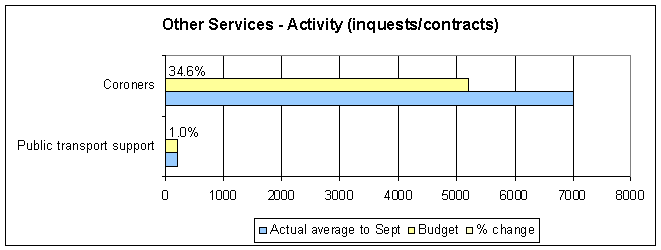
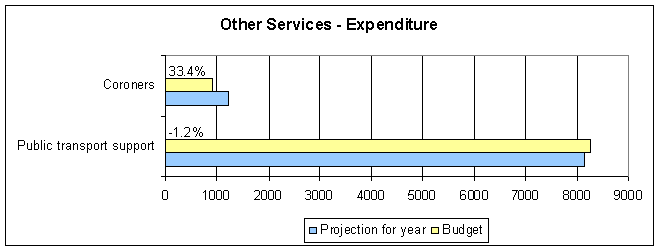
2.10. Appendix 1 summarises the monitoring of spending and activity on high risk/demand let budgets, which are mainly focused on Adult and Children's Services. Spending on these budgets is projected to be £7.7m (2.0%) higher than budgeted by £4.7m on Adult Services, £2.8m on Children's Services, £0.3m on Coroners, and with a projected saving of £0.1m on public transport support. Within Children's Services there is a projected saving of £0.9m on the Schools budget, so that the net projected overspending on the non-schools budget is £8.6m, compared with £7.2m at the end of the first quarter. The increase is mainly the result of the latest spending projections for 2009/10 on looked-after Children. At the equivalent stage in 2008/09 the projected overspending was £5.2m, indicating the extent to which budget pressures are greater than last year and will require more significant management action.
Employee budgets
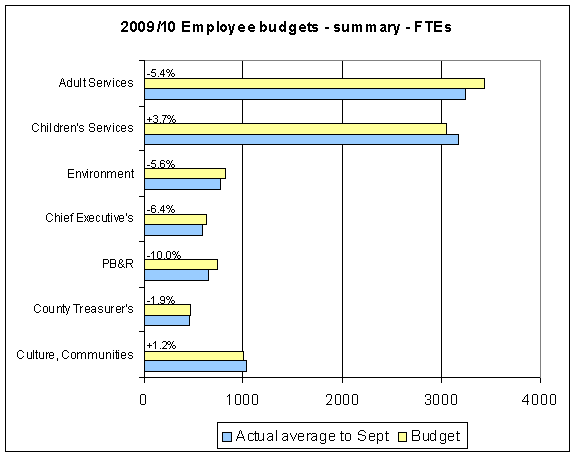
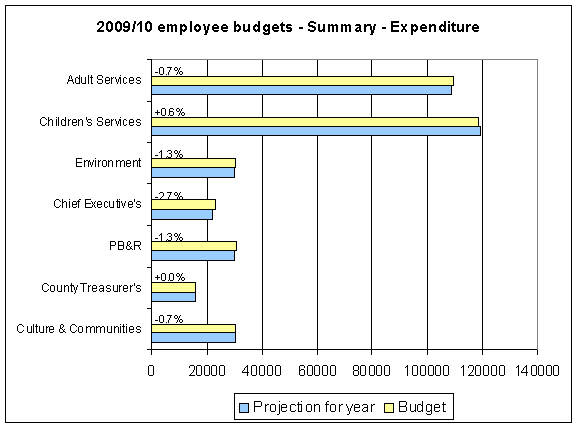
2.11. Overall spending on employee budgets is projected to be slightly lower than budgeted at £1.7m (0.5%) below the budget of £357.9m, though there are some variations between services. This includes the effect of the saving, estimated at £0.5m, arising from the settlement of the 2009 pay award at just over 1%. Actual employee numbers (excluding school based and business unit employees) for the first two quarters averaged 9,918 full time staff members (FTE), just over 2% lower than budgeted, but slightly higher than the 9,872 (FTE) in the previous quarter, reflecting additional posts included in the 2009/10 budget. With lower staff turnover and with some posts proving easier to recruit to than in the past, robust employee budget management arrangements have needed to be put in place.
Savings Plans
2.12. The 2009/10 budget included planned savings of £15.2m to finance one-off and recurring budget pressures in 2009/10 that could not be accommodated within the budget guidelines. This excludes savings achieved by means of carry forward of underspendings, the use of reserves or transfers from capital, which do not require monitoring.
2.13. Good progress has been made in implementing plans to achieve the budgeted savings, with savings of £6.4m assessed as having been already achieved and with firm evidence of likely achievement being available for £13.0m of the planned savings, thus limiting the extent to which it may be necessary to identify alternative savings to meet budget targets.
Financial Health indicators
2.14. A set of Financial Health indicators were incorporated in the budget proposals approved by Cabinet in February 2009. They are designed to provide an early warning of when action may be required to protect the County Council's financial health. Appendix 3 contains a summary of the targets for 2009/10 and either the latest full-year projection or data for the second quarter.
2.15. All of the indicators are expected to be within or very close to the target range or have favourable variances. Because forecast capital receipts for 2009/10 are only £4.7m, the risk to achieving lower capital receipts and third party contributions than budgeted is relatively low.
2.16. The proportions of debt outstanding which is below 60 days old and the proportion more than six months old at the end of the second quarter are both slightly outside the target range. This was also the case at the end of the second quarter last year and is influenced by the high proportion of debt raised in March each year, just prior to the year end. Any debt outstanding from this peak in the level of debt raised, becomes more than six months old at the end of the second quarter. The trend will be monitored in the next quarter.
2.17. The annual investment strategy approved by the County Council in February indicated that changes in the Council's lending list would be reported to the Cabinet on a quarterly basis. Some easing of the restrictions on duration of investment and overall investment limits have been made since September. The lending limit for Abbey has been increased from £10m to £20m but investments continue to be on an overnight only basis. The lending limit for the Leeds Building Society remains at £10m, but is now subject to a three month limit, whereas previously £5m was restricted to overnight. The amounts that can be lent to the UK clearing banks for periods between three and 12 months has been increased from £25m to £30m. No rating changes have occurred since September which affect the Council's lending list.
2.18. Also critical to the County Council's financial health over the next few years will be the ability to capitalise any equal pay claim costs that cannot be met from either the equal pay reserve, or in respect of schools, from school balances. Because capitalisation direction requests are considered by the Government on a year by year basis, the position beyond 2009/10 is uncertain. However the fact that the County Council's request for a direction of £4m in 2009/10 was not accepted, whereas a direction was approved but not subsequently required in 2008/09, gives an indication that the Treasury may be adopting a more restrictive approach to allowing revenue expenditure to be capitalised in view of the deterioration in the Government's fiscal position. The availability of capitalisation directions in 2010/11 is not likely to be clear until Autumn 2010.
3. Non cash-limited budgets
3.1. As reported in September, the continuation of very low short term interest rates and favourable trends in waste volumes are likely to produce lower capital financing costs than budgeted and a reduced call on the waste management contract contingency is also likely.
4. Conclusion
4.1. Action is being taken to manage the pressures in the 2009/10 budget consistent with supporting corporate priorities. The pressures particularly in Children's Services are more significant in 2009/10 than last year, but the effect of public spending cuts from 2011/12 means that it is vital to seek to ensure a firm financial platform in advance.
5. Recommendations
5.1 That the action being taken to deal with budget pressures in 2009/10 be supported
5.2 That a virement from the Road Safety Education and Safer roads partnership budgets of £751,000 to the capital programme be approved to contribute to the works arising from the review of A and B roads in line with members' priorities for speed management.
CORPORATE OR LEGAL INFORMATION:
Links to the Corporate Strategy
Hampshire safer and more secure for all: |
yes |
Corporate Business plan link number (if appropriate): | |
Maximising well-being: |
yes |
Corporate Business plan link number (if appropriate): | |
Enhancing our quality of place: |
yes |
Corporate Business plan link number (if appropriate): | |
Section 100 D - Local Government Act 1972 - background documents | |
The following documents discuss facts or matters on which this report, or an important part of it, is based and have been relied upon to a material extent in the preparation of this report. (NB: the list excludes published works and any documents which disclose exempt or confidential information as defined in the Act.) | |
Document |
Location |
IMPACT ASSESSMENTS:
1. Equalities Impact Assessment:
1.1. Equality objectives are not considered to be adversely affected by the proposals in this report.
2. Impact on Crime and Disorder:
2.1. The proposals in this report are not considered to have any direct impact on the prevention of crime.
3. Climate Change:
a) How does what is being proposed impact on our carbon footprint / energy consumption?
No specific proposals.
b) How does what is being proposed consider the need to adapt to climate change, and be resilient to its longer term impacts?
No specific proposals affecting adaptation to climate change.
Financial Health Indicators
2009/10 Target |
2009/10 Projection |
||
Variance from budget |
|||
Net Service spending(%) |
+ or - 1.0 |
+ or - 1.0 |
|
Overall spending met from formula grant, council tax and balances (%) |
+ or - 2.0 |
+ or -2.0 |
|
Balances as a % of budget requirement |
3.7 |
4.5 |
|
Capital programme management |
|||
Carry forward of capital schemes (% by value) |
20.0 |
20.0 |
|
Actual capital expenditure compared with estimate (% variation) |
10.0 |
10.0 |
|
Capital receipts and other third party contributions (% variation on financing plan) |
10.0 |
10.0 |
|
Prudential indicators relating to borrowing |
|||
Capital financing requirement at 31 March 2010 (£m) |
687.7 |
687.7 |
|
Maximum level of external debt: |
|||
£m |
690.0 |
462.0 |
Second Quarter |
As % of authorised limit |
100.0 |
67.0 |
Second Quarter |
Upper limit on: |
|||
Fixed rate borrowing (£m) |
320.0 |
272.0 |
Second Quarter |
Variable rate borrowing (£m) |
440.0 |
192.0 |
Second Quarter |
Ratio of financing costs to net revenue stream (%) |
7.6 |
7.1 |
|
Income collection |
|||
% of outstanding debt more than 12 months old |
17.5 |
14.1 |
Second Quarter |
% of outstanding debt more than 6 months old |
20.0 |
22.3 |
Second Quarter |
% of outstanding debt under 60 days old |
60.0 |
58.1 |
Second Quarter |