
Archived decisions
HAMPSHIRE COUNTY COUNCIL
Decision Report
Decision Maker: |
Executive Member - Environment | ||||
Date of Decision: |
12 January 2010 | ||||
Decision Title: |
Approach to Local Transport Plan 3 | ||||
Decision Reference: |
1185 | ||||
Report From: |
Director of Environment | ||||
Contact name: |
Geoff Hobbs | ||||
Tel: |
01962 846811 |
Email: |
|||
1. Executive Summary
1.1. The third Hampshire Local Transport Plan (LTP3) is due to come into force in 2011. It will contain a long-term strategy and a short-term implementation plan.
1.2. The LTP will:
(i) set out Hampshire County Council's transport policies and their relationship with national and local policy objectives within a concise single document;
(ii) take into account an increasing emphasis on maintenance and road safety, the need to support Hampshire's economy, emerging Local Development Framework (LDF) priorities, sustainability and the worsening public finance outlook (although the long-term nature of the strategy will look beyond this period of financial constraint);
(iii) be a corporate document, relevant to Hampshire, but meeting Government expectations on content; and
(iv) leave open the possibility of an early `refresh' should funding allocations change significantly from expected levels.
2. Introduction
2.1. Hampshire County Council is required to produce an LTP3 to replace the existing LTP2 by the end of March 2011. It should contain a long-term `strategy' setting out policies and a short-term `implementation plan' to cover delivery. The exemption from the requirement to produce an LTP for four-star CAA authorities no longer applies.
2.2. The intention is to produce a long-term strategy looking ahead to 2031, which will include a longer-term `vision' and a short-term three year implementation plan. This longer time horizon for the strategy mirrors the end date for the new Regional Strategy and encompasses the 2026 horizon for most LDFs in Hampshire, while the implementation plan aligns with the next Comprehensive Spending Review (CSR) period.
2.3. The purpose of a strategy looking to 2031, including a longer-term vision, is to provide a timeframe within which the County Council can realistically consider implementing a bold programme of strategic transport improvements. In the short-term there will be a sizeable downturn in public spending, which is very likely to affect transport budgets. By looking beyond the immediate funding downturn, the LTP3 strategy is more likely to help the County Council to secure national and regional funding for strategic transport infrastructure schemes.
2.4. An `LTP3 Board' of officers (mainly from the Environment Department but also including others) has been set up to oversee the development of Hampshire's third Local Transport Plan. In developing the LTP3, the Group will take into account Government guidance on LTP3 published in July 2009. The guidance encourages all duties and strategies relating to transport to be integrated into the LTP, where practicable.
3. LTP3 funding
3.1. LTP3 is required to demonstrate how capital and revenue funding can be used to deliver transport objectives. Indicative funding for LTP3 will be set by the Regional Funding Advice from the Regional Transport Board and confirmed through the three-year local government settlements. The funding will not be ring-fenced or subject to any national performance assessment. While the longer-term strategy can reflect an ambitious programme, to promote growth aspirations the shorter-term implementation programme needs to be realistic and deliverable. It is not anticipated that the actual Government funding levels will be known until next summer, following the General Election.
3.2. A series of workshops for Hampshire County Councillors was held in October and November to brief them on LTP3 development and raise awareness of issues, including discussions on priorities within a reduced level of funding. Members were made aware of the possibility that reduced funding will mean that it may not be possible to keep highway maintenance at current levels without significantly reducing safety and/or transport improvement programmes. At these events the consensus view was that levels of expenditure on highway maintenance should be broadly protected.
3.3. The County Council has traditionally used contributions from developers to support the transport capital programme, but such expenditure needs to be used where the development makes an impact and, owing to the economic downturn, income from this source is expected to reduce during the implementation period (although plans are in hand to accelerate the use of contributions already received).
3.4. Historically, the County Council enjoyed relatively generous capital allocations from central government for local transport improvements and highway maintenance. Over the last 10 years the allocation for local transport improvements has averaged £13.4 million per annum and the allocation for highway maintenance has averaged £16.3 million per annum.
3.5. However, in recent years a growing proportion of this allocation has been in the form of supported borrowing which does not fully cover borrowing costs for `floor authorities'. The Government has provided a grant which covers some of the cost of repaying the borrowing, but this leaves a shortfall that would have to be met by council tax payers. The County Council wished to avoid this burden falling on council tax payers, so has instead chosen not to take up its full borrowing allocation. This has meant the County Council has not been in a position to invest the full LTP settlement in new capital transport improvements. In light of the need for central government to reduce the amount of public spending over the next five or so years, transport capital allocations are expected to be significantly reduced compared to historic levels. Some possible scenarios to consider are reductions of 10%, 25% or 40% in funding for the LTP, while support from local resources is also expected to be lower, due to the impact of reduced development activity levels locally.
4. Sub-Regional Issues and Stakeholder Consultation
4.1. In the last round of LTPs, separate documents were produced by Hampshire County Council, Portsmouth City Council and Southampton City Council, but all included the same content within a Solent Transport Strategy. Since then Transport for South Hampshire (TfSH) has been formally constituted. A report on the approach to LTP3 within the TfSH sub-region was taken to the TfSH Joint Committee on 30 September 2009. At this meeting it was agreed that Hampshire, Portsmouth and Southampton would again produce their own LTP3 documents, but all include the same content on a jointly-developed South Hampshire Strategy for the TfSH sub-region. Each authority would produce its own Implementation Plan. In terms of governance arrangements, it has been agreed with the City Councils that the TfSH Strategic Management Board will oversee the development of the South Hampshire strategy, which will be developed by a TfSH Strategy Working Group.
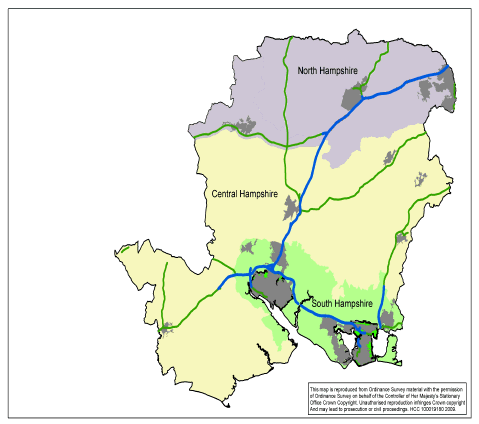
4.2. It is proposed to produce three area strategies: South Hampshire, North Hampshire, and Central Hampshire and New Forest. The latter area incorporates two National Parks, a number of market towns and a largely rural hinterland. The Central Hampshire and New Forest area strategy will need to incorporate the findings of the proposed review of the Highway Strategy for the New Forest. This would conform with Government guidance that relevant transport strategies should be consolidated within the LTP. A map showing the three proposed strategy areas is attached to this report in Appendix C. At the workshops held with County Councillors the three area strategy approach was broadly welcomed.
4.3. An initial consultation with stakeholders was carried out during November and December 2009 to seek views on the scope of LTP3. In particular this consultation aimed to clarify goals for the LTP3 and to specify the problems and challenges facing Hampshire that the strategy should aim to address. This consultation also fulfilled Stage A of the Strategic Environmental Assessment process. The results from this consultation are still being analysed. Once this process has been completed, an update will follow.
5. LTP3 Purpose and Content
5.1. The LTP3 will be developed with a clear idea of its target audiences and designed to meet their expectations, while addressing competing aspirations and priorities. The LTP3 should:
(i) meet the requirements of the guidance;
(ii) clearly set out County Council policies and how they fit with wider objectives, including the Local Area Agreement (LAA) and economic, environmental and social agenda;
(iii) set out County Council transport planning aspirations;
(iv) set out a realistic practical programme of schemes and other initiatives;
(v) provide the basis for transport policy and planning at the local and area level; and
(vi) provide useful guidance for LDFs.
5.2. LTP3 needs to cover:
(i) a long-term strategy setting out policies; and
(ii) a short term implementation plan to cover delivery.
5.3. The aim will be for the LTP3 to be a concise document, while giving sufficient recognition of the importance of the three area strategies.
5.4. It will be appropriate to develop an overarching transport vision for LTP3 to support the broad strategy approach similar to "Reduce, Manage, Invest" used in LTP2. This will be developed as LTP3 is taken forward, with a vision that mirrors the five policy goals set out in Delivering a Sustainable Transport System (DaSTS). The five DaSTS goals are:
(i) to support national economic competitiveness and growth, by delivering reliable and efficient transport networks;
(ii) to reduce transport's emissions of carbon dioxide and other greenhouse gases, with the desired outcome of tackling climate change;
(iii) to promote greater equality of opportunity for all citizens, with the desired outcome of achieving a fairer society;
(iv) to contribute to better safety, security and health and longer life expectancy by reducing the risk of death, injury or illness arising from transport, and by promoting travel modes that are beneficial to health; and
(v) to improve quality of life for transport users and non-transport users, and to promote a healthy natural environment.
A possible vision, looking beyond 2031, that encompasses the DaSTS goals is:
"a safe, efficient and reliable transport system supporting a prosperous and sustainable Hampshire".
5.5. Setting out a clear vision of what transport investment is needed in the longer term will ensure that the strategy can be used to support future funding bids for schemes from a variety of sources.
5.6. The LTP3 Implementation Plan for Hampshire will be a succinct delivery plan, which sets out clearly the projects to be pursued, the projected budget and funding source, timescales, the targets to be achieved and trajectories for achieving them. It will acknowledge programme and project risks, seek to mitigate those risks and consider possible remedial measures should the risks materialise. The monitoring arrangements for LTP3 will incorporate LAA (NI and LI) reporting processes. The Gateway process will help demonstrate that robust programme and performance management systems are in place. Detailed LTP funding allocation levels are not expected to be made known to the County Council until late 2010 so there will be a need to prepare a number of programmes/ scenarios based on a range of probable allocations.
5.7. Officer discussions have taken place with the Culture, Communities and Rural Affairs Department regarding the integration and alignment of Rights of Way Improvement Plans (ROWIPs) with LTP3. The preferred approach is to retain the seven ROWIPs covering the county as separate documents. In drafting the LTP3 strategy, effort will be taken to embed the principles of ROWIPs clearly into LTP3, drawing on recent guidance published by Natural England.
6. Timetable, Consultation and Resources
6.1. A draft timetable for preparing LTP3 is attached as Appendix D. Consultation with stakeholders forms an important part of the LTP process. It is proposed that, following the recent initial consultation with statutory bodies and key stakeholders on goals, problems and challenges (that took place in November and December 2009), a more detailed and wider 12-week consultation on a draft long-term LTP3 Strategy should take place in summer 2010, following the likely General Election. The two stages of consultation will also incorporate the requirements of the Strategic Environmental Assessment (SEA) and Equalities Impact Assessment (EQIA), Habitats Regulations Assessment (HRA) and Health Impact Assessment (HIA) processes.
6.2. The LTP3 will be consistent with other Hampshire County Council policy documents, such as the Sustainable Community Strategy and other regional and local planning policy documents.
7. Recommendation
7.1. That the proposed timetable for Local Transport Plan 3 development set out in Appendix D be approved.
2143Rpt/1185/GH
CORPORATE OR LEGAL INFORMATION:
Links to the Corporate Strategy
Hampshire safer and more secure for all: |
yes |
Corporate Business plan link number (if appropriate): | |
Maximising well-being: |
yes |
Corporate Business plan link number (if appropriate): | |
Enhancing our quality of place: |
yes |
Corporate Business plan link number (if appropriate): | |
Other Significant Links
Links to previous Member decisions: |
|||
Title |
Reference |
Date | |
Direct links to specific legislation or Government Directives |
|||
Title |
Date | ||
Local Transport Act Guidance on Local Transport Plans |
2008 July 2009 | ||
Section 100 D - Local Government Act 1972 - background documents | |
The following documents discuss facts or matters on which this report, or an important part of it, is based and have been relied upon to a material extent in the preparation of this report. (NB: the list excludes published works and any documents which disclose exempt or confidential information as defined in the Act.) | |
Document |
Location |
None |
|
IMPACT ASSESSMENTS:
1. Equalities Impact Assessment:
1.1. An Equalities Impact Assessment will form an integral part of the development of the Hampshire Local Transport Plan 3.
2. Impact on Crime and Disorder:
2.1. The LTP3 strategy will aim to set out how the County Council will look to improve levels of personal security through design of transport improvements.
3. Climate Change:
a) How does what is being proposed impact on our carbon footprint / energy consumption?
As shown in paragraph 5.4, climate change is one of the five central Government goals that will be used as the policy basis for determining local goals against which LTP3 will seek to deliver.
b) How does what is being proposed consider the need to adapt to climate change, and be resilient to its longer term impacts?
Both mitigation and adaptation will form part of the LTP3 strategy, which will be incorporated into the delivery of the implementation plan.
Appendix C - Proposed three area strategies for Hampshire LTP3 - 2011
North Hampshire - includes Andover, Basingstoke, Fleet, Farnborough and Aldershot, the towns of Whitchurch, Hook, Tadley and Yateley and a largely rural hinterland containing a number of villages.
The largely rural Central Hampshire and New Forest area - covering the New Forest and South Downs National Parks, Winchester, the market towns and rural villages.
The mostly urban "Transport for South Hampshire" (TfSH) area - where the County works together with the cities of Southampton and Portsmouth and other partners and stakeholders. TfSH has a Joint Committee of the three local transport authorities. TfSH has produced "Towards Delivery" which sets out its transport strategy. The LTP strategy for South Hampshire will be shared content within the LTP3s of the three local transport authorities - each of which will produce its own implementation plan.
Appendix D:
Outline of principal stages in development of Hampshire LTP3 from Autumn 2009 to Spring 2011