
Archived decisions
HAMPSHIRE COUNTY COUNCIL
Decision Report
Decision Maker: |
Regulatory Committee | ||||
Date of Decision: |
13 January 2010 | ||||
Decision Title: |
Installation of a 6 kilowatt Proven wind turbine on a 15 metre mast at Sopley Primary School, South Ripley | ||||
Decision Reference: |
977 | ||||
Report From: |
Head of Planning and Development | ||||
Contact name: |
Katherine Snell | ||||
Tel: |
01962 845938 |
Email: |
|||
1. Executive Summary
1.1. The proposal seeks planning permission to install a wind turbine on the playing field at Sopley Primary School.
1.2. The application was considered by the Regulatory Committee on 11 November 2009. It was deferred in order to gain clarification on the noise levels of the turbine and their impact, which are principal concerns raised.
1.3. Accordingly the issues investigated in this report are:
(i) a further assessment of noise levels on local amenity;
(ii) potential impacts of high frequency noise on children's ears;
(iii) renewable energy benefits of the proposal and;
(iv) visual impacts .
1.4. A site visit was undertaken by Members of the Committee to St Mary's C. E. Aided School, Clymping, West Sussex to inspect a wind turbine at a rural school location and get an appreciation of the noise impacts and other matters in the field.
1.5. The noise issues have been further addressed by the acoustic consultants and they are in agreement that the noise generated is unlikely to lead to significant disturbance and the amenity of neighbours protected. They agree also that there is no evidence that the proposal will cause any harm to school children.
1.6. The Environmental Health Officer (EHO) agrees with the conclusions. However, he still has a concern that the noise levels in the garden of the nearest resident may give rise to complaint.
1.7. Given the above advice a judgement is necessary to balance the merits of the application against the impacts particularly the residual concerns raised by the EHO.
1.8. It is noted that the proposal will create benefits for the school and the deliver the wider agenda on renewable energy. Energy renewables and carbon reduction measures are national policy ambitions (Planning Policy Statement: Planning and Climate Change - Supplement to Planning Policy Statement 1) and local aims (New Forest District Energy and resource use -Policy CS4).
1.9. Moreover it is considered that the issues of visual impact and nature conservation issues related to the proposal are satisfactorily addressed in the initial report (Addendum 1). The only outstanding matter concerns the colour of the mast and turbine head. This is now proposed as galvanised dull grey and white respectively and considered the least intrusive treatment.
1.10.It is therefore judged that the proposal would helping deliver renewable energy objectives - Policy CS4 - but would not materially harm the character, amenity or nature conservation of the area - Policy CS10(c)/CS3 (a)). Accordingly planning permission is recommended, subject to conditions.
2. Site and proposal
2.1. These details are set out in the original report (as amended) attached as Addendum 1. It should be noted it is now proposed that the turbine head be white on a galvanised dull grey mast to afford the least visual impact in the rural landscape.
2.2. For information also attached is a list (Addendum 6) of National Parks, Areas of Outstanding Natural Beauty (AONB), Sites of Special Scientific Interest and other UK public access sites which have Proven wind turbine installations
3. Consultations
3.1. Councillor Rippon-Swaine has requested the following points be addressed which arose from a local meeting held by the Parish Council:
(i) to ensure that the noise information presented to the Committee includes a chart that shows the wind turbine noise relative to the background noise at the end of the garden of Mr and Mrs Passmore, adjacent the School;
(ii) request that the report to Committee recommends 2 planning conditions, each focussed on the evidence proposed by the applicant:
(a) the limits imposed in the noise monitoring condition are lowered to mirror the noise that the manufacturer states will be produced; and
(b) if the turbine does not produce at least 10% of the School's energy usage within 12 months, the turbine must be removed.
Overall he is becoming more and more convinced that the hype of climate change is overruling our protective policies in the New Forest for little reward.
3.2. New Forest District Council retains their objection.
3.3. The Environmental Health Officer (EHO) - Following further work of assessment and analysis by acoustic consultants for the applicant, he is in broad agreement with the overall description of likely noise levels and character from the proposed turbine, as well as the response regarding concerns over any `Mosquito Effect'.
3.4. "Regarding the assessment of noise impact (ie effect on local amenity), the proposed condition would however allow levels which would permit a BS4145 rating level assessed in nearby gardens, during for example quieter parts of the evening, of approximately 6 dB below the `complaints likely' rating level. That +4dB rating is closer to the +10dB of `complaints likely' than the -10dB of `a positive indication that complaints are unlikely'. As is the norm for such assessments, BS4142 is a `reasonable criteria' to employ in the assessment. It is the standard assessment of industrial noise. In this case the impact in the quieter half of the day of a wind turbine in a rural location requires some caution when using the broad-brush description of `marginal significance'".
3.5. The EHO believes that it is appropriate to apply BS4142 criteria to the outdoor amenity area of a dwelling. Further, that such criteria should achieve more than `the avoidance of likely complaint' but protect amenity. In addition there is some residual uncertainty as to the precise background levels in windier conditions in the garden near the applicant location. He advises that to protect amenity, noise levels reaching the outdoor areas of residential property should be further reduced below those that might `just comply' with the applicant's proposed condition.
3.6. "It may be worth commenting that, following the helpful opportunity to assess the `Proven' Turbine in West Sussex, I believe there is some reason for optimism concerning noise impact. It would appear from those visits that the turbine assessed is in practice quieter than both the specification supplied by the manufacturer, and (therefore) the levels of the proposed condition, perhaps by approximately 4 dB. Unfortunately, against that optimism, it must be acknowledged that the manufacturer's specification should be based on a more thorough acoustic assessment than can be made by one or two visits to an existing turbine.
3.7. However, there remains in theory a significant, practical opportunity to eliminate adverse noise impact from this proposal. Locating the turbine 50 metres further to the East on land used by the school would still have a significant benefit (approximately 5dB) in reducing noise impact to outdoor areas at the nearest residential properties.
3.8. It is my view that, given the current understanding of potential noise impact, this application may still cause complaint from noise outside in gardens. This impact could be significantly reduced by re-positioning. I would anticipate that such a step would in fact eliminate any reasonable grounds for complaint, as well as protecting local amenity. "
3.9. The Environmental Heath Officer is unable to attend the Regulatory Committee meeting held on 13 January 2010 due to double booking of appointments.
3.10.Sopley Parish Council shares the views presented by County Councillor Rippon-Swaine. The Parish Council also conducted a poll of local households. Of the 38 households contacted, 25 responded - of whom nine were supportive of the scheme and 17 were opposed to it.
4. Representations
4.1. As at 18 December 2009 no further representations have been received:
5. Site Visit
5.1. On Monday 7 December 2009 Members conducted a visit in connection with the planning application to inspect an existing turbine at St Mary's Primary school.
5.2. Ten Members of the Committee, Councillors Beagley, Mrs Bailey, Bryant, Carter, Cooper, Hockley, James, Mrs McEvoy, Pearce, with Councillor McIntosh in the Chair, visited St Mary's C. E. Aided Primary School, Brookpit Lane, Clymping, Littlehampton, West Sussex to view an example of an identical wind turbine at a rural primary school location. This turbine has been operational for less than a year and is a different colour to the one proposed at Sopley in that it has a black head and dark green mast.
5.3. Members viewed the wind turbine from various points. In particular Members stood `upwind' of the turbine at distances that related to those of the proposed Sopley turbine from School and nearest dwelling façade. This enabled Members to get an idea on the sound and noise levels and how this would affect nearby residents if one was to be erected in Sopley.
5.4. Due to the high winds on the day of the visit, it was noted that the wind turbine was working at full capacity and the noise and motion was a worst case scenario.
5.5. The Head teacher of St Mary's, Mrs Llewellyn, confirmed that the children were very positive about the wind turbine and they had received no complaints of the children experiencing problems with the noise levels or from neighbours. With regards to electricity, Mrs Llewellyn confirmed that the school's electricity bill was paid as normal, and then the money generated by the turbine was paid to the school later. Once the Governments new feed-in tariff (FITS) become active in April 2010 the school is expecting to get 23p per kilowatt hour generated providing the school with a reasonable revenue income stream in the future. It was confirmed that the turbines data was not used directly as an educational resource, however, the turbine has given the school "Silver Eco School" status and is inspiring the children to take better care of the environment and be more aware of sustainable issues.
5.6. The following comments were collected from the primary school children:
'The good thing is that we give some of the electricity we use back for other people to use and it makes us a very eco-friendly school'
'People know we're a green school. We've started with a wind turbine and now we might be able to think of some other things to do like solar panels.'
'I'm on the eco-action team. We help the school improve and makes it more eco-friendly and help it to look nicer by making sure there's no litter. We probably wouldn't be so careful about things like that if we weren't a green school and it all started with the wind turbine'.
5.7. Members viewed the output panels at the school and requested to be provided with the total energy consumption of kWh used by the school per annum and the kWh generated so far this year. It is estimated - full year information is unavailable - that the St Mary's new turbine will generate an average annual yield of 5105 kWh. Unfortunately, the amount of electricity consumed by the school could not be obtained but Sopley Primary School uses an average 37400kWh per annum, giving a estimated contribution of 13.6%.
5.8. Arun District Council have no records of any noise complaints in connection to turbines installed at St Mary's.
6. Additional Information
6.1. In light of the concerns raised by a number of parties about noise further information about the issue has been established.
6.2. The two acoustic consultants engaged by the applicant - 24 Acoustics - and the local planning authority - ISVR Consulting - respectively, both advise that the primary criterion for planning purposes for assessing the application is that the noise level in the vicinity of dwellings should not exceed acceptable limits. This criterion has been applied in the both the consultants' reports.
6.3. The question of noise levels in the rear gardens of Numbers 1 and 2 South Ripley Cottages has been raised in the representations on this application. These gardens extend to within about 55 metres of the proposed turbine location. The wind turbine noise levels at the eastern end of the gardens will be 5-6 dB (A) higher than level close to the houses, because of the reduced distance. However, the background noise levels in this location, at the times when residents are likely to be present (ie during daytime and evenings) will generally be higher than the `low' night time (midnight to 5.00 am) noise levels adopted in the ISVR Consulting Report, and are likely to be closer to the higher levels adopted in the 24 Acoustics Report (which were combined evening and night-time levels). Therefore wind turbine noise levels in the garden, at times when the garden will be used, will not generally exceed the existing average background noise levels, and a noise assessment for the garden area would therefore be the same as for locations for the dwellings themselves.
6.4. The two independent noise experts have come to an agreement on the potential noise impacts on local amenity. Based on the available information, which includes additional measurements on a Proven 6 kW turbine at St Mary's Primary School in East Sussex, noise levels close to South Ripley Cottages, and in the rear gardens of these houses, would be of the same order as existing average background noise levels. Noise levels in this situation should be assessed using the method of BS4142, which assesses noise in terms of the likelihood that complaints will arise. The noise from the wind turbine has a distinctive characteristic, which would attract a penalty of +5dB under the BS4142 assessment method. With this penalty and assuming the lowest background noise level (ie the `worst case' scenario), an assessment under BS 4142 would rate the turbine noise as `of marginal significance'.
6.5. Concerns over high frequency noise affecting the school children were raised at the Regulatory Committee. It was pointed out that a deterrent device, `The Mosquito', is being used in areas such as urban shopping centres to discourage young people from loitering near shops and other premises. This device emits sound at a very high frequency (17 kHz) which is inaudible to most adults but is offensive to young people, who have more-sensitive high-frequency hearing. The stated concern in this case is that the turbine may emit very high-frequency noise (in the 15-20 kHz range) which would not be detected by adults but could distract or disturb children.
6.6. There is no evidence that the Proven wind turbine (or indeed any wind turbine) emits high-frequency noise of a level that would be detected by even the most noise-sensitive child. The turbine has no physical features that would be expected to be capable of causing noise emission at very high frequencies. Turbines of this type have been installed in a number of schools and no adverse effects have been reported, to our knowledge. Over the past 15 year Proven Energy have provided 81 turbines at educational facilities. Attached as Addendum 5 is a list of 14 schools known to have the Proven 6 kilowatt turbine installed.
6.7. It is not considered that there is a risk that the turbine will emit very high-frequency noise of a level that would be detected only by children or that would have any adverse effects. The subjective effects of the wind turbine noise can be adequately assessed by consideration of the noise emitted in the adult hearing frequency range, represented by the noise level measured on the dB(A) scale. The assessments carried out have been made on the basis of dB(A) levels.
6.8. The noise level generated by the wind turbine in the school playground when the turbine is operating will be in the range 40-55 dB(A), depending on the wind speed. This noise level is within limits for external amenity areas recommended by the World Health Organization and in British Standards. Many school playgrounds in suburban and urban areas are exposed to significantly higher levels of noise from traffic and other sources. Noise levels in the playground generated by the children, when they are engaged in `free play', will also generally be higher, of the order of 60-65 dB(A).
6.9. It is concluded that noise from the wind turbine will have no adverse effects on children in the playground.
7 Commentary
7.1. The principal concerns about this application are about the noise impact on the local community and it is noted that the two consultants agree that the turbine noise as `of marginal significance'. This view is broadly accepted by the Environmental Health officer and conditions are attached to ensure noise levels will not exceed those deemed as acceptable to local amenity.
7.2. However, it is disappointing there is not complete agreement over the matter and the residual concerns of the EHO are noted. However, the comments about relocating the turbine cannot be given any weight as this is not proposed and been assessed in planning terms. Accordingly it is a matter of judgement as the weight given to these concerns in assessing the merits of the application. The merits include the contribution the turbine would have on the school's carbon footprint and that it's a development that is compliant with the district council's recently adopted policy on renewable energy.
7.3. With regard to the other material considerations these concern visual impact and nature conservation issues. These were fully and satisfactorily addressed in the initial report (Addendum 1). The only outstanding matter in this respect concerns the colour of the mast and turbine head. This is now proposed as galvanised dull grey and white respectively and considered the least intrusive treatment. Whilst the turbine will be visible from some view points in the totality of the landscape it is not considered to have an unacceptable visual impact.
7.4. With regard to the noise condition suggested by the local community, this suggested that the permitted maximum noise levels should reflect the predicted low levels given by Proven. However in the light of the above comments the proposed noise condition in Appendix B is considered appropriate as it takes into account the local environment and there is agreement by the consultants as to its appropriateness.
7.5. An energy requirement condition has been suggested by the County Councillor, Sopley Parish Council and local residents; which would require the turbine needs to meet a 10% performance level, as mentioned in New Forest Policy (CS4), or it should be removed. It is considered that this policy is insufficient grounds to impose such a condition that would place an unreasonable burden on the developer. However, if the circumstances occur that the turbine becomes redundant, it is expected that it should be removed. A restoration condition has been suggested to serve this purpose.
7.6. In summary it is concluded that the proposal would help deliver renewable energy objectives - Policy CS4 - but would not materially harm the character, amenity or nature conservation of the area - Policy CS10(c)/CS3 (a)). Accordingly planning permission is recommended, subject to conditions.
8. Recommendation
8.1. That planning permission in respect of the installation of a six kilowatt hour Proven wind turbine on a 15 metre mast at Sopley CP School, South Ripley, Christchurch (Application No.09/94039) be granted, subject to the conditions set out in Integral Appendix B.
2096/977/KS
Links to the Corporate Strategy
Hampshire safer and more secure for all: |
no |
Corporate Business plan link number (if appropriate): | |
Maximising well-being: |
yes |
Corporate Business plan link number (if appropriate): | |
Enhancing our quality of place: |
yes |
Corporate Business plan link number (if appropriate): | |
Section 100 D - Local Government Act 1972 - background documents | |
The following documents discuss facts or matters on which this report, or an important part of it, is based and have been relied upon to a material extent in the preparation of this report. (NB: the list excludes published works and any documents which disclose exempt or confidential information as defined in the Act.) | |
Document |
Location |
Installation of a 60 kilowatt Proven wind turbine on a 15 metre mast at Sopley Primary School, South Ripley |
Environment Department First Floor Elizabeth II Court West Winchester |
CONDITIONS
Time Limits:
1. The development hereby permitted shall be begun before the expiration of three years from the date on which this planning permission was granted.
Reason: To comply with Section 91 (as amended) of the Town and Country Planning Act 1990.
Hours of Working
2. There shall be no access to the development site by any traffic associated with the construction/demolition (ie no delivery vehicles, no contractors' cars, nor plant and machinery) in the morning between 0830 and 0915; and in the afternoon between 1515 and 1545 on school days.
Reason: In the interests of public safety, to avoid traffic conflict at the times of the day when pupils are arriving at and departing from school.
3. No work relating to the construction of the development approved, including works of preparation prior to operations, the delivery of construction materials, skips or machinery, nor the removal of waste materials, shall take place before the 0800 or after 1800 Monday to Friday inclusive, before 0800 or after 1400 on Saturday and not at all on Sunday or recognised public holidays, unless otherwise agreed beforehand in writing with the Local Planning Authority.
Reason: To protect the amenities of occupiers of nearby properties.
Materials
4. Samples and details of the materials and finishes to be used for the wind turbine shall be submitted to and approved by the Local Planning Authority in writing before the development commences.
Reason: In the interests of visual amenity and to secure a satisfactory development.
Nature Conservation
5. Prior to commencement of development, the mitigation works as set out in the bat assessment as approved under permission 08/93166, shall be carried out in accordance with the approved scheme.
Reason: To protect bats, which are a protected species under Schedule 5 of the Wildlife and Countryside Act 1981 and Schedule 2 of the Habitats Regulations 1994.
Amenity protection
6. Noise during operation of the wind turbine shall not exceed the following limits as measured at a height of 1.2-1.5 metres at any position 20 metres from the base of the wind turbine mast. Noise limits are related to the local wind speed as measured at a height of 10 metres above ground level.
Average wind speed m/s at 10m 4 5 6 7 8 9 10
Noise limit at 20m LAeq 10m dB 42 44 47 49 51 53 55
Reason: In the interests of neighbour amenity.
7. Prior to development commencing an acoustic assessment scheme to monitor compliance with Condition 6 shall be submitted to the Local Planning Authority for approval in writing. The noise measurement procedure shall be based on the method set out in ETSU-R-97 The Assessment and Rating of Noise from Wind Farms published by the Energy Technology Support Unit for the Department of Trade and Industry, amended as necessary in agreement with the Local Planning Authority. The scheme shall be implemented as approved.
Reason: In the interests of neighbour amenity.
8. If the acoustic assessment scheme shows the noise levels exceed the limits in Condition 6 the turbine shall cease operation until remedial measures have been taken to reduce noise to approved levels.
Reason: In the interests of neighbour amenity.
Annexe to Reason for Conditions
(as required by Article 22 of the Town and Country Planning
(General Procedure) Order 1995 - as amended)
New Forest District (outside the National Park) Core Strategy (2009)
Policy CS2 Design quality
New development will be required to be well designed to respect the character, identity, and context of the area's towns, villages and countryside. All new development will be required to contribute positively to local distinctiveness
and sense of place, being appropriate and sympathetic to its setting in terms of scale, height, density, layout, appearance, materials, and its relationship to adjoining buildings and landscape features, and shall not cause unacceptable effects by reason of visual intrusion, overlooking, shading, noise, light pollution or other adverse impact on local character and amenities. New development will be required to incorporate well integrated car parking, and pedestrian routes and, where appropriate, cycle routes and facilities.
Policy CS3 Protecting and enhancing our special environment (Heritage
and Nature Conservation)
Development proposals must protect and, where possible, enhance sites of recognised importance for nature and heritage conservation. Working with local communities, features of local heritage value which contribute to local distinctiveness will be identified. New development proposals should maintain local distinctiveness and where possible enhance the character of identified features. Measures will be taken, working with other partners, to secure the enhancement, restoration and creation of biodiversity, including measures to adapt to the consequences of climate change, so as to assist in achieving national, county and local biodiversity targets as set out in the Hampshire and New Forest Biodiversity Action Plans. The special characteristics of the Plan Area's natural and built environment will be protected and enhanced through
applying relevant national and regional policies;
Policy CS4 Energy and resource use
High standards of energy efficiency and efficient water use in existing developments will be promoted wherever possible through retro-fitting. All new development should be built to a standard which minimises the consumption of resources during construction and thereafter in its occupation and use. New development will be required to maximise opportunities for the micro-generation of renewable energy. Renewable, low carbon and de-centralised energy will be encouraged in all development, and developments of more then 10 dwellings or 1000m2 of non-residential floorspace will be required to provide at least 10% of their energy from these sources unless (having regard to the type of development involved and its design,) this is not feasible or viable.;
Policy CS10 The spatial strategy
Retaining and supporting the Green Belt (as illustrated on the Key Diagram, Fig. 1, Fig. 17 and Fig. 18) in order to:
(i) check the sprawl of the built-up areas of Lymington, Hordle, Everton, Milford, New Milton, Bransgore and Ringwood and prevent these settlements from merging;
(ii) safeguard the countryside and coast from encroachment by built development;
(iii) preserve the setting of towns and villages, in particular the historic towns of Ringwood and Lymington. Limited, small scale changes to the boundary of the Green Belt adjoining defined settlements will be considered in a review of the Green Belt inner boundary in the Sites and Development Management Development Plan Document. Boundary changes will be considered where they are necessary to meet the local housing need or employment land needs which could not otherwise be met, as set out in Policies CS12 and CS18. This review will adopt a longer time horizon than the Plan.
Planning Policy Guidance 2 (PPG2) Green belts
Visual amenity
The visual amenities of the Green Belt should not be injured by proposals for
development within or conspicuous from the Green Belt which, although they would not prejudice the purposes of including land in Green Belts, might be visually detrimental by reason of their siting, materials or design.
HAMPSHIRE COUNTY COUNCIL
Decision Report
Decision Maker: |
Regulatory Committee | ||||
Date of Decision: |
11 November 2009 | ||||
Decision Title: |
Installation of a 6 kilowatt Proven wind turbine on a 15 metre mast at Sopley Primary School, South Ripley | ||||
Decision Reference: |
977 | ||||
Report From: |
Head of Planning and Development | ||||
Contact name: |
Katherine Snell | ||||
Tel: |
01962 845938 |
Email: |
|||
1. Executive Summary
1.1. The proposal seeks planning permission to install a wind turbine on the playing field at Sopley Primary School.
1.2. The main issues are:
(i) the visual implications of the tall structure to the neighbouring dwellings and wider reaching impact on the countryside and views;
(ii) potential impact on wildlife;
(iii) noise impact; and
(iv) benefits of the proposal, taking into account the existing school energy usage, conservation and predicted performance.
1.3. Although the wind turbine is clearly a prominent feature and an addition to the landscape, it is considered that the proposal would be in accordance with the development plan as it would not materially harm the character of the area (Policy CS10 (o)). Moreover, the impact on the green belt is weighed against other planning objectives, such as energy renewables and carbon reduction (Planning Policy Statement: Planning and Climate Change - Supplement to Planning Policy Statement 1) and New Forest District (outside the National Park) Core Strategy's (2009) Energy and resource use (Policy CS4 (c)). In addition the amenity of local residents (Policy CS2 (c)) is safeguarded as the noise generated is on balance unlikely to lead to significant disturbance. Moreover, a condition recommended by an independent noise consultant is recommended to safeguard amenity. There is no significant adverse impact on wildlife (Policy CS3 (a)). Therefore, planning permission is recommended, subject to conditions.
2. Recommendation
2.1. That planning permission in respect of an installation of a six kilowatt hour Proven wind turbine on a 15 metre mast at Sopley Primary School, South Ripley, Christchurch (Application No.09/94039) be granted for the following reason, subject to the conditions set out in integral Appendix B.
3. Site and proposal
3.1. Sopley Primary School, as shown on the attached plan, is a small school situated on the corner of two country lanes. The school is in mixed use for children between the ages of 5 and 11. There are about 90 pupils on roll. It is in the countryside outside Sopley, near Christchurch within the South West Hampshire Green Belt. To the east of the existing school is an area of tarmac and field available for the school, measuring approximately 110 x 50 metres. This area includes play equipment, a pond, utility sheds and the sports field.
3.2. The original school was built in 1890 and is single storey, being of traditional load-bearing brick construction. The school was extended in 1950 to provide a kitchen, in 1968 for a staffroom, in 1994 for three classrooms and in 2001 to include toilets and IT. Permission for an extension to provide two classrooms and offices was given by the Regulatory Committee on 19 January 2009 (permission 08/93166).There is currently a temporary classroom on site, with permission until 31 August 2012.
3.3. Two cottages are immediately adjacent to the southern boundary of the school. The rear of the nearest cottage's garden is approximately 60 metres south west of the proposed wind turbine location. The house itself is approximately 105 metres in distance.
3.4. This application seeks planning permission to install a wind turbine on the playing field to the rear of the school. The wind turbine will be coloured silver and will need to be lowered and raised for annual servicing. This is currently the utility area, next to the side vehicular access gate. The construction site access will be made through this side gate.
3.5. The wind turbine will be a total height of 17.75 metres high. This is a 5.5 rotar (blades) on a 15 metre high mast. It will provide between six and eight kWh of electricity per year depending on wind speeds.
3.6. The applicant states that the turbine is designed to minimise noise and maintenance. The Proven is a direct drive machine, this means it has no gearbox which produces less noise than other types. The rotor is connected directly to a generator which produces the current, this is then fed through a wind turbine controller and an inventor to match the mains current so that it can then be connected to the national grid. The Flexible Blade System (Furling) enables the turbine to generate power in light or strong winds. This system allows the blades to bend and flex. As the wind gets stronger, the blades twist to reduce their aerodynamic efficiency. This lets the Proven turbine maintain a high output even in the fiercest storms, unlike many turbines which need to stop generating power to protect themselves at high wind speeds. Compared with other modern small turbines, the blade tip speed of a Proven Energy turbine is low; this means that noise is reduced substantially. The blades also regulate their speed, preventing damage if the load from the turbine is disconnected through a power cut or electrical fault.
3.7. One heavy goods vehicle low-loader vehicle will be used to deliver the turbine and mast. This will reverse up Thatchers Lane for the off-loading period, expected to be approximately 1-2 hours. A JCB/Telehandler (crane-like forklift) will be used to offload the parts from the vehicle through the gate to the location. Two other vehicles for tools, equipment and staff transport will be involved in the installation, but do not require parking on site. The JCB/Telehandler will then manoeuvre and assist with the mast assembly. Raising the turbine will be done with a suitable winch. The JCB/Telehandler will only be utilised in the field for a short duration (a couple of hours). Access from the school will be blocked off with a high visibility warning fence for public safety. Unloading will be completed within two hours and full mechanical installation of the turbine and mast will be completed in one day. The electrical installation is expected to take two days and has been agreed in principle by the Regulator (District Network Operator) on behalf of the National Grid.
3.8. There shall be no movement of construction traffic outside the compound areas on normal school days for a period of 45 minutes at the start of the school day and for 30 minutes while school ends. Overall the installation of the turbine is expected to involve negligible traffic disruption, as there are only four main parts to bring onto site.
3.9. The proposal is not an EIA Development under the Environmental Impact Assessment Regulations 1999 and therefore an environmental statement has not been submitted.
4. Development plan
4.1. The proposal accords with New Forest District (outside the National Park) Core Strategy (2009):
(i) Policy CS2 (c) (General development criteria);
(ii) Policy CS3 (a) (Protecting and enhancing our special environment Heritage and Nature Conservation);
(iii) Policy CS4 (c) Energy and resource use; and
(iv) Policy CS-10 (o) (Development in the Green Belt).
5. Consultations
5.1. Councillor Rippon-Swaine has no objection to the principle of renewable energy, but any proposals must have the support of local residents and local people; without which the application should not be consented.
5.2. New Forest District Council objects to the proposal on the grounds that the height and siting would be an intrusive feature within the landscape, and have a detrimental impact on the character and appearance of the surrounding countryside and greenbelt.
5.3. The Environmental Health Officer (EHO) after reviewing the latest information contained in the report R3056-1 Rev 0 dated 30 October has concerns about the loss of amenity, inside and out, at the nearest residential property. In contrast to the report, the EHO believes a character correction of +5dB is applicable to the BS4142 assessment, and that ETSU-R-97 (wind farm standard) is not applicable. Accordingly, he must object to the turbine
5.4. Sopley Parish Council objects to the proposal as the funding will be partly from public money and is concerned that the school currently wastes energy due to its existing structure. Objections are also raised on noise and visual impact grounds. The Council conducted a poll and received 25 responses. Of these, 17 residents were opposed to the proposal.
5.5. Environment Agency has no objection.
5.6. Highway Authority has no objection to this proposal.
5.7. Southern Gas has advised that there is a gas main near the site.
5.8. Bournemouth Airport has no objection to this proposal.
6. Representations
6.1. As at 1 November 2009 five representations have been received concerning:
(i) the height would be the tallest structure for miles and so cause adverse visual impact;
(ii) potential for deaths and injuries for bats and birds;
(iii) there will be noise pollution. The noise produced would be especially intrusive at night when neighbours are trying to sleep, as ambient noise levels are generally lower at that time;
(iv) the amount of electricity produced is not clear, so the actual benefits are not known;
(v) the school is currently wasting energy, and so the proposal will be non-effective;
(vi) the proposal should have been more widely publicised; and
(vii) possible impacts on horse behaviour, with the potential of road accidents due to erratic horses and detriment to local livery businesses.
6.2. One letter of support has been received.
6.3. Regulatory Committee Site Visit
6.4. On Monday 26 October 2009 Members conducted a two stage site visit in connection to the planning application.
6.5. Eleven Members of the Committee, Councillors Beagley, Mrs Bailey, Bryant, Cooper, Gurden, Hockley, Neal, Pearce, Price, Wall with Councillor McIntosh in the Chair, undertook a site visit to Itchen Valley Country Park to view an example of a wind turbine. Members viewed the wind turbine from the public area adjacent.
6.6. Following this, ten Members of the Committee, Councillors Beagley, Bryant, Cooper, Gurden, Hockley, Neal, Pearce, Price, Wall with Councillor McIntosh in the Chair then went on to Sopley Primary School which is the subject of an application for the installation of a six kilowatt wind turbine on a 15 metre mast.
6.7. The Head of Planning and Development introduced the application and outlined the key features of the proposal. Members toured the site and viewed the area where the proposed wind turbine would be sited on the playing field at the rear of the school. They noted that the height of the mast would be 15 metres and the total height of the turbine would be 17.52 metres when its blades are in a vertical position. The construction would take three days and maintenance would be carried out once a year. It was proposed to site the wind turbine at the furthest point away from local residents and Members noted that the location to the nearest house is 105 metres diagonally and 60 metres to the edge of the boundary. Members asked whether the trees would impede the wind flow and the Head of Planning and Development advised that a feasibility study had been carried out which had confirmed that the proposed location was a suitable one and the surrounding trees would not be affected.
6.8. Members asked about noise levels and the Head of Planning and Development advised that the Environmental Health Officer had recommended noise conditions and a Noise Consultant had recommended a noise condition which varies according to the wind speed. An independent noise survey had been carried out and Property, Business and Regulatory Services had taken the opportunity to request another set of background noise recordings. The data has been assessed and would be included in the final report. Members noted that the wind speed should be six metres per second and this one had been assessed and would be 5.2 per second.
6.9. Members asked that graphs showing the noise level to residents and which way the noise would travel be available at the Regulatory Committee meeting.
7. Commentary
7.1. There are objections to the height and scale of the wind turbine. PPG 2 stipulates that "visual amenities of the Green Belt should not be injured by proposals" as the local policy CS10 (c) also reflects. Whilst it is accepted that the tall structure that will be seen by the immediate neighbours and appear in views from all directions for some distance, the school site is not within a designated area and the New Forest National Park is approximately one mile away and the turbine would barely affect it. The location of the turbine is on the side of the school field that is furthest away from the adjacent cottages. Although the surrounding area is countryside, the location of the turbine is on a school within the settlement of South Ripley Moreover, visual impact has an element of subjectivity and must be balanced with other material planning objectives.
7.2. This perspective is guided by a Government policy statement - "we are reforming planning laws, finding new ways of working with local communities and are determined to persuade people that we need a significant increase in onshore wind as part of the UK's future energy mix." (27 July 2009 - Press Release - Extra finance to start flowing for wind power.) The proposal also satisfies Energy and resource use (Policy CS4 (c)) as it provides an opportunity for the micro-generation of renewable energy.
7.3. The potential impact on wildlife from this proposed development has been investigated and no significant harm will result from this development. Mitigation work for bats (protected under EU law by the Conservation (Habitat &c) Regulations 1994) is already being undertaken on site, in support of the extension works (permission 08/93166) and is relevant to this proposal. This mitigation includes measures to control bat access into the new extension area, create new access and roosting opportunities in the roof space at the western far end of the existing school and to try to ensure that any potential roosting bats use the opposite end of the building to the proposed turbine. The western, southern and eastern site boundaries will also be planted with hedgerow plants to encourage bats to move around the edges of the site (as well as to provide additional foraging habitat), instead of across the open central area of the site. As a result, the turbine will be at least 50 metres from a potential roost access site and an entry/exit flight path and away from foraging/commuting routes. Therefore it will have no significant impact to the bat population or be of detriment to the maintenance of the population of the species concerned at a favourable conservation status in their natural range. Furthermore the development is needed to provide an educational opportunity and contribute as a source of renewable energy and so is in the public interest. Therefore concern for the impact on bats and birds is noted, and due regard to Article 12 and 16 of the Habitats Directive and regulation 44 of the Habitats Regulations has been taken in concluding there will be no significant harm resulting from this development, this is in accordance with local Policy CS3 (a), Protecting and enhancing our special environment (Heritage and Nature Conservation). Notwithstanding this, conditions have been attached to ensure that there is no adverse impact to bats as a consequence of the proposal.
7.4. Local objections on noise grounds have been received, which have been endorsed latterly by the EHO. However, the noise information for the turbine has been independently reviewed by the applicant's consultant and an independent one engaged on behalf of the planning authority and have come to a different conclusion. Two site assessments and noise surveys has been conducted as part of a review. Further information from the manufacturers (Proven) has been obtained and strengthened the robustness of the assessments and associated conclusions. Through these studies it was found that there will be no unacceptable impact on neighbours based on the noise information provided - see attached appendices. However to safeguard the amenity of the nearest residents, conditions will be attached. These conditions include noise limits which are not to be exceeded at a specified location and a monitoring requirement.
7.5. The feasibility of the proposal at Sopley Primary School has been presented, in the Wind Turbine Feasibility Report which was submitted with the application. Sopley Primary has been chosen to have Hampshire County Council's first wind turbine as the proposed site has suitable topography, with open land to the South and South west (which carry the prevailing winds),and favourable predicted wind speeds. At 15 metres high, an average of 5.2 m/sec is expected (Noabl UK wind speed data, the database is provided by the department for Business Enterprise & Regulatory Reform). Irrespective of other site considerations such as topography and obstacles, and working on the basis of 5.2 metres/second reading with a 6 kilowatt Proven turbine on a 15 metre mast; this would achieve 10,601 kilowatt hours (kWh) electricity per year. There are currently no wind turbines installed on Hampshire County Council sites. Generally in Hampshire there are not many sites suitable for a wind turbine due to various restrictions, for example military areas, flight paths and low wind speeds.
7.6. The justification for the proposal has been queried in objection letters. However, the school currently uses 37,400 kWh of electricity per year. The wind turbine is expected to produce - allowing for local circumstances - approximately 7,745 kWh out of the potential 10,601 kWh per year. This represent about 20% of the school's electricity consumption and reduces the carbon footprint by approximately 3.2 tons of carbon dioxide, as desired in local Policy CS4(c).
7.7. Details of the energy produced from the example wind turbine at Itchen Valley Country Park visited by Members have been supplied for review. The turbine was installed on site in May 2005, but monitoring only began in 2007. The Visitor centre uses around 20,000 KWh a year and the total amount of electricity produced has been recorded as 4047 KWh, this is a comparable saving of 5% for the Park's electricity.
7.8. The energy efficiency of the school has also been raised in the objections. However, the extensions to the existing Victorian school building of 1995 and 1999 were built with thermal insulation in the walls and roof and these extensions `wrap around' the original building. This means that about 65% of the existing building benefited from improved insulation. The new extension currently under construction at the school includes triple glazed windows, low energy lights switched on automatic sensors, solar panel and solar hot water via the south roof and a new efficient boiler system to supply hot water and heating to the whole of the school. The replacement of the old existing heating plant with a modern efficient boiler system will also reduce the school's energy costs. As part of the Building Regulations compliance submission, calculations show that by installing the wind turbine, along with the recently permitted extension, the overall energy efficiency of the school building will greatly improve. The school is keen to complete the works to have an overall energy efficient building, which will score a B grade on an Energy Performance Certificate (EPC). Therefore, although the proposal will not supply all the school's electricity needs, it would be of benefit in terms of carbon reduction and it's sustainability credentials.
7.9. Although this will be the first wind turbine installed at a Hampshire County Council school, the precedent has been set at other school sites in England. It is accepted that the turbine will have an impact on the landscape, however the support from central Government for renewable energy production is clear (Planning Policy Statement: Planning and Climate Change - Supplement to Planning Policy Statement 1). The proposal also satisfies the New Forest District (outside the National Park) Core Strategy (2009) policy for Energy and resource use (Policy CS4) as it provides an opportunity for the micro-generation of renewable energy.
7.10. Notwithstanding the views of the EHO, these are contrary to those of two noise consultants and a balance has to be struck between them. It is considered that in planning terms the amenity of local residents (Policy CS2) is safeguarded as the noise generated is not expected to be significantly above background noise levels - see Appendix 3 and 4. Moreover a planning condition is recommended to ensure amenity standards are maintained.
7.11. There will be no harm to the local wildlife population and due regard to Article 12 and 16 of the Habitats Directive and regulation 44 of the Habitats Regulations has been taken in concluding there will be no significant harm to bats resulting from this development, and accords with Policy CS3 (a) Protecting and enhancing our special environment (Heritage and Nature Conservation).
7.12. As there are no significant adverse impacts associated with the proposal and it offers the benefit of renewable energy, planning permission subject to conditions is recommended.
8. Recommendation
8.1. That planning permission in respect of the installation of a six kilowatt hour Proven wind turbine on a 15 metre mast at Sopley CP School, South Ripley, Christchurch (Application No.09/94039) be granted, subject to the conditions set out in Integral Appendix B.
Links to the Corporate Strategy
Hampshire safer and more secure for all: |
no |
Corporate Business plan link number (if appropriate): | |
Maximising well-being: |
yes |
Corporate Business plan link number (if appropriate): | |
Enhancing our quality of place: |
yes |
Corporate Business plan link number (if appropriate): | |
Section 100 D - Local Government Act 1972 - background documents | |
The following documents discuss facts or matters on which this report, or an important part of it, is based and have been relied upon to a material extent in the preparation of this report. (NB: the list excludes published works and any documents which disclose exempt or confidential information as defined in the Act.) | |
Document |
Location |
Installation of a 60 kilowatt Proven wind turbine on a 15 metre mast at Sopley Primary School, South Ripley |
Environment Department First Floor Elizabeth II Court West Winchester |
CONDITIONS
Time Limits:
1. The development hereby permitted shall be begun before the expiration of three years from the date on which this planning permission was granted.
Reason: To comply with Section 91 (as amended) of the Town and Country Planning Act 1990.
Hours of Working
2. There shall be no access to the development site by any traffic associated with the construction/demolition (ie no delivery vehicles, no contractors' cars, nor plant and machinery) in the morning between 0830 and 0915; and in the afternoon between 1515 and 1545.
Reason: In the interests of public safety, to avoid traffic conflict at the times of the day when pupils are arriving at and departing from school.
3. No work relating to the construction of the development approved, including works of preparation prior to operations, the delivery of construction materials, skips or machinery, nor the removal of waste materials, shall take place before the 0800 or after 1800 Monday to Friday inclusive, before 0800 or after 1400 on Saturday and not at all on Sunday or recognised public holidays, unless otherwise agreed beforehand in writing with the Local Planning Authority.
Reason: To protect the amenities of occupiers of nearby properties.
Materials
4. Samples and details of the materials and finishes to be used for the wind turbine shall be submitted to and approved by the Local Planning Authority in writing before the development commences.
Reason: In the interests of visual amenity and to secure a satisfactory development.
Nature Conservation
5. Prior to commencement of development, the mitigation works as set out in the bat assessment as approved under permission 08/93166, shall be carried out in accordance with the approved scheme.
Reason: To protect bats, which are a protected species under Schedule 5 of the Wildlife and Countryside Act 1981 and Schedule 2 of the Habitats Regulations 1994.
Amenity protection
6. Noise during operation of the wind turbine shall not exceed the following limits as measured at a height of 1.2-1.5 metres at any position 20 metres from the base of the wind turbine mast. Noise limits are related to the local wind speed as measured at a height of 10 metres above ground level.
Average wind speed m/s at 10 m 4 5 6 7 8 9 10
Noise limit at 20m LAeq 10m dB 42 44 47 49 51 53 55
Reason: In the interests of neighbour amenity.
7. Prior to development commencing an acoustic assessment scheme to monitor compliance with Condition 6 shall be submitted to the Local Planning Authority for approval in writing. The noise measurement procedure shall be based on the method set out in ETSU-R-97 The Assessment and Rating of Noise from Wind Farms published by the Energy Technology Support Unit for the Department of Trade and Industry, amended as necessary in agreement with the Local Planning Authority. The scheme shall be implemented as approved.
Reason: In the interests of neighbour amenity.
8. If the acoustic assessment scheme shows the noise levels exceed the limits in Condition 6 the turbine shall cease operation until remedial measures have been taken to reduce noise to approved levels.
Reason: In the interests of neighbour amenity.
Annexe to Reason for Conditions
(as required by Article 22 of the Town and Country Planning
(General Procedure) Order 1995 - as amended)
New Forest District (outside the National Park) Core Strategy (2009)
Policy CS2 Design quality
New development will be required to be well designed to respect the character, identity, and context of the area's towns, villages and countryside. All new development will be required to contribute positively to local distinctiveness
and sense of place, being appropriate and sympathetic to its setting in terms of scale, height, density, layout, appearance, materials, and its relationship to adjoining buildings and landscape features, and shall not cause unacceptable effects by reason of visual intrusion, overlooking, shading, noise, light pollution or other adverse impact on local character and amenities. New development will be required to:
(c) incorporate well integrated car parking, and pedestrian routes and, where
appropriate, cycle routes and facilities; and
Policy CS3 Protecting and enhancing our special environment (Heritage
and Nature Conservation)
Development proposals must protect and, where possible, enhance sites of recognised importance for nature and heritage conservation.
Working with local communities, features of local heritage value which contribute to local distinctiveness will be identified. New development proposals should maintain local distinctiveness and where possible enhance the character of identified features.
Measures will be taken, working with other partners, to secure the enhancement,
restoration and creation of biodiversity, including measures to adapt to the
consequences of climate change, so as to assist in achieving national, county and local biodiversity targets as set out in the Hampshire and New Forest Biodiversity Action Plans.
The special characteristics of the Plan Area's natural and built environment will be
protected and enhanced through:
(a) applying relevant national and regional policies;
Policy CS4 Energy and resource use
High standards of energy efficiency and efficient water use in existing developments will be promoted wherever possible through retro-fitting. All new development should be built to a standard which minimises the consumption of resources during construction and thereafter in its occupation and use. New development will be required to:
(c) maximise opportunities for the micro-generation of renewable energy. Renewable, low carbon and de-centralised energy will be encouraged in all development, and developments of more then 10 dwellings or 1000m2 of non-residential floorspace will be required to provide at least 10% of their energy from these sources unless (having regard to the type of development involved and its design,) this is not feasible or viable.;
Policy CS10 The spatial strategy
(o) retaining and supporting the Green Belt (as illustrated on the Key Diagram, Fig. 1, Fig. 17 and Fig. 18) in order to:
· check the sprawl of the built-up areas of Lymington, Hordle, Everton, Milford,
New Milton, Bransgore and Ringwood and prevent these settlements from
merging;
· safeguard the countryside and coast from encroachment by built development;
· preserve the setting of towns and villages, in particular the historic towns of Ringwood and Lymington. Limited, small scale changes to the boundary of the Green Belt adjoining defined settlements will be considered in a review of the Green Belt inner boundary in the Sites and Development Management Development Plan Document. Boundary changes will be considered where they are necessary to meet the local housing need or employment land
needs which could not otherwise be met, as set out in Policies CS12 and CS18. This review will adopt a longer time horizon than the Plan.
Planning Policy Guidance 2 (PPG2) Green belts
Visual amenity
The visual amenities of the Green Belt should not be injured by proposals for
development within or conspicuous from the Green Belt which, although they would not prejudice the purposes of including land in Green Belts, might be visually detrimental by reason of their siting, materials or design.
The Feed In Tariff (FIT) scheme
The FIT scheme is a Government initiative which offers a higher rate per unit generated of renewable electricity to be paid for 20 years on Wind Turbines
To qualify for both the capital grant (LCBP2) and the FIT scheme, the renewable system must be installed by April 1st 2010. If implemented after this date only one monetary incentive is available. The actual FIT rates have not yet been released, but the "likely payments" (table at the bottom of this email) have been published in the `Consultation on Renewable Electricity Financial Incentives 2009' document by the Department of Energy and Climate Change. This is expected to be confirmed by end of 2009. At the moment the best rates paid on wind is around 15pence per unit (ppu) (exported).
The FIT rates for Sopley would be 23ppu on small wind (plus either 5 ppu exported or less the cost per unit they are paying if used on site - i.e. you get the FIT and the saving for not buying that unit in). To easily equate for commercial is to say add 7.5 ppu (on the basis half is exported and half used on site) so that would mean: the electricity generated is worth 30.5ppu.
Value (no FIT) Value (with FIT) Annual difference with FIT
Sopley Wind
1161.75 2362.23 + £1200.48
Therefore) the value of FIT to Sopley (if the standard market rate remained the same ) would be £1200.48 x 20 years = £24,009.60
The likelihood is that over the next 20 to 25 years the price of energy will rise . If it does the proportional value of the FIT will fall (the FIT is fixed but of the market rate rises so the gap between the market rate and the FIT will close meaning it is not so profitable). If the market rate exceeds the FIT price, then the recipient can opt out of the scheme.
Data collected from the wind turbine at Itchen Valley County Park (Planning permission F/04/51688).
Month (2007) |
Total output (KWh) |
Month (2008) |
Total output (KWh) |
Month (2009) |
Total Output (KWh) |
January |
January |
278 |
January |
167 | |
February |
February |
135 |
February |
33 | |
March |
59 |
March |
258 |
March |
162 |
April |
3 |
April |
71 |
April |
69 |
May |
35 |
May |
30 |
May |
127 |
June |
21 |
June |
83 |
June |
26 |
July |
41 |
July |
131 |
July |
106 |
August |
39 |
August |
132 |
August |
81 |
September |
16 |
September |
97 |
September |
7 |
October |
27 |
October |
134 |
October |
|
November |
59 |
November |
96 |
November |
|
December |
219 |
December |
72 |
December |
|
Year Total |
519 |
Year Total |
1517 |
Year Total |
778 |
May 2005- January 2007 Total |
2814 |
Total so far: |
4047 KWh |
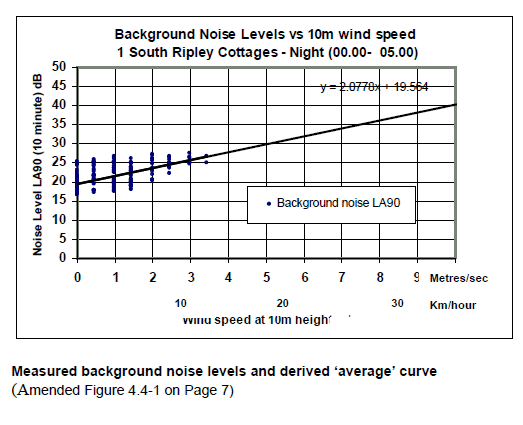
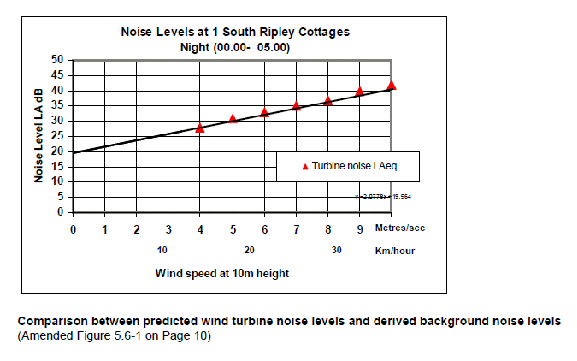
Graph to show night time noise levels at varying wind speeds.

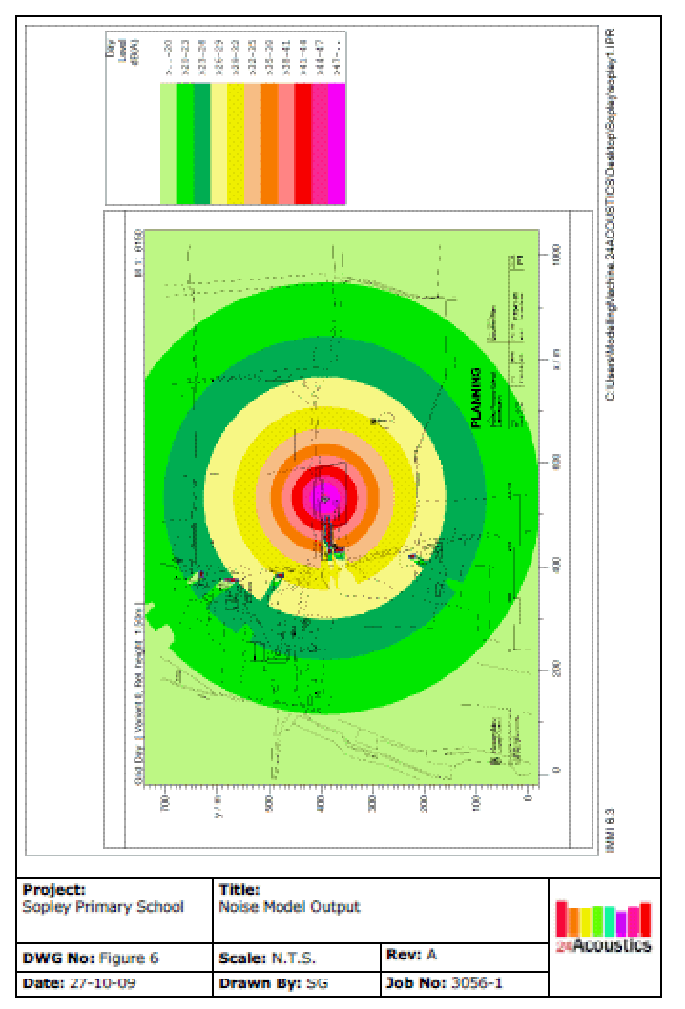
Noise model from Technical Report R3056-1 Rev 0. 30/10/09
Note: The red blocks are simply the convention used by the software - in finer resolution they show as red bricks. The software package assumes wind blowing in all, it does not allow for a single wind direction to be modelled (as this is outside the scope of ISO 9613).
Sopley Primary Renewable Energy Systems Summary
Predicted annual production |
% of existing school electricity use (37,400 kWh/year) |
Predicted Annual Income including FITs |
CO2 saved per annum (430 gCO2 /kWh) | |
Wind Turbine |
7,745 kWh |
20% |
FIT: 7745 x 23p + Energy cost saved = (7745/2)12p + Export Fit = (7745/2)5p Total = £ 2439.68 |
3.2 Tonnes |
Solar Photo Voltaic |
2,350 kWh |
6% |
FIT: 2350 x 36.5p + Energy cost saved = (2350/2)12p + Export Fit = (2350/2)5p Total = £ 1061.03 |
1 Tonne |
Annual income for wind turbine is based on 50% of the produced energy being used on site and 50% exported. It includes FITs and current guideline levels of 23ppu (1.5-15kW wind turbine) and assumes a price of 12ppu for the electricity bought by the school. Eventual figures may actually be higher - there is some debate if the export unit is also paid for by the utility in addition to the 5ppu export FIT. The above is as accurate as we can be today.
Annual income for PV is based on 50% of the produced energy being used on site and 50% exported. It includes FITs and current guideline levels of 36.5ppu (sub 4kW retrofit PV): assumes a price of 12ppu for the electricity bought by the school. Eventual figures may actually be higher - there is some debate if the export unit is also paid for by the utility in addition to the 5ppu export FIT. The above is as accurate as we can be today.
ISVR Noise report
24 Acoustics Noise Report
Other School Sites with a Proven 6kw wind turbine
Leventhorpe School - Sawbridgeworth - Hertfordshire - (web site - 2 turbines)
Astley Cooper School - Hertfordshire
Kilmory Primary School, Isle of Arran
Eastleigh Primary School, Cumbernauld
Brill Primary School, Buckinghamshire
Ladygrove Primary School
Telford Thurlton Primary School, Norfolk
Fadleigh Primary School, lpswich
Skegness Grammar, Yorkshire
Seaton Primary School, Devon
St. Johns Primary School, Liverpool
Thames Valley University, London
Baird Memorial School, Cumbemauld
Climping School, West Sussex
National Parks, Areas of Outstanding Natural Beauty (AONB), Sites of Special Scientific Interest and other UK public access sites which have Proven wind turbine installations.