
Archived decisions
HAMPSHIRE COUNTY COUNCIL
Decision Report
Decision Maker: |
Cabinet | ||||
Date of Decision: |
25 January 2010 | ||||
Decision Title: |
Hampshire County Council's response to the Government's `Personal Care At Home" consultation | ||||
Decision Reference: |
1134 | ||||
Report From: |
Director of Adult Services and County Treasurer | ||||
Contact name: |
Gill Duncan | ||||
Tel: |
01962 847200 |
||||
1 Executive Summary
1.1 The purpose of this paper is to enable Cabinet to consider and comment on the proposed County Council response to the Government's consultation "Personal Care At Home". The County Council's draft response is set out at Appendix D. The deadline for submission of comments is 26 February 2010, but the Department of Health (DH) has requested responses by 26 January if possible.
1.2 The County Council's response builds on Hampshire's public Commission of Inquiry into Personalisation held in 2008, the recommendations of which were reported to and endorsed by Cabinet in December 2008.
2 Contextual information
2.1 The Government published its Personal Care At Home Bill in November 2009, which would give some people the right to free care at home subject to meeting new eligibility criteria. On the 23 November, the Department of Health published its consultation documents on its proposals for regulations and guidance in pursuance of the aims of that Bill.
2.2 At its meeting on the 21 December 2009, Cabinet received the report on the provisional financial settlement and budget guidelines 2010/11 - 2012/13. That report set out that further analysis was being prepared and that Cabinet at its January meeting would receive a proposed draft response to the consultation.
2.3 The proposals set out in the Bill were not included in the DH's own Green Paper `Shaping the Future of Care Together' which they published in July 2009. The proposals are intended to be implemented with effect from 1 October 2010.
2.4 The DH proposes a Personal Care at Home Grant to, in part, compensate local authorities for the loss of income and additional costs. The grant is only intended to cover 63% of the costs estimated by the Department of Health. Hampshire would receive between £4.26m and £5.16m in 2010/11 dependent on the final agreed formula. The balance is intended to be funded by local authority efficiencies, although it is unclear how these are expected to be achieved, but our expectation is that it would link to national efficiency work, which has indicated potential efficiencies relating to residential care. The financial risk associated with these estimates fall solely on local authorities.
3 Summary of the proposals
3.1 The Hampshire Commission's report `Getting Personal' proposed a move towards free crisis care, recognising the significance of periods of crisis and the value of re-ablement thereafter. The report recognised that there would be a significant cost to this change, but argued that crisis care is a legitimate priority for investment. The Government's proposals go much further. Whilst they provide for a six week period of free re-ablement care, the core of the proposal is to provide free long term care at home for those with the highest needs.
3.2 The Bill and draft regulations would provide free personal care at home for some people. It defines what is eligible care and who would be eligible. The key components are:
_ A period of six weeks free re-ablement, which authorities can make a qualifying step to free care;
_ Free personal care (defined in Appendix C) provided at home, excluding support for carers;
_ Eligibility for free care being for those who then meet the Critical Criteria plus need significant assistance with at least four Activities of Daily Living (defined in Appendix C)
_ Available regardless of income or assets;
_ A full community care assessment only after that re-ablement period;
3.3 Whilst supportive of the period of six weeks free re-ablement care, there are a number of concerns about the broader aspects of the policy and the proposed funding arrangements.
3.4 The policy will create an additional new eligibility test which could add to the confusion and sense of unfairness in the system. For example, it will be difficult to explain to a service user who needs help with three Activities of Daily Living and their family why they have to pay for their care, whilst a neighbour (who is perceived to have similar needs but is assessed as needing assistance with four Activities of Daily Living) gets free care.
3.5 The proposals have not been tested to any degree and the costings are based on largely untested assumptions. For example, the assumption that 41% of people in the Critical Eligibility band will meet the new criteria is based on the English Longitudinal Survey of Ageing (ELSA), but within the DH papers it admits that this is not a particularly reliable source for this estimate, yet this is a critical assumption in understanding the cost of the proposal.
3.6 The implementation will not allow local authorities sufficient time to prepare. The assessment tool proposed will not be available until the summer at the earliest. This will not allow sufficient time for the development and delivery of training or ensuring compatibility with existing systems. For many authorities, including Hampshire, it will fall across the implementation of Self Directed Support (SDS), which is a key component of Transforming Social Care. Both Self Directed Support and the proposed new criteria affect how assessments are carried out and require staff training and systems changes.
3.7 The policy also does not fit well with Putting People First nor the Hampshire Model, which is based around a balanced approach that provides a continuum of care from universal services through early intervention for those with low level needs up to crisis care. There is a danger of repeating the mistakes of the implementation of Community Care, by over focussing resources on those with the highest needs to the detriment of early intervention and prevention. Both Putting People First and the Hampshire Commission response recognised the importance of having a balanced portfolio of services from prevention, through early intervention to critical and crisis care. That requires a balanced allocation of finite resources.
3.8 It is also widely recognised that adult social care needs more resources, to meet the growing demand from an ageing population and the increasing numbers of disabled people with complex needs. This proposal adds additional demands on already stretched resources, rather than addressing the need for more resources. The Department of Health's Green Paper on the future funding of social care promoted a co-payment approach as a way to start to address the funding shortfall. Free personal care contradicts the co-payment principles, and will make an already complex system more confusing for people. People will be uncertain how to plan for the future as they will not know whether their care needs will be means tested or free.
3.9 At a time when local authorities are planning to manage with reduced resources, this Bill will place new burdens on them. The consultation document acknowledges that, by their estimates and assumptions, local authorities will have to bear 37% of the cost of implementation. However, we have significant doubts about the legitimacy of the assumptions and the reliability of the costings given in the consultation documents.
4 Finance implications:
4.1 The key financial issues are:
_ The level of Personal Care Grant to be provided.
_ The loss of income from existing HCC clients;
_ The cost of funding care for those who currently fund their own care at home, but will meet the criteria for free personal care;
_ The cost of those who currently would meet the costs of their residential & nursing care, but choose to stay at or return home due the prospect of receiving free care;
_ The costs of providing the additional assessments.
4.2 The DH propose three funding formulas for the Personal Care Grant. These would give Hampshire between £8.5m and £10.3m per annum (pa) (£4.26m and £5.16m in 2010/11) towards the cost of free care. The three options have different issues with them. The first (which gives Hampshire the least) includes an element for deprivation, even though it is not a relevant factor for a non-means tested benefit. The third option (which would give Hampshire the most grant) is based on the English Longitudinal Survey of Ageing, which is potentially flawed.
4.3 The DH are assuming that they will fund 63% of the costs from this grant, leaving authorities to pick up the rest of the cost from efficiencies. This ignores the fact that authorities are already making significant efficiency savings to meet funding reductions, and increased demand in social care. There is also no link between the proposal and the achievement of efficiencies. They are making assumptions that maintaining people at home is cheaper. However, care at home can be more expensive, particularly where people need night cover and two carers for moving and handling.
4.4 There are a number of key assumptions that have to be made in order to assess the real cost of the policy:
_ The proportion of people in the current Critical Eligibility band who would meet the new criteria (critical plus significant help with four activities of daily living);
_ The proportion of self funders relative to the number of people currently provided for by Adult Services;
_ The number of self funders who will come forward immediately and over time to be funded by Adult Services.
4.5 The DH have assumed that 41% of people in the current critical band will meet the new criteria, based on an interpretation of the English Longitudinal Survey of Ageing (ELSA). In their own documents, they admit that this is not a reliable source and there is a significant risk that this figure is incorrect. The DH estimates would leave Hampshire having to fund £2m-3m in 2010/11 and £4m-6m pa thereafter, based on their estimate that 41% of people in the critical band will meet the new criteria. If this estimate understates eligibility, the financial consequences fall on local authorities. We calculate that an additional 5% falling into eligibility above the 41% will cost Hampshire in the region an additional £1.3m pa in lost income and additional care costs.
4.6 In Hampshire we estimate that we contribute towards the cost of care of approximately 40% of people with eligible care needs. The remainder fund their own care. This is based on a number of sources, including our own surveys of residential care homes, work by Age Concern and inspection reports.
4.7 It is impossible to know how many will come forward for free care immediately and over time. Our estimates are based on a half of these people coming forward for free care immediately and the rest over time. If more people come forward more quickly, then the costs will escalate to the eventual cost more quickly. It is possible that less than 50% of self-funders will come forward for free care. However this seems unlikely given the levels of dissatisfaction with the current arrangements for paying for long term care.
4.8 Based on these assumptions, a range of costs have been established for 2010/11 (half year effect), 2011/12 (full year effect but with only a proportion of self-funders coming forward) and eventual full-year effect (assuming all self-funders come forward). The lower estimate assumes that 41% of people currently meeting the critical band will meet the new criteria. The higher estimate assumes 70%. All estimates assume that we receive the minimum level of grant. These are set out in the table below.
Estimate: |
2010/11 (part year & 50% self funders) |
2011/12 (full year & 50% self funders) |
Eventual FYE (100% self-funders) | |
Lower (41%) |
Gross |
£6.8m |
£13.5m |
£25.5m |
Less grant |
£4.7m |
£9.4 |
£9.4m | |
Net |
£2.1m |
£4.1m |
£16.1m | |
Higher (70%) |
Gross |
£11.7m |
£23.4m |
£43.3m |
Less grant |
£4.7m |
£9.4 |
£9.4m | |
Net |
£7.0m |
£14.0m |
£33.9m | |
Table 1: cost of free personal care (critical plus 4 ADLs) for Hampshire after grant applied
4.9 The creation of a new upper needs band brings into question the relationship with NHS Continuing Health Care (CHC), which is a legal entitlement for those that meet the criteria and is free. Many of the people in the new category will be people that move in and out of eligibility for Continuing Health Care, which is not means tested. There is no mention of the relationship, but raises concerns that there may be a blurring of the lines between CHC and free personal care, to the detriment of local authorities. This is particularly the case given the recent talk of moving social care commissioning into Primary Care Trusts.
4.10 There is significant financial risks that will fall to Hampshire as a result of this policy. Even at the lower end of the estimates, these are significant and come on top of growing demand and complexity of care needs.
5 Performance Implications
5.1 The policy change will impact a number of national indicators. It is difficult to assess the impact on Hampshire performance ratings as it will affect all authorities and ratings are as much about relative as absolute performance. The main indicators affected and whether this is expected to have a positive or negative impact on performance are shown below.
Indicator |
Description |
Expected impact |
NI 125 |
Achieving independence for older people through rehabilitation / intermediate care |
Increase (positive) |
NI 129 |
End of life care - percentage who die at home |
Increased (positive) |
NI 131 |
Delayed transfer of care |
Increase (negative) |
NI 132 |
Timeliness of social care assessment |
Decrease (negative) |
NI 133 |
Timeliness of social care packages following assessment |
Decrease (negative) |
NI 136 |
People supported to live independently through social services |
Increase (positive) |
6 Conclusion
6.1 The proposals set out in the Bill and draft guidance create new burdens for local government. The proposed funding only intends to partly reimburse local government for the costs of these burdens, and that is based on doubtful estimates. Our own estimates, and those of other county councils, indicate that the Governments estimated costs are significantly under estimated. The burden on local authorities is therefore much greater than the £250m per annum (full year effect) that they state.
6.2 The Government is assuming that the gap can be filled by efficiency savings and seek to say how these can be met. However, this is in the context of existing 4% Gershon efficiency savings (£27.2m for HCC and £12.6m for Adult Services) and further actions to plan for expected real terms reductions in Government grants. It also ignores significant differences in local markets and costs, and seeks to override local democratic decision making in response to local needs.
6.3 The manner and timing of this Bill and proposed implementation causes significant uncertainty in budget preparation and planning for local authorities as it is not certain that the bill will be passed or implemented by the new Government if passed. It further increases the financial risks of demographic changes by drawing more people in the public spending arena.
6.4 The impact on councils such as Hampshire will be that much greater as there are a greater proportion of people who fund their own care, who will now be drawn into the publicly funded sector. This switch in funding, from those who can afford to pay, to the Council taxpayer, is being made at the wrong time because of the increased cost pressures from an ageing population and future spending cuts. The grant support options that are offered are deficient. None of these options recognise the `relative affluence' factor required because the costs relative to the relevant population will be higher where there are more self funders (the converse of the existing needs assessment for a means tested service).
6.5 The proposals are inconsistent with the Government's own stated intent, set out in its Green Paper, and places significant new burdens on local authorities. If the proposal are to be enacted, it is reasonable to expect Central Government to fully fund them and underwrite the very significant financial risks it poses to local authorities.
7 Recommendations
7.1 That subject to the comments made by Cabinet, the response to the Bill and consultation ` Personal Care At Home', be submitted to the Department of Health by the Leader of Hampshire County Council.
7.2 That the Executive Member for Adult Social Care reports back to Cabinet on any contingency budget requirement should the Bill be passed by Parliament and enacted.
Appendices
Appendix C - Definition of Personal Care, FACS Critical Band and Activities of
Daily Living
Appendix D - Hampshire County Council response to the Government's
Personal Care At Home" Bill consultation
CORPORATE OR LEGAL INFORMATION:
Links to the Corporate Strategy
Hampshire safer and more secure for all: |
yes |
Corporate Business plan link number (if appropriate): | |
Maximising well-being: |
yes |
Corporate Business plan link number (if appropriate): | |
Enhancing our quality of place: |
yes |
Corporate Business plan link number (if appropriate): | |
Other Significant Links
Links to previous Member decisions: |
|||
Title |
Reference |
Date | |
Report on Commission of Inquiry into Personalisation and the proposed model for adult social care in Hampshire |
458 |
22 December 2008 | |
Direct links to specific legislation or Government Directives |
|||
Title |
Date | ||
`Shaping the Future of Care Together` Government Green Paper |
14 July 2009 | ||
Section 100 D - Local Government Act 1972 - background documents | |
The following documents discuss facts or matters on which this report, or an important part of it, is based and have been relied upon to a material extent in the preparation of this report. (NB: the list excludes published works and any documents which disclose exempt or confidential information as defined in the Act.) | |
Document |
Location |
IMPACT ASSESSMENTS:
The needs of younger adults with mental health issues, learning or physical disabilities have not been adequately covered within this consultation. This is highlighted as an area of concern in the response to consultation question 1.
Impact on Crime and Disorder:
The County Council has a legal obligation under Section 17 of the Crime and Disorder Act 1998 to consider the impact of all the decisions it makes on the prevention of crime. The proposals in this report have no proven impact on the prevention of crime.
Climate Change:
a) How does what is being proposed impact on our carbon footprint / energy consumption?
No impact has been identified, since this report is a response to a Government consultation exercise.
b) How does what is being proposed consider the need to adapt to climate change, and be resilient to its longer term impacts?
The DH consultation document does not cover these issues.
Definition of Personal Care, FACS Critical Band and Activities of Daily Living
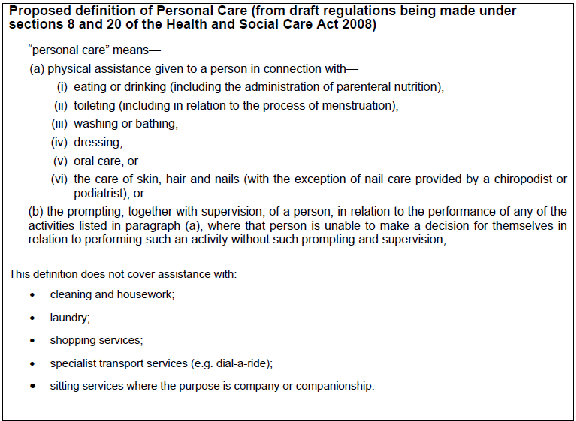
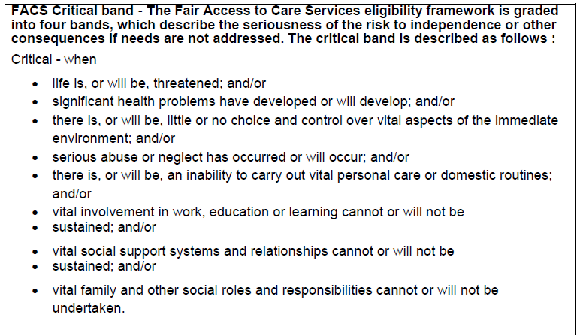
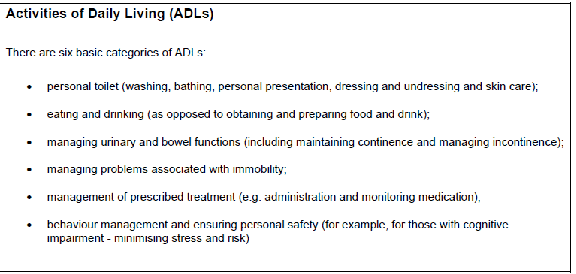
Extracts from Personal Care At Home, DH November 2009
Hampshire County Council response to the Government's Personal Care At Home" Bill consultation
1. Introduction
1.1 Hampshire County Council welcomes the opportunity to comment on the Personal Care At Home Bill and consultation document. We would like to state firstly our surprise at the speed and manner in which the Bill has been introduced. In particular, it brings into question the validity and purpose of the Green Paper "Shaping The Future of Care Together" and the fundamental principles of personalisation.
1.2 Some aspects of the proposals fit with the recommendations of the Hampshire Commission's findings, particularly with regard to the desire to move towards free crisis care. We believe that it is right to provide up to 6 weeks free re-ablement care. We believe that this is an important step to fairness and integrated services. However, the Bill goes much further and proposes free long term care for some. Below we set out our concerns with regard to the cost and implementation of such a proposal. There is a significant danger of diverting resources to one group of people at the expense of the wider need, thus jeopardising a balanced approach to personalisation.
1.3 The proposals are at odds with what you have set out in your own Green Paper and our conclusions in our Commission report Getting Personal. Both recognise the importance of a continuum of care from prevention through to crisis care to have an effective and efficient system. Both also recognise the importance of promoting co-payment if we are to have a sustainable response to the ageing population. These proposals focus scarce resources on a narrow group of people and undermine the need for people to utilise their own resources in meeting their needs. We have to question whether free long term care is affordable longer term.
1.4 The Bill and outline regulations appear to create a new eligibility criteria, critical plus significant assistance with four activities of daily living. This does not appear to have been tested as a workable and defensible threshold. It is not clear that this will be understandable for the general public. An assessment tool is promised, but will only be available shortly before implementation, leaving no time for training or integration into new systems being established as part of the implementation of Self Directed Support. The outline regulations appear to propose six weeks free re-ablement regardless of eligibility. It is not clear whether this was intended, or is the consequence of rushed and poorly drafted proposals.
1.5 We would question the affordability of these proposals at a time when public services will be facing very significant financial pressures. There is common agreement that adult social care needs more resources to meet growing demand, but this proposal increases demands on resources far in excess of the additional resources you are proposing. By your own calculations, the proposals will cost Local Government £250m (37% of your estimated costs) and Hampshire £5-6m in a full year. We note that this is notionally intended to be met from "efficiencies", but this ignores the fact that local authorities in general and social care departments in particular are already making very significant levels of efficiency savings to meet growing demand and complexity and to make good existing shortfalls in Government funding.
1.6 This policy itself offers no efficiencies, the assumption that there will be savings from diversion from residential care ignores the loss of income and the fact that many of these people will need intensive packages of care to stay at home. This can easily cost more than residential care. It will also draw in people not currently funded by local government.
1.7 The policy also does nothing to address the fundamental problem of the financial impact of demographic changes. In fact, it will exacerbate the problem by drawing additional people into an already over stretched system. Providing assessment, information and advice to people who fund their own care is a widely accepted necessity. However, providing free care for those able to fund their own care is a conflicting priority.
1.8 In addition, we would challenge the costings that you have provided. The assumption that only 41% of people in the critical band would meet the new criteria presents a very high risk for local authorities, as the criteria are untested. By your own admission in the consultation document and impact assessment, the ELSA is not a reliable source for this estimate and our understanding of this may change with experience. Yet local authorities are expected to bear all of this risk for at least two and a half years (para 5.10 page 9 of the impact assessment). This will place an unacceptable burden on local authorities and Council Tax payers and could impact on the roll-out of personalisation.
1.9 It is our view that this is an under-statement of the number of people that will meet the new criteria. Your own impact assessment admits that you have no basis for estimating the impact on younger adults. Each additional 5% that meet the critical plus 4 ADLs criteria will cost Hampshire at least £1.3m pa in lost income and additional care costs.
1.10 The financial assessment does not realistically account for the impact on current self-funders approaching authorities for free care. In Hampshire, we estimate that self-funders make up more than half of those needing care and expect a significant proportion of these to approach Hampshire for care funding.
1.11 The impact on councils such as Hampshire will be that much greater as there are a greater proportion of people who fund their own care, who will now be drawn into the publicly funded sector. This switch in funding, from those who can afford to pay, to the Council taxpayer, is being made at the wrong time because of the increased cost pressures from an aging population and future spending cuts. The grant support options that are offered are deficient. None of these options recognise the `relative affluence' factor required because the costs relative to the relevant population will be higher where there are more self funders (the converse of the existing needs assessment for a means tested service). Countyies like Hampshire have a relatively high number of self-funders, so are disproportionately affected by these proposals. The funding proposals do not take account of this sufficiently.
1.12 All of the financial risks fall on local authorities, as the Department of Health seems to be cash limiting its exposure. All of the risks therefore fall on Council Tax payers. Given the failure to test the assumptions made, it is difficult to estimate the exact cost of this policy shift. However, we estimate the cost to Hampshire (before grant) to be between £25.5m and £43.3m in a full year of all eligible self-funders approach us for free care. This compares to proposed grant of between £8.5m and £10.3m fye.
1.13 This new and untested system of assessment would, according to your timetable, need to be implemented whilst most authorities are rolling out Self Directed Support. It will place additional burdens of assessment capacity, which is untested and unfunded, and could hamper the implementation of personalisation.
1.14 There does not appear to be any rationale for the discrimination between people receiving care and carers. It also creates a new eligibility cliff edge into the care system, which will increase the confusion and sense of unfairness that may be felt.
1.15 The proposals seem to have been drafted with older people in mind, with little thought to the implementation for people of working age. In particular the documentation does not set out how the proposals relate to transition or for life long disabilities.
2. Response to consultation questions
Is the level of detail proposed for the regulations appropriate? If not, why not?
Is the balance right between regulations and guidance ? If not, why not?
Is there anything that you feel should be in the guidance rather than regulations, or vice versa?
Has anything been omitted from this document that should be included in either the regulations or the guidance/
2.1 The outline regulations do not make clear whether the six week period of re-ablement is intended to be only for those people meeting each authorities' eligibility criteria or is intended to be regardless of need. If the latter, how has this been costed?
2.2 We have already implemented re-ablement services and therefore support the principle of free re-ablement care. It works particularly well in relation to hospital discharge for older people. Our Community Re-ablement Team provides a rapid response service up to six weeks free care. Thirty seven percent of their clients do not need any further care after the six weeks, and twenty seven percent continue with a reduced package of care at home. However, for many people with long term conditions (eg stroke and dementia) a 6 week re-ablement period is of very limited value.
2.3 A longer period of free re-ablement could, however, make a significant difference. We have some evidence from a Balance of Care Audit carried out jointly with health, that three months provides improvement for some people with dementia coming out of hospital. It showed that 33% of people with dementia showed improvements in mobility, activities of daily living, continence and/or cognitive function after three months in nursing home care, even without specific intervention. An investment in these longer periods of re-ablement, rather than free long term care, might provide a better targeted, more affordable and more outcome focused policy.
2.4 The basis of the Bill and regulations appear to be largely untested and therefore represent a very high risk. The Government should underwrite this risk in full and this should be included in the regulations.
2.5 The proposals appear to identify physiotherapy as appropriate social care re-ablement rather than health care. This would be a cost shunt from health to local authorities. The regulations need to make clear that some aspects of re-ablement are the responsibility of health and should be funded by the health service.
Which of the 3 options do you feel would be most appropriate for allocating the amount needed for personal care needs to eligible individuals?
Do you have any further comments on the allocation of the amount needed for personal care needs to eligible individuals?
2.6 We believe that there is little value in a national indicative amount as it would take no account of real needs or the costs of meeting those needs.
Do you have any comments on the aspects of implementation outlined in the document? In particular, do you have any comments around any level of retrospection?
Do you have any comments on the collection of new data and its relation to existing information?
2.7 The proposed timescales do not allow sufficient time for effective implementation. As set out, it is likely to lead to confusion and delays in assessments. The assessment tool is promised for just a couple of months before implementation, allowing no time for evaluation, development and delivery of training or integration in existing assessment systems or care records.
2.8 The timing of the proposed implementation falls across the implementation of self directed support and other aspects of personalisation. It will place a very significant burden on assessment capacity, which will put that transformation at risk.
2.9 Allowing retrospective claims will add to the cost, administrative burden and risk of dispute.
Which of the 3 options do you prefer for the funding formula for the Free Personal Care Grant? Do you have any specific comments about the 3 funding formula options?
2.10 We do not believe that any of the options properly reflect the costs and risks that Hampshire will bear. There should be no bias for deprivation given that the proposals affect all income groups equally. The third option, is the least worst option. However,none of these options recognise the `relative affluence' factor required because the costs relative to the relevant population will be higher where there are more self funders (the converse of the existing needs assessment for a means tested service).
2.11 The proposals should be properly tested in a small number of areas to properly assess the financial impact of the changes. It is usual and sensible to pilot a change that has unknown risks and costs.
3. Conclusion
3.1 The proposals set out in the bill and draft guidance create new burdens for local government. The proposed funding only intends to partly reimburse local government for the costs of these burdens, and that is based on doubtful estimates. Our own estimates, and those of other county councils, indicate that the Governments estimated costs are significantly under estimated. The burden on local authorities is therefore much greater than the £250m per annum that they state.
3.2 The Government is assuming that the gap can be filled by efficiency savings and seek to say how these can be met. However, this is in the context of existing 4% Gershon efficiency savings and further actions to plan for expected real terms reductions in Government grants. It also ignores significant differences in local markets and costs, and seeks to override local democratic decision about responses to local needs.
3.3 The manner and timing of this bill and proposed implementation causes significant uncertainty in budget preparation and planning for local authorities as it is not certain that the bill will be passed or implemented by the new Government if passed. It further increases the financial risks of demographic changes by drawing more people in the public spending arena.
3.4 The impact on councils such as Hampshire will be that much greater as there are a greater proportion of people who fund their own care, who will now be drawn into the publicly funded sector.
3.5 The proposals are inconsistent with the Government's own stated intent, set out in its Green Paper, and places significant new burdens on local authorities. It contradicts co-payment principles and will draw resources away from early intervention and prevention. It places new financial burdens on local authorities who are already coping with increasing demand and are planning for significant reductions in funding. If the proposals are to be enacted, it is reasonable to expect Central Government to fully fund them and underwrite the very significant financial risks it poses to local authorities.