
Archived decisions
|
The Castle, Winchester Hampshire SO23 8UD |

The Blackwater Valley Network was formed in 1996 to work jointly on land-use, environmental, transport and economic issues. It is a formal partnership between Hampshire and Surrey county councils; Bracknell Forest and Wokingham unitary councils; and Guildford, Hart, Rushmoor, Surrey Heath and Waverley district councils.
Last year, the Network commissioned consultants Atkins and Ancer SPA to undertake a study of the Blackwater Valley. The study would help the authorities to consider conceptual options for sustainable economic growth in the Blackwater Valley and their spatial implications. It would also inform and influence the review of Regional Planning Guidance and new development plans for the area.
The consultants have now completed their work, and this document reproduces the summary from their report. The analysis and conclusions are those of the consultants; neither the Network nor any of the individual authorities have yet come to a view on any part of the report.
In September, the Network will decide how the study should be taken forward. In coming to our decisions, we will take account of the views of the individual authorities who are now considering the consultants' report.
You too can influence those decisions by responding to the five questions on the opposite page. I hope you will do so, and thus help to shape the future planning of the Blackwater Valley area. Please send your comments to Sarah Applegate at the address opposite by 18 July.
Councillor Peter Hutcheson,
Chairman, Blackwater Valley Network and Member of Hampshire County Council
1.1
Foreword
This study was undertaken by Atkins and Ancer SPA for the Blackwater Valley Network, a formal partnership of the nine county, unitary and district councils. It was undertaken in response to the revised Regional Planning Guidance (RPG) for the South East, which identified the Blackwater Valley as a Sub-Region and calls for `...a study to assist in optimising the future economic growth in the area.'
The primary objective of the study is to provide a basis for the consideration of conceptual options for sustainable economic growth and their spatial implications. The study is also intended to inform and influence both the review of RPG and the preparation of development plans and other documents at a more local level.
The Study identifies three "scenarios" for future policy direction. Each of the scenarios has positive and negative aspects. The scenarios are not mutually exclusive and different scenarios could be applied in different degrees to different parts of the area.
The nine Blackwater Valley Authorities will be considering the Consultants'
report over the next few months.
The views of organisations and interested individuals are being sought on the following questions:
1. Does the study satisfactorily address the issues in Regional Planning Guidance?
2. What are your views on the various scenarios?
3. How can the scenarios assist in "optimising the future economic growth of the area"?
4. How can the Blackwater Valley Network use the conclusions of the study to develop the wider vision for and role of the Blackwater Valley, especially having regard to the recent Planning Bill and the need to develop and foster joint working?
5. What additional information and resources will be needed to take the work forward and develop the wider vision for and role of the Blackwater Valley?
Please send your comments to:
Sarah Applegate
Environment Department
Hampshire County Council
The Castle WINCHESTER
Hants SO23 8UD
Email: [email protected]
by 18 July 2003
THE BRIEF SET OUT IN REGIONAL PLANNING
GUIDANCE FOR THE SOUTH EAST
12.51 The Blackwater Valley encompasses all or parts of the administrative districts of Surrey Heath, Waverley and Guildford in Surrey; Bracknell Forest and Wokingham in Berkshire; and Hart and Rushmoor in Hampshire. The Valley runs in a south to north-west direction and covers the larger towns of Farnham, Aldershot, Farnborough and Camberley, and several smaller settlements including Ash, Frimley Green, Blackwater and Sandhurst. Although in proximity to each other, these are clearly distinguishable as separate settlements.
12.52 The area is connected north-south by the A331 (Blackwater Valley Road) and A325, and east-west by the M3, A30 and A31. The railway network also links the larger towns. The area enjoys reasonable proximity to both Heathrow and Gatwick airports. Whilst the initial impression is that the area is quite well served by the transport system, closer analysis reveals that there are shortcomings in the rail network, particularly the poor relationship between north-south and east-west links. Evidence also indicates that there is no significant capacity in the rail network to serve additional commuters, with the likely consequence that any new development would increase levels of car-borne commuting. There is therefore a need for improvements to the public transport systems.
12.53 The towns in the Blackwater Valley experienced significant expansion in the 1960s and 1970s and generally enjoy a buoyant economy. There is now pressure for further residential and employment development yet the area is partly constrained by the Green Belt and environmental designations of international importance. Through the Blackwater Valley network of local authorities, efforts are being made to avoid problems of fragmentary initiatives in this area. If future economic growth is to take place, further collaboration will be required to ensure a co-ordinated approach to land-use and transport planning, making best use of the existing urban areas and infrastructure.
12.54 Joint working will be required to:
a undertake a study to assist in optimising the future economic growth in the area. Such a study could clarify the extent of the Blackwater Valley sub-region and identify the best locations for economic growth on the basis of taking advantage of local potential. It should help to identify areas where labour supply is constraining growth and take positive measures to relieve this problem, either by the provision of more housing or by the improvement of public transport; and
b reflect any agreed strategy for the area in development plans, local transport plans and other relevant strategies.
The study area
1. RPG identifies the Blackwater Valley as a sub-region of the Western Policy Area, which stretches from Watford in the north to Gatwick in the south. The Western Policy Area is characterised by a buoyant economy where high-tech industries are strongly represented. While the area is strategically well placed it is subject to increasing levels of congestion.
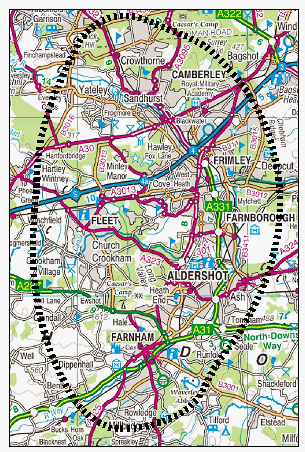
2. The Blackwater Valley has strong functional links with adjoining areas particularly London and the Thames Valley, but also with other parts of Surrey and Hampshire, see Figure 1 below.
3. In terms of identity, the area is defined by the unique identity and close proximity of its individual settlements and the strong economic and functional relationships between them.
4. Furthermore, the complexities of the administrative arrangements in the Blackwater Valley create the need for a co-ordinated policy response to address the strong development pressures which the area faces. The Blackwater Valley Network provides a cross-boundary approach to undertaking this work.
5. Key features of the Blackwater Valley include:
· The area has a population of over 300,000 with the five largest towns - Aldershot, Camberley, Farnborough, Farnham and Fleet - each having populations of between 30,000 and 52,000. Consequently no single centre dominates the area;
· The labour market is characterised by employment in higher paid knowledge based occupations particularly in the aerospace, defence, high-tech and telecommunications sectors;
· Figure 1: Blackwater Valley study area boundary
· The housing area is dominated by expensive larger homes while there is also a significant demand for smaller and affordable homes;
· Commercial property is characterised by an oversupply of offices and strong demand for light industrial space;
· Transportation issues are dominated by a complex pattern of travel movements both within the area and to surrounding areas. Levels of commuting both into and out of the area are high;
· Car ownership and usage are high and public transport usage is low apart from those commuting to London to work;
· The environmental quality of the rural area is high as demonstrated by designations of national and international significance.
SWOT Analysis
6. The key characteristics of the Blackwater Valley have been refined into a SWOT analysis (below) which highlights the strengths, weaknesses, opportunities and threats associated with the study area.
Figure 2: SWOT analysis
Strengths: · vibrant high value economy · high quality rural environment · good strategic transport links |
Weaknesses: · poor integration of rail network · high level of commuting · shortage of sites for businesses to expand · fragmented approach to decision making |
Opportunities: · economic growth · integrated public transport based on development opportunities in town centres · focus on a single centre for higher order town centre uses |
Threats: · an overheating economy · unbalanced housing market · continued car dependency |
Development issues
7. Among the key development issues which need to be addressed as part of the future planning of the Blackwater Valley is the question of balance - between growth which responds to the key drivers of change and the further development of the knowledge based economy and sustainable forms of development.
8. The lack of a coherent vision for the area may result in the Blackwater Valley failing to optimise future economic growth. Further, the lack of a dominant town centre leads to extensive travel, both within and outside the Study Area, to meet a range of employment, leisure and shopping needs. The future role of the town centres in the Blackwater Valley is, therefore, a fundamental issue for the area.
9. In terms of the local economy, issues to be addressed include business retention, support for emerging industries and the need for a balanced economy. Balance is also required in terms of housing - the lack of affordable housing and the lack of smaller dwellings is an important issue.
10. In environmental terms, the qualities which make the area attractive also constrain growth. Therefore, a further important issue is the balance between development and conservation and whether the release of greenfield sites is necessary or desirable in the context of other policy considerations.
11. Finally, in terms of transport, the problems of road congestion and low public transport patronage need to be addressed so as not to prejudice the economic health of the Blackwater Valley.
Towards a sustainable future
12. A sustainable future for the Blackwater Valley needs to be based on a policy framework which integrates social, economic and environmental goals. Guidance provided at national level, particularly through Planning Policy Guidance notes, provides core principles while RPG9 sets out themes which are integral to the promotion of sustainability.
13. A set of desirable outcomes for sustainable development in the Study Area which provides the assessment criteria for considering the relative merits of the economic growth scenarios is also presented, based on sustainability criteria.
Strategic scenarios for the
Scenario 2 - Active discouragement of growth:
· Low rates of development of employment land
· Low rates of housing development based on natural internal population growth
· No significant investment in transport infrastructure
· Strong environmental protection measures
· Measures to improve labour force productivity
· Small scale programmes to address existing transport problems
Scenario 3 - Active adaptation to growth and change:
· Proactive policies with major investment in public transport
· Proactive policy coupled with measures to preserve and develop key wealth generating industries
· Provision of accommodation for high value added activities
· Encourage development which leads to more intensive use of land and property and further affordable housing
· Addressing the need for education and training and related support infrastructure
· Support for growing economy particularly through the supply of lower skilled labour.
Blackwater Valley
14. Three possible policy led strategic scenarios for the Blackwater Valley have been identified, namely:
Scenario 1 - Limited intervention:
· Continued internal growth and inward investment
· Marginal public sector intervention
· Planning policies which continue to allow higher levels of growth
· Incremental improvements to transport system
· Development would continue to be market led
· Development on environmentally sensitive areas would be restricted
15. Each scenario would result in both positive outcomes and adverse consequences in the medium to long term, which are outlined in the full report.
Evaluation of scenarios
16. From an evaluation of the three scenarios in terms of their consequences and implications, the extent to which they are likely to achieve a sustainable outcome and their projected population and employment, the following conclusions are drawn:
17. Of the three scenarios it is Scenario 3 - Active adaptation to growth which would lead to a greater level of self-sufficiency in the Study Area, with net out commuting declining as a closer balance is achieved between jobs and the local workforce in the longer term. Both Scenarios 1 and 2 would fail to enhance the self-sufficiency of the area, leading to high levels of out commuting and transport congestion.
Spatial Options
18. A number of spatial options for the future sustainable development of the Blackwater Valley have been identified, as follows:
· Concentrating development around key town centres, chiefly Aldershot and Farnborough and, to a lesser extent, Fleet, Camberley and Farnham;
· Spreading development within existing urban areas including the above and local centres;
· Rural housing, which may offer limited opportunities for growth in villages;
· Urban extensions, through this option will need careful evaluation given the importance of strategic gaps and the need to safeguard areas affected by restrictive planning and environmental designations; and
· New settlements, for which the redevelopments of MoD sites may offer opportunities.
19. Each of the three scenarios is likely to entail elements of urban concentration, infilling of villages and other windfall developments. However, urban extensions and new settlements are more likely to occur under Scenario 3 - Active growth management, than under either of the other two scenarios. What will distinguish the spatial implications of the alternative scenarios will be the amount of growth and its distribution around the Study Area.
20. A spatial strategy for the sustainable development of the Blackwater Valley is likely to focus on a number of key themes:
· The promotion of urban renaissance;
· Sustaining rural activities;
· The efficient use of land;
· The integration of land use and transport; and
· The protection and improvement of environmental assets.
21. In drawing up a spatial strategy for the Blackwater Valley a number of factors will need to be taken into consideration, including:
· the degree of consensus amongst the Blackwater Valley Local Authorities on the future vision for the area;
· The political will of Local Authorities to work together in the formulation and promotion of a spatial strategy;
· The level of resources, and funding likely to be available for implementation;
· The nature and degree of support from stakeholders in the area, not least the business community.
22. These are all matters which will require some detailed consideration by the Blackwater Valley Network.
Summary of the Blackwater Valley Mass Transit Study
These two pages summarise the findings of the Blackwater Valley Mass Transit Study undertaken by consultants, Steer Davies Gleave. It was a separate study from the Blackwater Valley Sub-Regional Study, but each has implications here for the other. That is why a summary of the Mass Transit Study is included in this document. The Mass Transit Study is not part of this consultation and comments are not sought on it. |
For further information about the Mass Transit Study, contact:- Peter Syddall, - Hampshire County Council Tel: 01962 846050 Email: [email protected] George Burnett - Surrey County Council Tel: 0208 541 9372 Email: [email protected] Sue Cuthbert - Bracknell Forest Borough Council Tel: 01344 351168 Email: mailto:[email protected] |
The Blackwater Valley Mass Transit Study was undertaken during 2002 for Hampshire County Council, Surrey County Council and Bracknell Forest Borough Council. Its aim was to investigate the feasibility and economic viability of introducing a rapid transit system in the Blackwater Valley area, together with possible modes and route options.
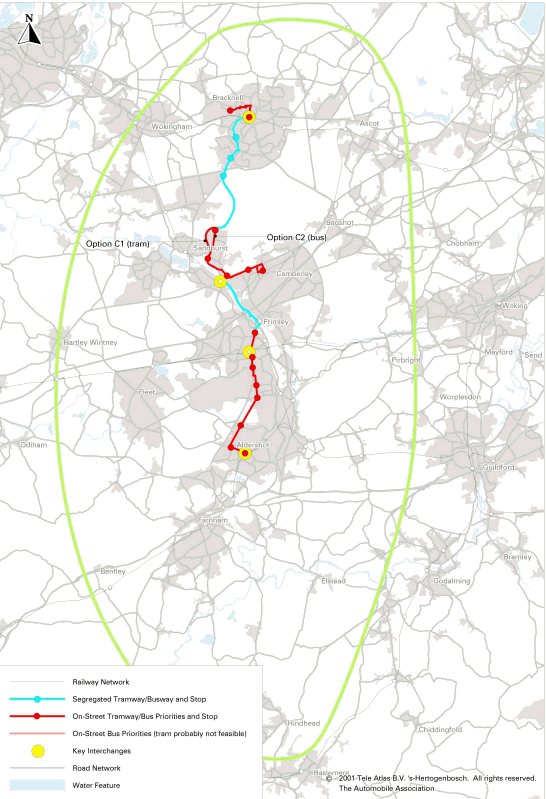
The area covered by the Mass Transit Study is larger than that covered by the Sub-regional study; see map inside the back cover. The study looked at options for light rail, guided light transit, conventional bus and alternative fuel technology. The study brief specifically excluded consideration of improvements to the heavy rail network.
The study began with collection and analysis of data on road traffic, bus and rail use, future development sites and environmental features. Views and ideas were obtained from bus and rail operators, and regional and local planning bodies.
Existing bus services, rail routes and the road network were then studied to identify possible alignments for mass transit routes. From this analysis, six alternative main transit networks were formulated - serving different areas by different types of systems - all of which were technically feasible.
Their economic viability was tested using a computer model which predicted the numbers of people likely to use each network. These predictions included people transferring from car, bus or rail services, together with new demand generated by planned housing, business and other developments.
The most promising option is shown on the inside back cover of this document. However the predicted patronage of all six options was well below the minimum required to make a light rail/tramway system economically viable. In addition, the consultants calculated that none of the six options would meet the Government's cost/benefit criteria.
The consultants therefore recommended a step by step approach towards the ultimate objective of a rapid transit system in the long term.
For the short and medium term, they recommended improvements to existing bus services through Quality Bus Partnerships together with integrated ticketing and comprehensive marketing.
These improvements would create the right conditions for the achievement of a light rail transit system in the Blackwater Valley region In the long term as guided bus or light rail.
To that end, the consultants recommended the local planning authorities to:
· safeguard routes/alignments in the medium term for the possible implementation of a mass transit system in the long term;
· implement mechanisms for co-ordinating parking charges across local authority boundaries, with the objective of discouraging long stay car parking (and therefore car commuting), possibly introducing higher charges or a workplace parking levy;
· influence development control and planning policies to promote intensification of development densities and proximity to and the funding of high quality public transport;
· request the prospective developers in the area to make financial contributions towards the study proposals.
 Mass Transit Study: option C
The full report can be purchased from Hampshire County Council, details below:
By Post:
Jacqui Hall
Environment Department
Hampshire County Council
The Castle
Winchester
Hants SO23 8UD
By email:
By telephone:
01962 846806
Additionally the full report can be viewed on the website below:
Published by Hampshire County Council on behalf of the Blackwater Valley Network: Hampshire County Council; Surrey County Council; Bracknell Forest Borough Council; Hart District Council; Guildford Borough Council; Rushmoor Borough Council; Surrey Heath Borough Council; Waverley Borough Council and Wokingham District Council.