
Archived decisions
Contact: Tracey Messer, Strategic Manager (Childcare and Business Support) 01962 813878, [email protected] and Tracey Sanders, Head of Early Education and Childcare Unit, 01962 812887 [email protected].
1 Summary
1.1 This report identifies the key messages from the Hampshire Childcare Sufficiency Assessment (CSA), which was undertaken in March 2008 to meet new duties under the Childcare Act 2006. The report seeks support for the priorities for action to address gaps identified which include the need to continue to develop out-of-school childcare, to help childcare providers to adapt to offer the new early years education entitlement, to ensure the sustainability of childcare delivered through children's centres, to improve communication about the childcare that is available to meet the needs of children with special educational needs or disabilities and enhance provision where necessary, to meet the childcare needs of rural communities and to consider and implement mechanisms which improve the affordability of childcare.
1.2 The report also proposes revision to the childcare market management systems including the launch of a revised start up and sustainability grant funding system and confirms the need to build on links with extended schools, children's centre, and social care initiatives.
2 Recommendations
That the Executive Member for Children and Families agrees the following priorities for action during 2008/2011 as listed in Section 7.
3 Background
3.1 The Hampshire CSA was undertaken during 2008 to meet the new duties on the local authority by Section 11 of the Childcare Act 2006, which stipulates that an audit of the current childcare market is undertaken and that parental needs are surveyed. There is also a requirement that consultation takes place regarding the results of the CSA and, as a result, a variety of consultation events were held. Finally, Section 11 of the Childcare Act 2006 stipulates that a final CSA is made publicly available. The full CSA report can be found at www.hants.gov.uk/childcare, and comprises of an executive summary (see Appendix 1), an overview of the Hampshire context, a description of the methodology adopted, a summary of the key childcare needs identified for the county and separate full reports regarding the childcare market and needs within the 11 borough and district council areas (see Appendix 2).
3.2 Section 6 of the Childcare Act 2006 Act gives local authorities a new duty of securing, so far as is reasonably practicable, the provision of childcare so that it is sufficient to meet the requirements of parents in their area in order to enable them to work or undertake education or training leading to work.
3.3 Section 7 of the Childcare Act gives the local authority a related duty to secure free part-time early years provision for all 3 and 4 year old children.
3.4 Having conducted the CSA and considered how the local authority can meet duties under Section 6 and 7 of the Childcare Act 2006, this report now sets the next steps to ensure that the childcare needs of families in Hampshire are met.
4 Current supply of childcare places
4.1 In Hampshire, the supply of childcare1 places is higher than the national average and the county's statistical neighbours (see Appendix 3). The stock of childcare places in Hampshire represents 3% of the national childcare market and provides for Hampshire's population of children aged 0 - 14 years (16 years with SEN and disability), which represents 2.5% of the national child population.
4.2 Hampshire has 47,400 registered childcare places supplied by 3,600 childcare providers from the following sectors.
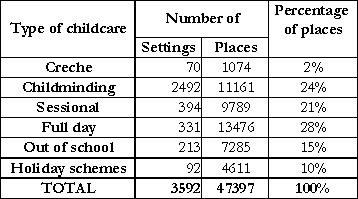
These places vary from 2 hour sessions provided on an occasional basis (e.g. crèche provision) to 10-hour sessions provided 5 days a week for 50 weeks of the year (e.g. day care provision).
4.3 The childcare indicated above is provided through the private, voluntary, and independent sector (PVI), with less than 2% of out-of-school facilities being directly managed through schools. The childcare provision for under 5 year olds does not include provision offered by the 11 maintained nursery schools/units or 443 reception classes in schools which provide additional places.
4.4 In order to provide a meaningful judgement regarding the level of childcare provision within a local authority, the ratio of childcare places to a cohort of 100 children is calculated. Using this calculation, the CSA indicated that the number of childcare places available in Hampshire provides a ratio of 18 places per 100 children (0-16 years). As noted earlier, this ratio is high when compared to the national average or Hampshire's statistical neighbours. However, it is not clear whether this level of childcare meets parental needs in Hampshire. As a result, a parental survey was conducted and this confirmed that approximately 32% of those responding indicated that they did not have a need to use formal childcare. Taking this into account (by removing the 32% from the estimated population requiring childcare) it suggests that the current stock of places provides a ratio of 27 places per 100 children indicating that around 1:4 children could access childcare provision.
4.5 When analysing the stock of childcare places by age group it is evident that generally, Hampshire provides a ratio of 43 places per 100 children for the under 5s. However, when considering the 5 - 16 year age range the ratio falls significantly to 6 places per 100 children, rising to 9 when taking account of those families who do not need childcare and indicating a deficit of provision for this age group.
5 Summary of the Demand for Childcare
5.1 As noted earlier the CSA aimed to establish whether the childcare available in Hampshire met parent's needs and assessed this through a postal survey and focus groups conducted with parents throughout Hampshire. The childcare postal survey was conducted in summer 2007 with 11,051 families whose children were entering Year R, Year 2, Year 6, and Year 9. There was a 15% return rate.
5.2 Focus group consultation took place with families of children aged 0 - 3 years, families of children with additional needs (undertaken by Hampshire Children and Families Forum), young people who had, or were about to have, a child (conducted by the Teenage Pregnancy Team) and ethnic minority families (conducted by the Ethnic Minority Achievement Traveller Service).
5.3 As a result of the survey and focus groups a total of 2,358 parental views have been considered which represented a 22% response rate from the sample group.
5.4 The majority 70% (1646) of respondents were in two-parent families. 22% of respondents (524) accounted for one-parent families, 6% (154) were adoptive parents with 0.1% (3) being foster parents. The parental survey response contained a higher proportion of both single parent families and adoptive parents than would be expected in comparison with the data for Hampshire as a whole. Also 58% (1,573) of respondents indicated they were employed with approximately half of these indicating that they were in professional or managerial roles and a further quarter indicating employment within administration/secretarial roles.
5.5 Key messages that arose through consultation with parents indicated the needs are:
· School summer holiday provision: The parental survey indicated that both those who currently used childcare and those who did not, considered there to be a lack of provision during the summer vacation.
· Local provision: The parent survey confirmed that there is a preference for childcare to be provided within 3 miles of home.
· Out of school provision: Parents indicated that there is increased demand for this type of childcare and further development of provision is required.
· Provision to support different times of care needs including unsociable hours: The parental survey indicated a high number of parents/carers were not using childcare, as it was not offered at the times it was needed. Within Hampshire there are urban areas where employment takes place over 24 hours per day such as in the health, retail and leisure industries. The parental survey indicated that where such patterns of employment occur there is a reliance on family and friends to provide the care.
· Greater affordability: families cited the cost of childcare was often a barrier. However, the parental survey and the provider surveys indicated there was a high awareness of Working Tax Credits and that families did take up Childcare Tax Credit.
· Childcare for children with special needs: parents with children with special needs often found it difficult to secure childcare to meet their child's needs. This appeared to be primarily because of a lack of confidence in the provider's ability to meet their child's needs and/or a lack of understanding of the support available.
5.6 These needs are consistent with those identified with a national review of CSA fundings.
5.7 In addition to the needs expressed by parents it is also anticipated that there will be childcare demands that arise due to a number of local authority priorities, which include:
· The Extended flexible entitlement: The change in the requirement for early years providers to offer 15 hrs of free2 entitlement flexibly across 38 weeks by 2010 is likely to place pressure upon places available for 0-3 year olds as more 3 and 4 year olds accessing longer hours fill childcare places.
· Children with complex needs: It is clear that further childcare is required which is able to include children whose needs are complex. For example, through the provision of short breaks, through the development of childcare in special schools and through the development of specialist places within mainstream provision in districts where this is currently not available.
· Developing provision in rural communities: The LA is aware that childcare provision in rural communities is sparse due to sustainability and access issues, and therefore may not be meeting parents needs.
6 Limits of the CSA survey and further investigations required
6.1 The CSA has raised a number of issues that require further clarification and research to help increase the understanding of the childcare market in Hampshire.
6.2 The CSA has been able to quantify the number of places of childcare and the location by electoral ward of the provision. However, undertaking the CSA has exposed some areas for improved data collection such as, the need for all childcare settings to provide up to date information regarding the times that their services are available and the charges that are levied for services provided.
6.3 Whilst the views of families who may experience barriers to accessing childcare were explored through focus group consultations, for example, the views of lone parents; it is important to note that 58% of respondents indicated that they were employed with the highest response from those in professional or managerial roles and further analysis needs to be undertaken to consider the needs of lower income families and families in workless households.
6.4 The CSA has begun to look at the needs of different types of families however; further analysis of the data set is needed to provide comparative data across different family types, employment types, geographical location, and age groups of respondents to provide a more detailed understanding of the childcare gaps.
6.5 As part of the CSA, local authorities are required to seek the views of employers. Hampshire County Council as part of the government's "Fast Track" initiative, was provided with free consultancy from "4Children" who explored the views of employers in Hampshire regarding the need for childcare and reviewed the methods of employer engagement with the childcare market. Initial contact was made with six local large employers: Hampshire NHS, Portsmouth PCT, Hampshire Police, the British Army, Asda in Eastleigh and Hampshire County Council, to establish their work life balance practices and ascertain whether there were recruitment and retention issues as a result of parents need for childcare. The employer responses indicated that most offered some flexible recruitment opportunities and that the NHS considered holiday and out-of-school childcare to be a need. Further research is required to assess the demand on the childcare as perceived by a range of Hampshire's employers, both large and small.
7 Priorities for Action
7.1 As a result of the CSA resources will be focused so that the supply and type of childcare places in local areas can be are more closely aligned. This will be achieved by working on the following priorities:
· Developing out-of-school childcare and in particular summer holiday provision by working in partnership with Extended Schools Co-ordinators to determine the best way of delivering services, which maintain quality and viability and take into account of the varied menu of activities that schools are delivering.
· Developing sessional and full day care to meet the new early years education extended flexible entitlement by supporting providers in considering solutions to operational and business pressures.
· Financially supporting childcare delivered as part of the full core offer to children's centres as it is likely that this provision is at most risk of sustainability pressures.
· Strengthening special educational need (SEN) provision in areas of need including developing provision for children with complex needs requiring short breaks, and promoting the support that is available to children with SEN and disabilities, which enables access to childcare.
· Considering and implementing strategies to meet the needs of families within rural communities and atypical working hours.
· Undertaking a review of costs and charges. The EECU Business Support Officers will continue to work with settings to develop financial models of best practice which supports quality of provision and affordability. Further analysis of pricing structures of the different models of childcare will be conducted to assist strategies to support both families of low income where price is a barrier and also to ensure the sustainability of a high quality childcare provision. A review of childcare subsidy and how this could be applied to assist families of low income will be undertaken and outcomes considered for possible implementation subject to budgetary requirements and future years allocations.
· Developing systems and processes to provide quarterly updates of childcare settings that have closed or are proposing to open that can be reported at postcode level and includes feedback from the Children's Information Service, particularly from the outreach team, on the types of childcare being requested and the types that are proving difficult to secure. Additionally, avoiding duplication of information gathering of parental childcare needs by ensuring that there are links with other local level consultations, and finally gaining information regarding economic development within Hampshire.
· Reviewing and releasing new childcare start up and sustainability grant programme to reflect new priorities.
· Publicising areas of insufficient supply as business opportunities and actively promoting these through the EECU local development teams and other sources.
· Reviewing the practicalities of producing a combined CSA and School Places Plan in 2011.
8 Consultation
8.1 As noted earlier, consultation regarding findings of the childcare sufficiency was undertaken through a series of County road shows and meetings with stakeholders, support organisations, partners, and Councillors during March 2008. The CSA and associated documentation together with an on-line evaluation is made available on the EECU website.
8.2 The road shows were attended by a total of 243 people, which included childcare providers, local interested parties (Councillors, local council staff), partner agencies (e.g. the National Childminding Association, Pre-school Learning Alliance and Hampshire Children and Families Forum), and others. Feedback from the events indicated that the information was extensive.
8.3 Notification of the publication of the CSA was sent to all Chief Executives of local boroughs and districts and to all respondents of the parent/carers survey who had indicated they wished to receive a copy of the final assessment.
9 Legal implications
9.1 The strategy meets the duties under the Childcare Act 2006, sections 6, 7 and 11.
10 Financial implications
10.1 The work of the EECU and partner agencies is primarily funded by the Sure Start Early Years and Childcare Grant (SSEYCG), which is provided by the Department for Children, Schools and Families (DCSF) and consists of revenue funding strands to support children's centres and extended schools and early years education and childcare. The early years education and childcare strand of the SSEYCG is provided to foster sufficiency and access to childcare, improve outcomes for young children, enhance quality and inclusion within childcare and raise qualification levels. The extent to which the funding is allocated to these priorities is a matter for the local authority to decide, although the Government indicate a split in making the grant allocations. The early years education and childcare indicative allocation for 2008/09 is £6.9m, 2009/10 is £7.7m, and 2010/11 is £8.7m. This represents an overall reduction of funding available in 2008/09 of 26%, 2009/10 of 18%, and 2010/11 of 6% (not including inflation), compared with 2007/08 for expenditure on early years education and childcare. However the overall SSEYCG funding allocation for 2008/11 has increased when compared to the 2007/08 allocation reflecting changing priorities for the DCSF with greater investment in children's centres and extended schools.
10.2 As a result, managers have considered spending priorities for each financial year and significant reductions have been made in EECU running costs, publications, allocation of funding to contracted childcare support services, recruitment activities, staff attendance at conferences and a subscription scheme for provider training has been devised to provide additional income. Many of these reductions will be in force for 2008/09 only and there is a recovery plan for future years, which takes into account the impact of these cuts. Additional funding for the work of the EECU is derived from Hampshire County Council's core budget, grants to voluntary organisations and the Standards Fund.
10.3 During 2008/09, approximately £2.9 m has been allocated to foster sufficiency of and access to childcare. This funding enables a range of activities to take place including the provision of business support, support to providers regarding establishing provision, maintaining a provider database, offering advice to changing provision etc. In addition, a small proportion of the funding is used to provide revenue "start up3" grants to stimulate the growth of childcare and "sustainability4" grants. Capital grants5 are also available and are managed through the Children's Services strategic planning team.
10.4 The total value of revenue grants that have been given since 2006/07 are:
Type of Award |
2006/07 |
2007/08 |
Total value of grants |
£1,239, 356 |
£947263 |
Development outside Children's Centres6 |
62%7 |
23% |
Development within Children's Centres8 |
57% | |
Sustainability |
38% |
19% |
The budget allocation for 2008-/2011 is:
Budget allocation |
2008/09 |
2009/109 |
2010/1110 |
Early Education and Childcare unit funding for childcare development and sustainability |
£440,000 |
£660,000 |
£880,000 |
Development |
65% |
65% |
70% |
Sustainability |
25% |
25% |
20% |
Contingency emergency fund |
10% |
10% |
10% |
10.5 The value of the grant fund available in 2008/09 is significantly reduced from previous years because of the 27% budget reduction to the EECU of the General Sure Start Grant funding.
10.6 In previous years funding has been available to providers for awards for up to three years and the commitment of these awards falling due for second or third payments for the 2008/09 budget year amounts to £110,000. Allowing for a10% contingency for emergency requests11, this leaves a revenue grant funding total of £287,000. Should the contingency funding not be used then it will be released into the new applications funding allocation to be used in the January to March 2009 period. It is anticipated that there are likely to be new applications for start up and sustainability grant of in excess of £300,000 during 2008/09.
10.7 As a result, the revenue grants programme has been reviewed and a revised applications process has been developed to assist applicants to consider their need for grant funding or whether improved business processes are required and where possible, providers will be encouraged to seek alternative sources of funding. The grants process has revised criteria so that it is strategically aligned to the CSA and strategic priorities of the EECU Strategic plan 2008/2011 and in particular new grants will be awarded using the following priorities:
· Sustaining provision - if application has been supported by business support officer appraisal.
· Developing for out-of-school and holiday provision.
· Supporting an existing approval in principle to fund a new setting.
10.8 During 2008/11, local authorities have each been provided with an allocation of £5.04m capital funding respectively in 2008/09, 2009/10, 2010/11, to support settings in the PVI sectors to improve the quality of the learning environment in early years settings, to support the delivery of the EYFS with a particular emphasis on improving play and physical activities, to develop ICT resources, ensure all children, including disabled children, are able to access provision and enable PVI providers to deliver the extension to the free early education offer for 3 and 4 years olds and to do so flexibly.
10.9 The early years capital programme will be planned in conjunction with the capital programmes for extended schools, children's centres, the aiming high project and the play builder initiative.
10.10 The early years capital programme is being managed through Children's Services and features in the capital report Children's Services Capital Programme Issues, which was prepared for the consideration of the Executive Lead Member Children's Services (Education) on 22 May 2008.
11 Personnel implications
11.1 Schools may consider directly supplying childcare to be managed through the school's governing body. As a result, there may be a need for schools to increase their establishments by recruiting appropriately qualified staff or provide further training for existing staff, as required. Schools are able to access the training provided through the EECU at a subsidised rate.
11.2 There are possible Transfer of Undertakings Protection of Employment rights (TUPE) considerations that need to be taken account of when a school either directly supplies childcare, takes on an existing childcare provision, or seeks a third party to take replace an existing provision.
11.3 The capital programme will require project management resources and the Property, Business and Regulatory Services is currently determining the resource needs.
12 Impact assessment
12.1 A full impact assessment has been undertaken regarding the provision of early years education and childcare provision for minority groups, which includes findings from the CSA. The priorities within the childcare strategy now seek to address the barriers identified in accessing childcare for children with SEN, disability, from minority ethnic groups and low income families and other groups.
13 Crime prevention issues
13.1 It is anticipated that this strategy will contribute to crime prevention by offering families increased opportunities to access childcare and therefore access employment. There is also likely to be a longer-term impact upon crime prevention as this strategy aims to offer increased opportunities for children at risk of poor outcomes to access enriched early years experiences, which in turn will lead to improved outcomes.
14 Views of the Local County Councillor
14.1 As noted earlier local County Councillors received information regarding the childcare sufficiency assessment through a road show presentation and Councillors were also invited to respond to the online consultation. Their views have been taken into account when devising this strategy.
15 Conclusion
15.1 This report has highlighted the key messages from the Hampshire CSA, which was undertaken in March 2008 to meet new duties under the Childcare Act 2006. In particular, priorities for action have emerged which include the need to continue to develop out-of-school childcare, to help childcare providers to adapt to offer the new early years education entitlement, to ensure the sustainability of childcare delivered through children's centres, to improve communication about the childcare that is available to meet the needs of children with special educational needs or disabilities and enhance provision where necessary, to meet the childcare needs of rural communities and to consider and implement mechanisms which improve the affordability of childcare. The report also highlights the need to revise the childcare market management systems including the launch of a revised start up and sustainability grant funding system and confirms the need to build on links with extended schools, children's centre and social care initiatives.
LINK(S) TO CORPORATE STRATEGY | ||
Yes |
No | |
Hampshire safer and more secure for all |
_ |
|
Maximising well-being |
_ |
|
Enhancing our quality of place |
_ |
|
This proposal does not link to the Corporate Strategy but, nevertheless, requires a decision because: | ||
Section 100 D - Local Government Act 1972 - background documents
The following documents discuss facts or matters on which this report, or an important part of it, is based and have been relied upon to a material extent in the preparation of this report.
NB: the list excludes
1. Published works
2. Documents which disclose exempt or confidential information as defined in the Act.
List documents here or type `none'.