
Conserving and enhancing biodiversity in Hampshire
The conservation and enhancement of biodiversity is central to a sustainable future for Hampshire. A rich natural environment underpins economic prosperity, supports climate resilience, and provides vital benefits for health and wellbeing.
- Benefits of biodiversity
-
A healthy natural environment provides a wide range of benefits that support daily life, the economy and the wellbeing of communities across Hampshire.
These benefits, often referred to as ecosystem services, include:
Supporting a healthy environment
- maintaining clean air, water and healthy soils
- enabling natural processes such as pollination and nutrient cycling
- supporting habitats for wildlife and maintaining ecological balance
Providing essential resources
- producing food, fresh water and raw materials
- supporting agriculture, forestry and local economies
- providing natural resources that underpin medicines and innovation
Regulating natural systems
- helping to manage flooding and reduce soil erosion
- regulating climate and storing carbon
- improving water quality and resilience to environmental change
Enriching health and wellbeing
- providing access to green spaces for recreation and relaxation
- improving mental and physical health
- contributing to cultural identity, education and quality of life
Biodiversity underpins all of these benefits. A more diverse and resilient natural environment is better able to support communities, adapt to change and deliver long-term environmental, social and economic value.
- Nature and health
-
Access to and interaction with the natural environment plays an important role in supporting the health and wellbeing of people, wildlife and livestock across Hampshire.
Benefits for people and communities
Access to nature supports both physical and mental health. Evidence shows that:
- people who live near green spaces are more physically active
- contact with nature can reduce stress, anxiety and low mood
- spending time outdoors can support recovery from illness and improve overall wellbeing
Green and blue spaces also provide opportunities for recreation, learning and social connection, helping to build healthier and more resilient communities.
Benefits for wildlife and ecosystems
Healthy, well-connected habitats support resilient ecosystems that are better able to:
- sustain diverse species populations
- recover from environmental pressures
- adapt to climate change
This contributes to a more stable natural environment that continues to provide benefits over the long term.
Benefits for livestock and farming systems
A healthy natural environment also supports livestock health and sustainable farming by:
- providing diverse, species-rich grazing that can improve nutrition
- offering shelter and shade through trees and hedgerows, helping to reduce heat stress and improve animal welfare
- supporting agroforestry systems, where trees enhance productivity by improving soil, microclimate and resilience
- supporting natural processes such as pollination and pest control
- improving soil health, water quality and long-term land condition
- reducing exposure to disease and environmental stressors
Integrating nature recovery into land management can therefore benefit both biodiversity and agricultural productivity.
- Our role
-
Hampshire County Council plays a key role in conserving and enhancing biodiversity across the county through its responsibilities as a landowner, service provider, planning authority and strategic leader.
Biodiversity and climate change are closely linked and are embedded across a wide range of functions, including:
- countryside and land management
- highways and infrastructure delivery
- planning and development
- flood and coastal risk management
- public health and wellbeing
- climate change and environmental strategy
- tree planting and landscape connectivity
Significant areas of land are managed for nature, supporting habitat restoration and species recovery. This work is delivered in partnership with local authorities, organisations, landowners and communities to deliver nature recovery at a landscape scale.
This includes initiatives such as the Hampshire Forest Partnership and wider tree planting programme, which support nature recovery by improving habitat connectivity and strengthening climate resilience across the county.
This work is coordinated across services and supported by evidence and data from the Hampshire Biodiversity Information Centre and the Council’s Ecology Team.
The approach is guided by the Biodiversity Duty and the Local Nature Recovery Strategy for Hampshire (LNRS), which together provide a clear framework for action and delivery.
This work aligns with the Climate Change Strategy, recognising the important role that nature plays in climate mitigation and adaptation.
- Biodiversity Duty Report
-
Hampshire County Council has published its first Biodiversity Duty Report, setting out how the Council is meeting its legal duty to conserve and enhance biodiversity.
The report outlines:
- actions taken between January 2023 and December 2025
- how biodiversity is embedded across council services and decision-making
- progress on habitat restoration, species recovery and biodiversity net gain
- priorities and next steps for 2026–2028
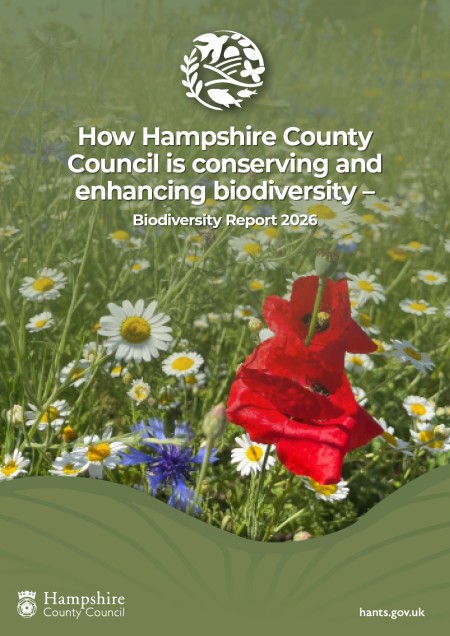
Hampshire Biodiversity Report 2026
Biodiversity Duty Report – At a glance summary
A shorter summary version of the Biodiversity Duty Report is available, providing a high-level overview of key achievements, priorities and actions in an accessible format.
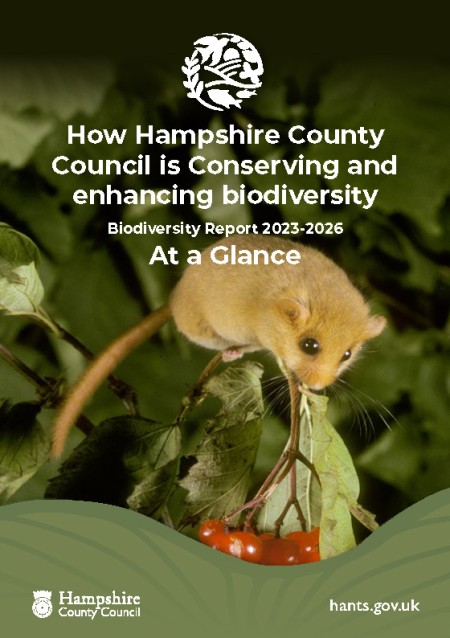
Hampshire Biodiversity Report - At a glance
This summary is intended to give a quick overview of the Council's biodiversity work without needing to read the full report.
- Nature recovery in Hampshire
-
Nature recovery is a key priority for Hampshire. Our work is guided by the Local Nature Recovery Strategy (LNRS), which sets out the priority habitats, species and locations where action is needed to support nature’s recovery.
The LNRS has been developed in partnership with local authorities, organisations, landowners and communities, and provides a shared framework for coordinated action across the county.
- Local Nature Partnership
-
The Hampshire and Isle of Wight Local Nature Partnership (LNP) brings together organisations, businesses and public bodies to support a coordinated, strategic approach to nature recovery across the region.
The partnership plays an important role in:
- promoting collaboration across local authorities, landowners and environmental organisations
- championing nature-based solutions that benefit people, the economy and the environment
- supporting the development and delivery of the Local Nature Recovery Strategy
- helping to align funding, policy and action to achieve nature recovery at a landscape scale
Local Nature Partnerships provide strategic leadership and help ensure that the value of the natural environment is reflected in local decision-making.
Alongside this, work is underway with partners to develop a more coordinated delivery approach (referred to as Nature Hampshire), bringing together organisations and stakeholders to support the implementation of nature recovery priorities across the county.
- Working together for nature recovery
-
Conserving and enhancing biodiversity requires a coordinated, long-term approach. In Hampshire, this is achieved through collaboration between the County Council, local authorities, landowners, environmental organisations, businesses and communities.
The County Council plays a key role in supporting nature recovery, particularly through its responsibility for preparing the Local Nature Recovery Strategy (LNRS). Alongside this, it works in partnership with others and fulfils its statutory Biodiversity Duty. All local authorities and public bodies have a shared responsibility to conserve and enhance biodiversity.
Partners across the county play a vital role in delivering coordinated action on the ground. By working together, organisations can align priorities, share expertise and make the most effective use of available resources.
Working together enables:
- a shared understanding of priorities across the county
- coordinated action at a landscape scale
- more effective use of funding, skills and resources
- delivery of wider benefits for climate, health and the local economy
To support this, a countywide delivery approach (referred to as Nature Hampshire) is being developed. This will bring together partners to coordinate efforts, support implementation of the LNRS, and help deliver long-term outcomes for nature.
Nature recovery requires action at all levels — from organisations and land managers to local communities and individuals — with everyone playing a part in restoring and enhancing Hampshire’s natural environment.
Biodiversity in your area
Biodiversity is managed and delivered locally across Hampshire. You can find out more about biodiversity policies, projects and priorities in your area by visiting your local authority’s website:
- Basingstoke and Deane Borough Council - Natural Environment; Biodiversity Duty Report
- East Hampshire District Council - Natural Environment; Biodiversity Duty Report
- Eastleigh Borough Council - Biodiversity; Biodiversity Duty Report
- Fareham Borough Council - Biodiversity; Biodiversity Duty Report
- Gosport Borough Council - Nature Conservation
- Hart District Council - Green spaces and nature
- Havant Borough Council - Climate and Biodiversity Strategies; Biodiversity Duty Report
- New Forest District Council - Biodiversity Net Gain; Biodiversity Duty Report
- Portsmouth City Council - Biodiversity Duty Report
- Rushmoor Borough Council - Biodiversity and nature conservation; Biodiversity Duty Report
- Southampton City Council - Local nature and wildlife; Biodiversity Duty Report
- Test Valley Borough Council - Biodiversity; Biodiversity Duty Report
- Winchester City Council - Nature Emergency; Biodiversity Duty Report
These pages provide information on local initiatives, planning policies and opportunities to get involved in nature recovery.