

For almost two decades, one of Hampshire’s rarest plants appeared to have vanished.
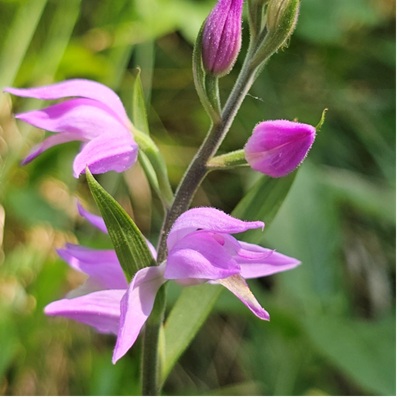
The red helleborine is an exceptionally rare woodland orchid. Fewer than 50 plants may flower across Britain in any one year, and Hampshire supports one of only a handful of known UK sites.
Its presence at Ashford Hangers National Nature Reserve was first confirmed in 1986, when a single flowering plant was spotted beside a track. Over the following decade, 16 individual plants were found along a 150-metre stretch of beech woodland, although only a few appeared above ground in any one year.
For a time, Ashford Hangers became one of the best places in Britain to see this elusive orchid.
Then things began to change.
When doing the obvious thing isn’t enough
Red helleborines need a very particular balance of conditions.
The woodland appeared to be becoming too shady, so trees were felled around the colony to allow more light to reach the ground. Initially the orchids responded well.
But increased light also encouraged vigorous bracken and bramble. At the same time, increasing deer numbers added further pressure through browsing.
By 2007, the red helleborines had disappeared.
Annual searches continued, but year after year there was no sign of them.
For 18 years, none were seen.
The experience demonstrated something fundamental about species recovery: rare species often cannot be helped simply by applying a generic habitat-management prescription.
Their needs can be highly specific, and changing one part of a habitat can have unexpected consequences elsewhere.
Turning evidence into action
In 2023, encouraged by orchid specialist and Plantlife co-founder Andy Byfield, Hampshire County Council successfully applied to Natural England’s Species Recovery Programme for a project to conserve Hampshire’s helleborines.
The project received £87,500 and focused particularly on Ashford Hangers.
Rather than dramatically opening the woodland again, around three hectares were gently thinned. The aim was to allow shafts of light to reach the woodland floor while avoiding the sudden increase in light that could encourage bramble and other competitive vegetation.
A 750-metre deer fence was also installed around the site, with particular care taken to prevent muntjac getting underneath it.
Elsewhere within the reserve, fencing allowed an important area supporting sword-leaved helleborines to be grazed again for the first time in many years, helping maintain its species-rich vegetation.
Staff and volunteers also rebuilt the long flight of steps leading down the steep woodland slope to the orchid site. Volunteer and staff time contributed more than £12,000 of additional value to the project.
By March 2025, the physical work was complete.
All that remained was to watch and wait.
Then came the phone call
On the morning of 17 June 2025, Andy Byfield called with remarkable news.
Close to the original locations, he had found two non-flowering red helleborine plants.
After nearly two decades without a sighting, the orchids were still there.
The belief is that they may have survived underground, supported through their relationship with mycorrhizal fungi, waiting until conditions became suitable for them to emerge again. And they weren’t the only plants responding.
Monitoring during the summer recorded more than 100 white helleborines, several sword-leaved helleborines and a dramatic increase in bird’s-nest orchids. Where previously only one or two bird’s-nest orchids might have appeared, more than 30 were counted inside the enclosure.
The increased light may have helped the red helleborines return, while excluding deer appears to have been particularly important for many of the other woodland plants.
What this tells us about nature recovery
The Hampshire Local Nature Recovery Strategy identifies red helleborine as one of the county’s priority species requiring bespoke conservation action.
That is precisely what happened at Ashford Hangers.
The LNRS measure S2 – Managing land specifically for priority species recognises that some species need targeted management designed around their individual ecological requirements, rather than relying solely on general habitat improvement.
The project also demonstrates the importance of S1 – Species survey, monitoring and evaluation.
Without years of records, annual searches and continued monitoring after the management work, we would not know whether the intervention had worked – or have the evidence needed to shape what happens next.
Perhaps most importantly, the story shows why nature recovery sometimes requires patience.
A species that appears to have disappeared may not necessarily be lost forever. With the right evidence, specialist knowledge, appropriate management and long-term monitoring, recovery can still be possible.