


Communications and campaigns

When the game begins, know where to turn
Major football tournaments bring people together, but for some, they also bring increased risk.
Domestic abuse can escalate during high-profile matches. Research and local data consistently show that incidents of domestic abuse rise around major men’s football events, with reports increasing by around 25% following matches - regardless of whether the team wins, loses or draws.
This campaign aims to raise awareness, support those affected and encourage everyone to take action.
Why this campaign matters
For many people, domestic abuse is a hidden harm that can intensify behind closed doors. Changes in routine, alcohol consumption, heightened emotions and financial pressures (including gambling) can all be contributing factors.
During major tournaments:
- Services often see increased demand for support
- Victims/survivors may feel less able to seek help
- Friends, family, and neighbours may notice concerns
Raising awareness helps people recognise the signs of abuse and understand that support is available - before, during and after match days.
Domestic abuse can affect anyone and is not always physical. It can include emotional or psychological abuse, controlling or coercive behaviour, financial abuse, threats and intimidation, and online or digital abuse.
Get support – for yourself or someone else
You are not alone. Confidential help is available.
📞 Hampshire Domestic Abuse Advice Line: 03300 165 112
- The Advice Line is run by our independent charity partner, Stop Domestic Abuse
- Free, confidential, and non-judgemental
- Open to anyone experiencing abuse, including concerned family and friends
- Also available for professionals needing guidance
- You can call for yourself or on behalf of someone else
You can also access our Live Chat sessions on the Stop Domestic Abuse website.
If you or someone else is in immediate danger, always call 999.
What is safety planning?
Safety planning is a practical way to help reduce risk and prepare for different situations. It can be done with support from a trained professional or on your own.
A safety plan might include:
- Identifying safe places you can go in an emergency
- Keeping important items ready (keys, phone, medication, important documents)
- Setting up a code word with a trusted friend or family member
- Planning how to leave safely if needed
- Thinking about safer times to seek help
- Ensuring your phone is charged and accessible
- Learning how to quickly leave a situation if you need to
Even small steps can make a big difference.
You don’t need to do this alone - our advice line can support you to create a plan that works for your situation. Give us a call.
If you’re worried about someone else
You may notice signs that something isn’t right. You can help by:
- Checking in safely and privately
- Listening without judgement
- Avoiding putting them under pressure to act
- Sharing information about support services
- Respecting their choices
If you believe someone is in immediate danger, call 999.
For professionals
We recognise that practitioners play a crucial role in identifying and responding to domestic abuse.
The Advice Line is also available for:
- Consultation on cases
- Guidance on risk and safeguarding
- Support with safety planning
- Signposting and referrals
Please don’t hesitate to get in touch.
Help us extend the reach of this campaign
You can play a vital role in helping more people access support during the tournament.
We encourage partners and professionals to share this campaign widely:
Campaign video
- Share our campaign video on your social media channels, websites or internal platforms.
- Display the video on screens in public-facing spaces such as waiting rooms, reception areas, community venues and events.
Campaign posters
- Download and print our print-ready campaign posters to display in your settings, including offices, health settings and community spaces.
- Share posters with local venues, including pubs, clubs and hospitality settings, where they can reach people during match days.
- Download our static poster images, optimised for use in newsletters, email communications, internal bulletins, website content etc.
By increasing visibility, we can help ensure that anyone experiencing abuse—or concerned about someone else—knows where to turn for support.
Assets available to download
- Print ready posters (for use with professional printers)
- Poster images (for use with smaller print requirements – e.g. office printers)
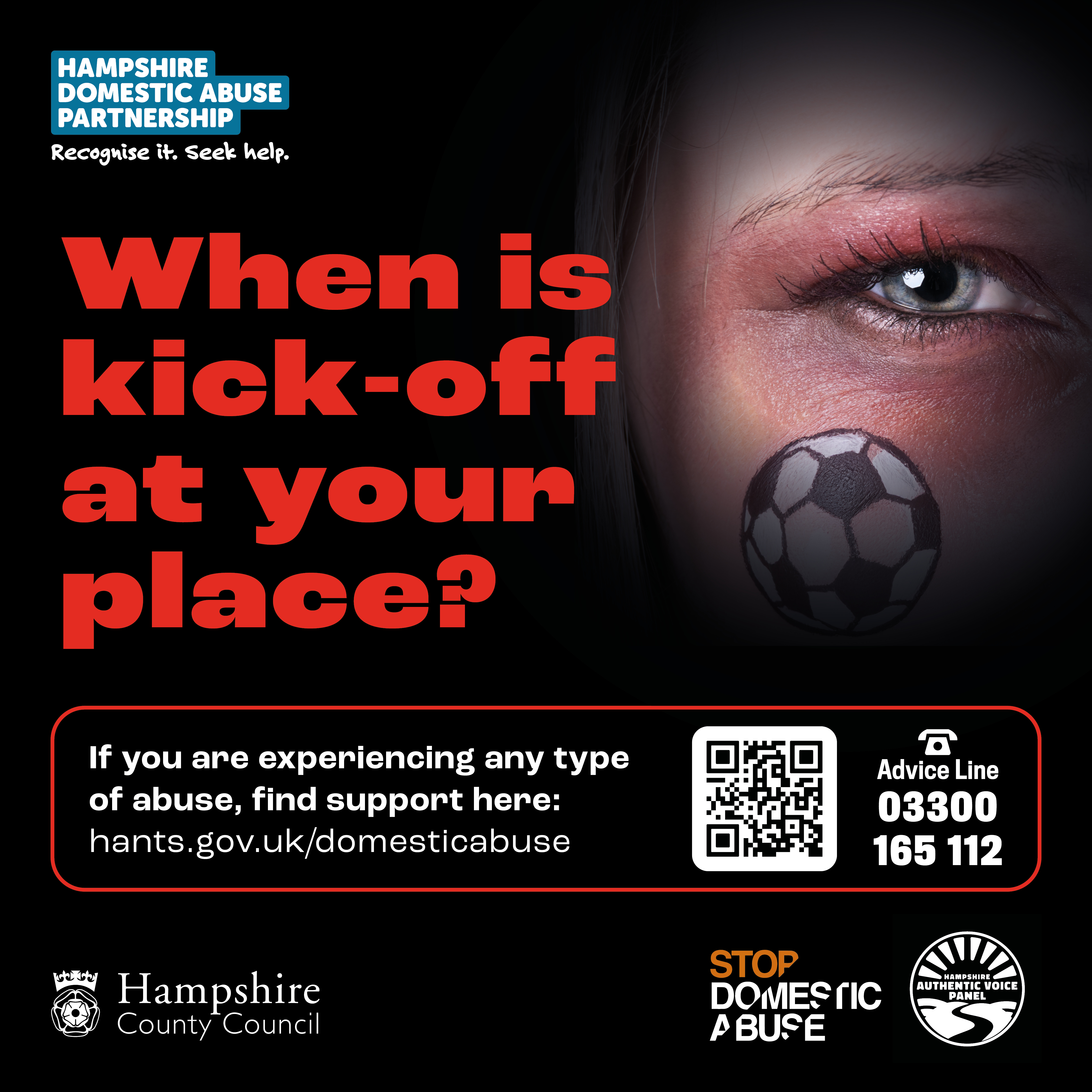
- When is kick off at your place? Square image
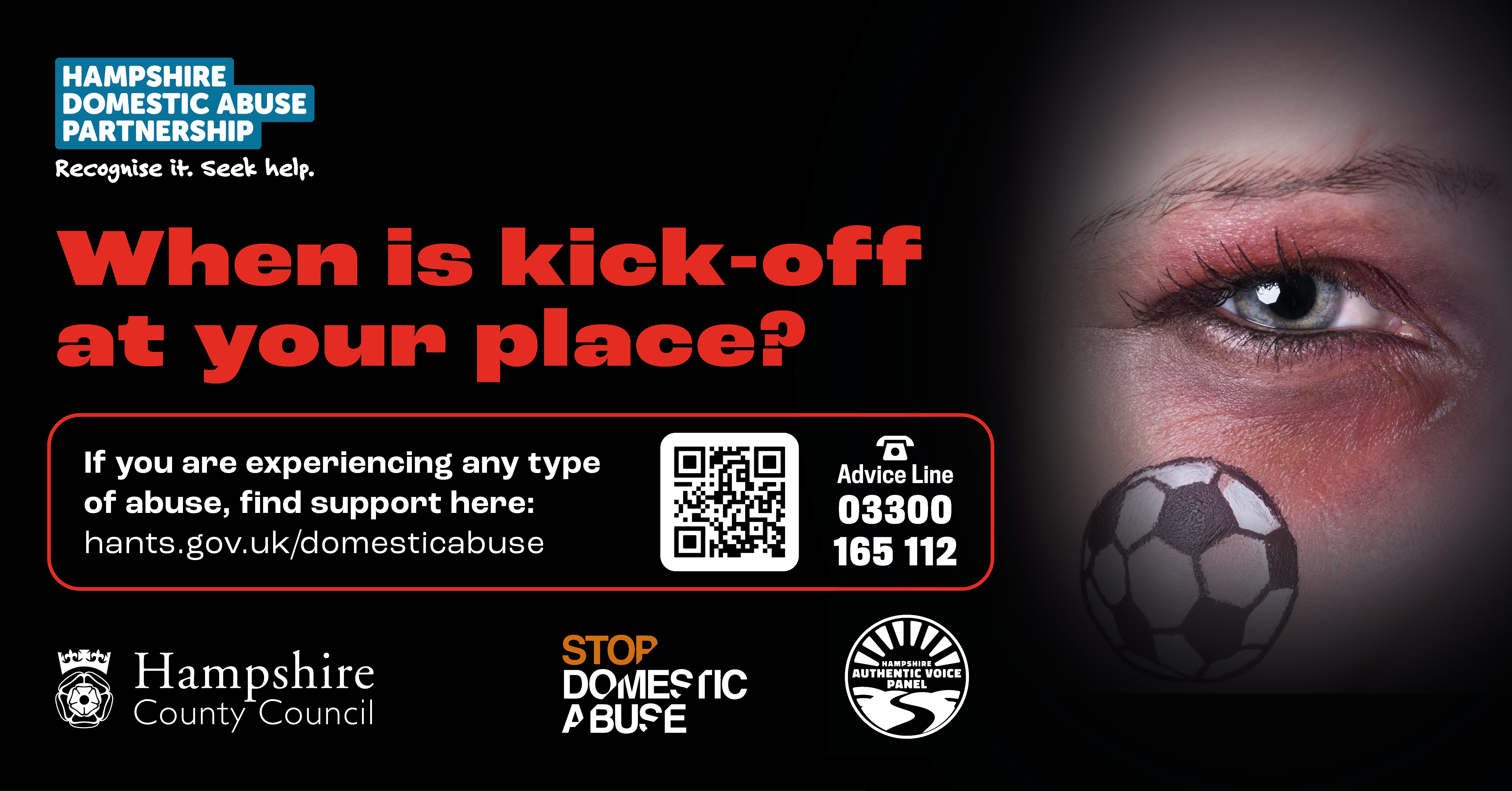
- When is kick off at your place? Landscape image
- Domestic abuse rises during major football events – animation
- When is kick off at your place? – animation
Together, we can make a difference
Football should be something everyone can enjoy safely.
By raising awareness, looking out for one another, and knowing where to turn, we can help reduce harm and support those who need it most.
Past campaigns
Is this love?

This campaign shines a light on coercive and controlling behaviour — a hidden but devastating form of domestic abuse. Through some short videos shared across Facebook, Instagram, Snapchat, and Google, we’re raising awareness of how coercive control works, how it affects people, and where to get help.
If something in the videos feels familiar or unsettling, you're not alone. Keep reading to learn more about coercive control, how it builds up over time, and what support is available in Hampshire.
What is coercive control?
Coercive control is a pattern of behaviour used by abusers to dominate, isolate, and frighten their victims. It’s often invisible and non-physical but deeply damaging.
Examples include:
- Isolating you from friends and family
- Monitoring your movements and communications
- Controlling your finances, clothing, or daily routine
- Threats, humiliation, and intimidation
- Passive aggression (a way of expressing negative feelings indirectly, often through stubbornness, sarcasm, or intentional inefficiency)
- Depriving you of access to food, sleep, or medical care
It’s been a criminal offence in the UK since 2015. Survivors often describe it as feeling like being held hostage in their own life.
More information:
What is coercive control - SafeLives
Coercive control - Women’s Aid
How coercive control takes hold
Coercive control often begins subtly—small rules, guilt trips, or “concern” that seems caring. Over time, these behaviours accumulate into a system of control that can feel impossible to escape.
It builds gradually:
- Starts with “I just worry about you” or “I need to know you’re safe.”
- Progresses to monitoring your movements, isolating you from friends, and controlling finances.
- Eventually, you may feel like you’re “walking on eggshells,” constantly adjusting your behaviour to avoid punishment or conflict.
This pattern is intentional and strategic—designed to make you dependent, confused, and fearful. It’s not about losing temper; it’s about gaining power.
Gaslighting: twisting reality
Gaslighting is a powerful form of psychological abuse used to make someone question their own reality. It’s not just lying—it’s a deliberate strategy to destabilise and control.
Common gaslighting tactics include:
- Denial of events: “I never said that.” / “You’re making things up.”
- Trivialising your feelings: “You’re too sensitive.” / “You always overreact.”
- Shifting blame: “If you weren’t so difficult, I wouldn’t get angry.” / “You’re the one causing problems.”
- Rewriting history: “That’s not how it happened.” / “You’re remembering it wrong.”
- Undermining your confidence: “You’re not smart enough to understand.” / “Everyone thinks you’re crazy.”
- Isolating you from others: “Your friends don’t really care about you.” / “Your family always takes your side because they don’t know the real you.”
Over time, these tactics can make you feel confused, anxious, and dependent on the abuser for a sense of reality. You may start to doubt your own memory, instincts, and ability to make decisions—making it easier for the abuser to tighten their control, especially through technology.
Technology and text messaging
Technology-facilitated coercive control is increasingly common. Abusers may:
- Send barrages of texts demanding instant replies
- Use location tracking apps or demand passwords
- Monitor social media or post abusive content
- Control access to online banking or devices
These behaviours are often disguised as care or jealousy but are rooted in control. Victims may feel watched, judged, and unable to escape—even digitally.
More information:
Technology-facilitated coercive control - Compass
Tech abuse: What is digital coercive control and why is it increasing? | ITV News Border
Secure your tech - Refuge
Post-separation abuse
Leaving an abusive relationship doesn’t always end the abuse. In fact, post-separation abuse can intensify.
As of April 2023, coercive control after separation is a criminal offence in England and Wales.
Common tactics include:
- Withholding or manipulating child maintenance
- Prolonging court proceedings to exert control
- Harassing via texts, calls, or social media
- Using children to manipulate or maintain control over a situation or relationship
This abuse can be economic, emotional, or psychological—and it’s now recognised in law.
Narcissists and coercive control
Narcissistic abusers are particularly skilled at coercive control. They often:
- Use charm and manipulation to create dependency
- Weaponise love: “I only act this way because I care so much”
- Gaslight: Deny things they said or did, making you question your reality
- Control your social circle, finances, and even your appearance
- Use emotional blackmail and threats to maintain dominance
They may appear loving to outsiders, making it harder for victims to be believed. Their tactics are often invisible but deeply damaging.
Local support in Hampshire
Hampshire offers a range of services for anyone affected by domestic abuse:
- Stop Domestic Abuse – The lead provider offering confidential support, safe housing, and recovery programmes. Advice Line: 03300 165 112
- Hampton Trust – Specialist services including work with people who are causing harm and want to change their behaviour. Enquiries: 023 8000 9898
- Bright Sky App – A free app offering support and information.
- The Hampshire Domestic Abuse Partnership – a group of local services and agencies in Hampshire working together to provide help and support for victims/survivors of abuse, children living with domestic abuse, people who may be abusing or hurting someone and professionals seeking advice.
Who are Stop Domestic Abuse?
Stop Domestic Abuse is Hampshire’s specialist provider of domestic abuse services, offering both safe accommodation and community-based support for individuals and families.
Accommodation services
- Refuge accommodation: Safe, confidential housing across Hampshire, Portsmouth, and Southampton for women and children fleeing abuse.
- Dispersed accommodation: Self-contained housing for people who may not be able to access refuge accommodation, including:
- Male victims
- Women with older male children
- Families with complex needs
- Emergency access: Available 24/7 via their helpline: 03300 165 112
Community-based support
- One-to-one outreach: Tailored support for adults and children to stay safe and rebuild their lives.
- Children & Young People’s Services: Support in schools, homes, and communities to build confidence and emotional resilience.
- Group work: Recovery-focused sessions for adults and children, including confidence-building and healthy relationships.
- Target hardening: Safety assessments and equipment to make homes more secure.
- LGBTQ+ advocacy: Specialist support for LGBTQ+ individuals experiencing abuse.
- Stalking advocacy: Help with safety planning, cyberstalking, and emotional support.
- Health advocates: On-site support in hospitals for staff and patients.
- Support for harmful cultural practices: Including forced marriage, FGM, and honour-based violence.
Group programmes
A range of group programmes are offered, focusing on recovery from abuse, building resilience, and promoting healthier relationships. These include therapeutic, trauma-informed, and empowerment-based courses that help participants increase self-awareness, strengthen boundaries, improve emotional wellbeing, and develop coping strategies. Outcomes commonly reported include reduced self-blame, enhanced confidence, stronger support networks, and a renewed sense of personal agency.
- Freedom programme: Explores the tactics and impacts of domestic abuse, helping participants identify abuse, understand patterns of control, and regain self-confidence.
- Own My Life: A trauma-informed, empowerment-based course supporting women to understand how abuse affects their lives, reclaim ownership of their choices, and develop strategies for long-term recovery.
- Phoenix programme: Therapeutic group focused on healing from trauma, supporting participants to develop coping skills, resilience, and self-care strategies.
- Adolescent-to-Parent abuse group: A specialist group for parents/carers affected by violence or abuse from adolescent children, addressing boundaries, communication, and trauma-informed parenting.
- Power To Change: A change-focused group supporting women to explore self-worth, personal growth, and future goals, helping them move from surviving to thriving.
Is my information safe?
Your safety and privacy are a priority.
- Your information is kept confidential
- It will not be shared without your consent unless there's a serious risk to life or safety
- You can use LiveChat or email for discreet contact
- They recommend using private browsing and clearing your history when seeking help
See Beyond the Silence
Help Us Protect Children from Domestic Abuse
Children May Not Always Have the Words But Their Behaviour Often Speaks Volumes
Abuse in the home can leave lasting emotional scars, even when children are not the direct target. As the summer holidays approach and children spend more time at home, the risk of harm can increase - and so does the importance of the adults around them noticing the signs.
Whether you’re a teacher, neighbour, sports coach, friend, or family member, you could be the one who sees what others don’t.
The Campaign: “See Beyond the Silence”
Developed by Hampshire County Council, in partnership with the Hampshire Domestic Abuse Partnership and the Hampshire Authentic Voice Panel, this campaign urges adults to pause, look closer, and act.
Children experiencing domestic abuse might:
- Seem anxious, withdrawn, or unusually aggressive
- Become suddenly fearful or overly compliant
- Struggle with sleep or concentration
- Show signs of guilt or self-blame
These behaviours are often a child’s way of asking for help - without saying a word.
Campaign images for Partners to use:
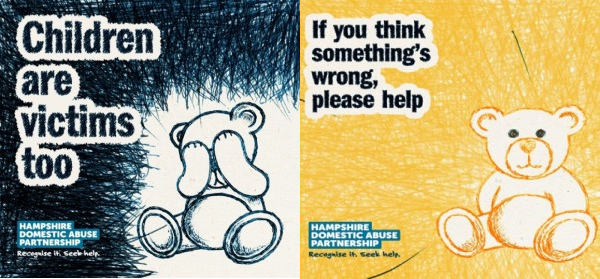
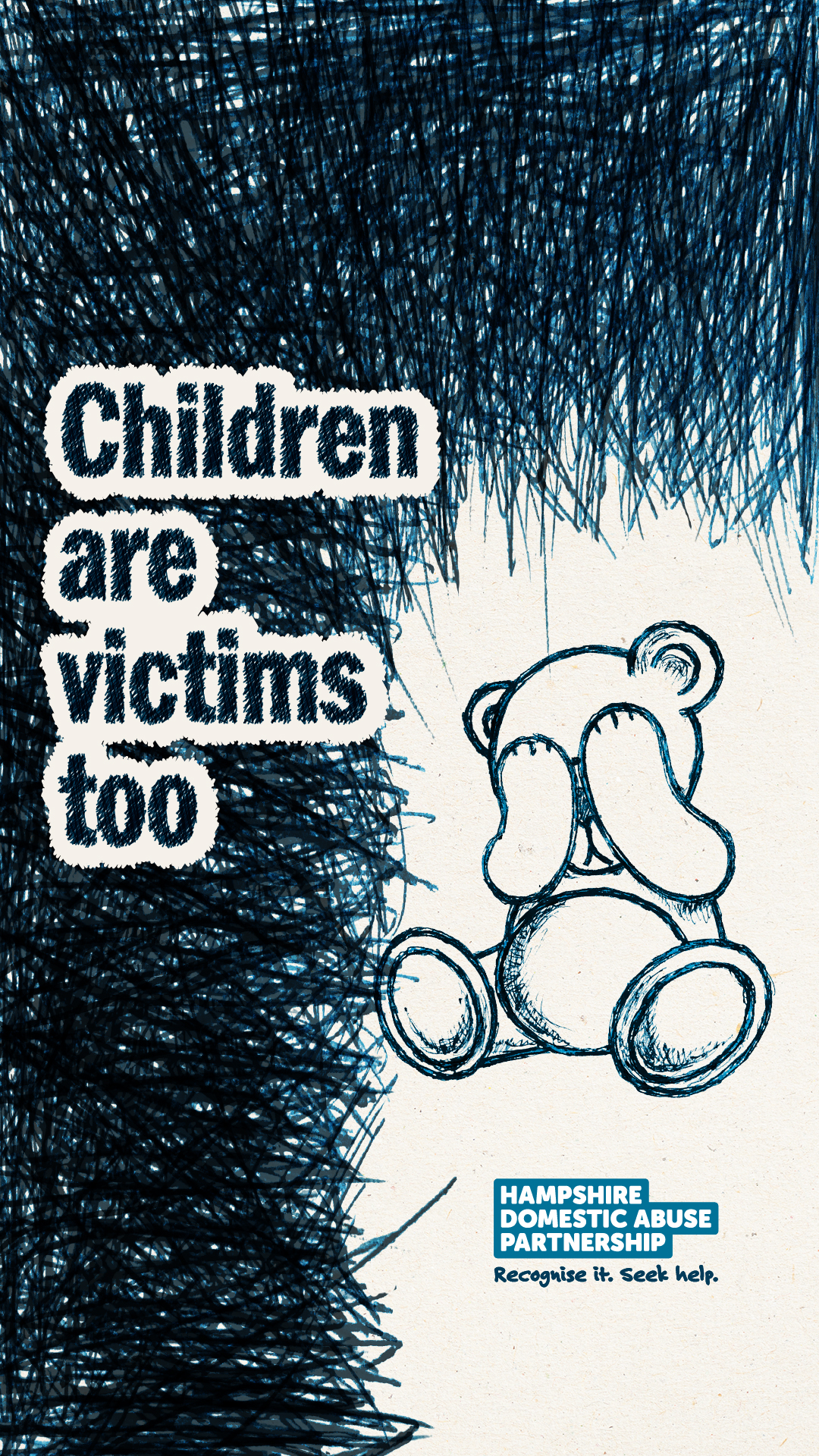
Children are victims too 1080x1920 resolution for mobile content
Children are victims too Blue and White Bear 800x800 resolution
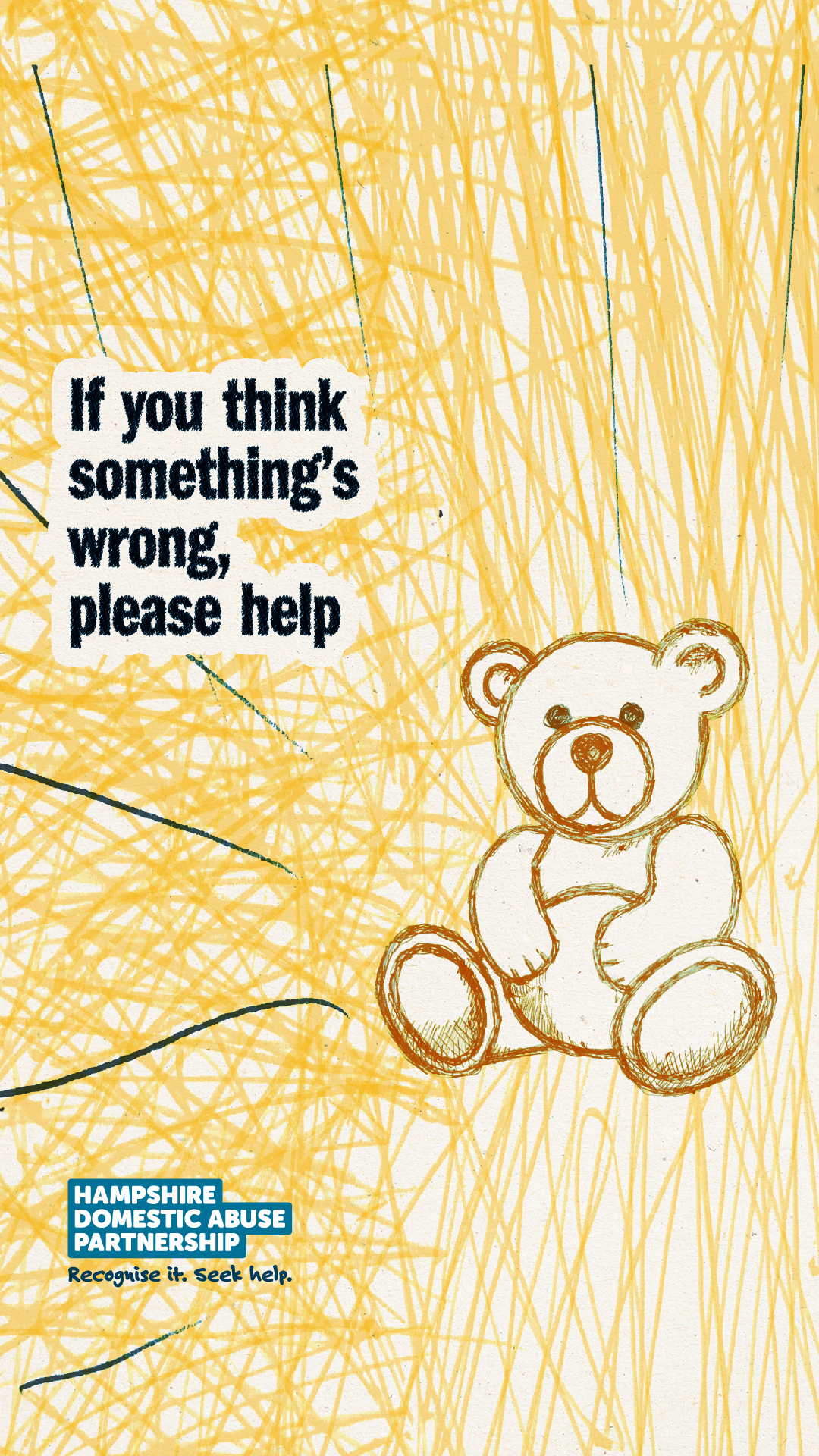
If you think something's wrong please help Yellow Bear square image 1080x1080 resolution
If you think something's wrong, please help 1080x1920 resolution for mobile content
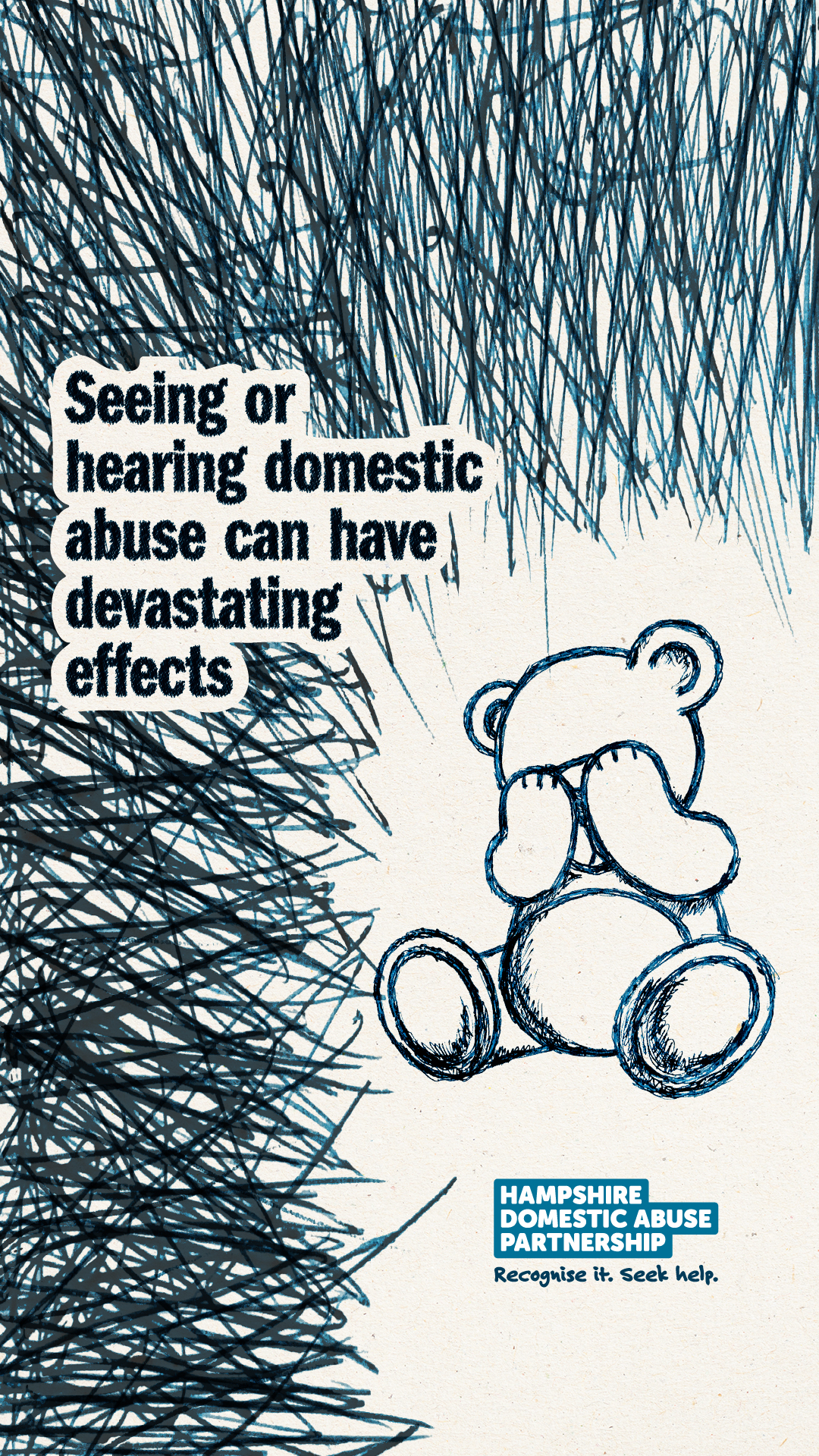
Seeing or hearing domestic abuse can have devastating effects Blue and White Bear 1080x1920 resolution for mobile content
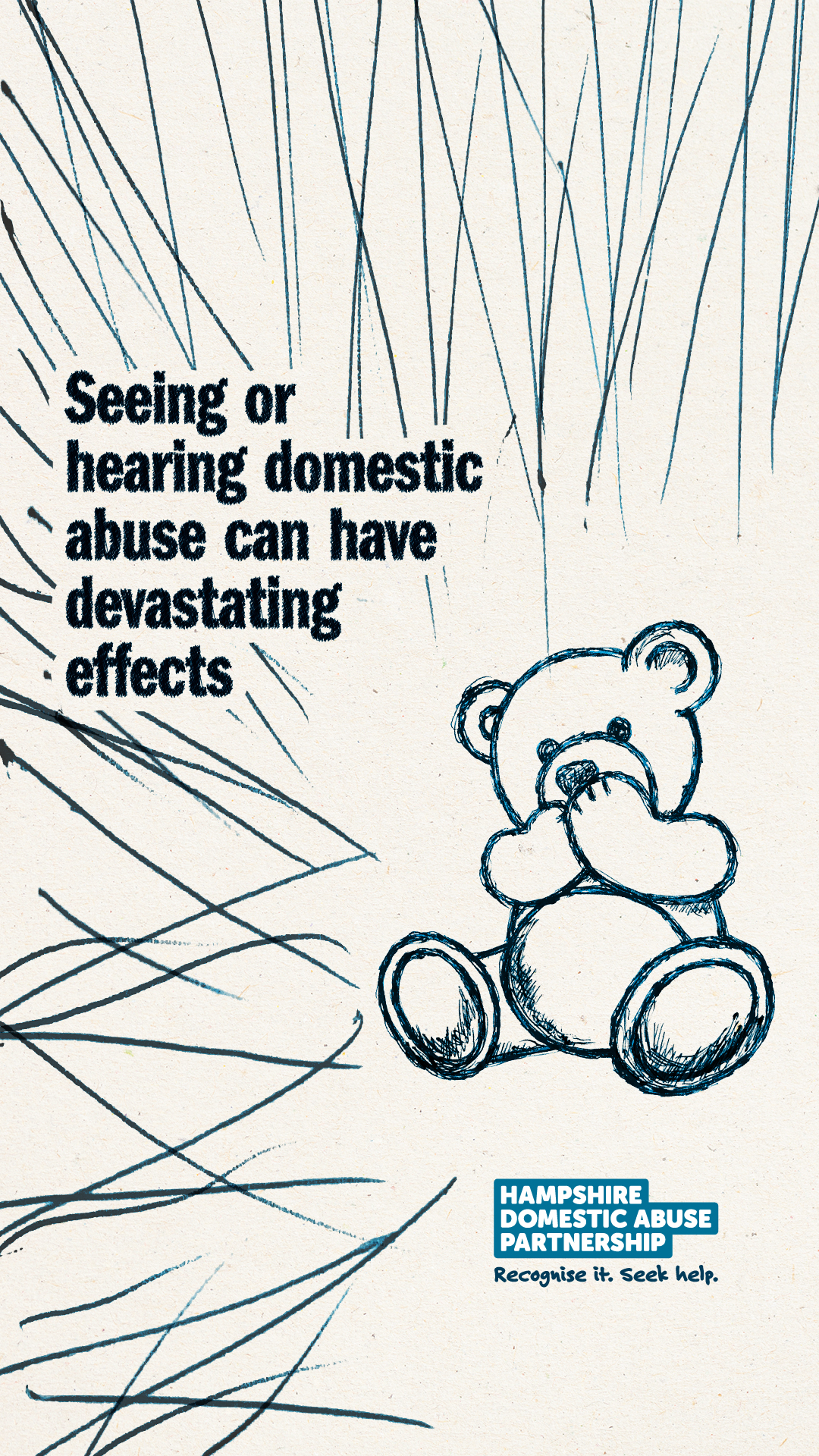
Seeing or hearing domestic abuse can have devastating effects White and Blue 1080x1920 resolution for mobile content


You Don't Need to Be Certain. You Just Need to Care.
If something doesn’t feel right, trust your instincts. Your concern could be the first step toward safety for a child.
You don’t have to investigate - just speak to someone who can help. Whether it’s your local safeguarding team, a school’s designated safeguarding lead, or a domestic abuse charity, reaching out could change a child’s life.
Spot the Signs. Start the Conversation. Seek Support
Your awareness could be a child’s lifeline.
Learn What to Look For: Signs of Domestic Abuse in Children and Young People
Domestic abuse doesn’t just affect adults—it can have a devastating impact on children and young people too. Sometimes the signs are easy to spot, but other times they can be hidden.
More Obvious Signs
These are changes you might notice in a child’s behaviour or emotions:
- Becoming very quiet or withdrawn
- Acting out with anger or aggression
- Having trouble sleeping or frequent nightmares
- Sudden changes in school performance
- Seeming anxious, scared, or jumpy
- Complaining of physical symptoms like stomach aches or headaches with no clear cause
- Becoming controlling in friendships – trying to take charge or isolate others, possibly as a way to feel safer or more in control
Hidden Signs
Some children try to hide what they’re going through. They might:
- Over-achieve at school – trying to be “perfect” to avoid drawing attention
- Take on adult responsibilities – like caring for siblings or worrying about money
- Seem very mature for their age – because they’ve had to grow up quickly
- Always try to please others – even at the cost of their own needs
- Mask their feelings – smiling or joking to hide sadness or fear
Why It Matters
Even if a child seems “fine,” they might be struggling inside. It’s important to look beyond the surface and notice changes in behaviour, mood, or habits. Every child deserves to feel safe, supported, and heard.
Find out more about the effects of domestic abuse on children.
Start the Conversation: How to Talk to a Child If You’re Worried About Domestic Abuse
If you’ve noticed signs that a child or young person might be experiencing domestic abuse, it’s important to talk to them in a kind and safe way. Here are some simple steps to help you start and manage that conversation:
Choose a Safe, Quiet Moment: Find a time when you can talk privately, without rushing. Make sure the child feels safe and not watched or overheard.
Be Calm and Gentle: Speak in a soft, calm voice. Let them know you care and that they can talk to you if they want to.
You could say: “I’ve noticed you seem a bit upset lately. I’m here if you ever want to talk.”
Don’t Push Them to Talk: It’s okay if they’re not ready. Just knowing someone is there for them can make a big difference.
Listen Without Judging: If they do open up, listen carefully. Don’t interrupt or ask too many questions. Let them speak in their own time.
Reassure Them: Let them know
- What’s happening is not their fault
- They are not alone
- You believe them
Worried About a Child? Keep them safe - get help
Immediate Risk
Hampshire Children’s Services: Public Tel: 0300 555 1384 (Monday – Friday, 9am to 5pm), Out of Hours: 0300 555 1373
Professionals should complete the online inter-agency referral form. For urgent Child protection enquiries, also call the Professionals Line: 01329 225379.
All other concerns
🔹 Hampshire Domestic Abuse Advice Line
Run by Stop Domestic Abuse, for anyone concerned about a child or young person.
📞 Call: 03300 165 112
📧 Email: [email protected]
🔹 Hampshire Children’s Services
To report a safeguarding concern, always complete the Inter-Agency Referral Form (IARF). It is important to do this as your piece of information could be part of a much bigger picture and could make the world of difference to a child.
📞 Call: 0300 555 1384 (Office hours)
📞 Out of hours: 0300 555 1373
🌐 hants.gov.uk
🔹 NSPCC Helpline
For advice and support if you're worried about a child.
📞 Call: 0808 800 5000
📧 Email: [email protected]
🌐 nspcc.org.uk
🔹 Childline
For children and young people to reach out directly.
📞 Call: 0800 1111
🌐 childline.org.uk
For Professionals: Be a Catalyst for Change
Share the campaign
Whether you work in education, healthcare, youth services, or community support - your voice carries weight. Here’s how you can help extend the reach of “See Beyond the Silence” and prepare your service for those who may now seek help:
- Raise Awareness Within Your Network
- Share the campaign on your organisation’s website, social media, and notice boards.
- Incorporate campaign resources into team meetings, staff training days, and newsletters.
- Host awareness workshops or short information sessions tailored to your network’s needs and context.
- Be Prepared for More Disclosures
- Make staff aware of this campaign
- Ensure all frontline staff are confident in identifying and responding to signs of abuse in children.
- Ensure all staff are up to date on your safeguarding procedures and referral pathways.
- Partner With Others
- Build bridges with local schools, clubs, health services, and community centres to share materials and coordinate efforts.
- Nominate a campaign lead within your organisation to champion progress and track impact.
- Use Your Platform, No Matter the Size
- Whether you're a large institution or a one-person practice, your voice matters. One conversation can open the door to safety for a child.
For any queries about the campaign, email [email protected].
UEFA Euros 2024

We are currently running a campaign to encourage anyone living with domestic abuse to seek help from our local services.
The UEFA Men’s European Championship 2024 launches this week on Friday 14 June and this sees the start of our latest campaign focusing on ending the violence. Research shows that when England lose a game in the World cup incidents of domestic violence and abuse increase by 38%, and by 26% when they win1. Further research from Warwick Business School found that reported cases of alcohol-related domestic abuse rose by 47 per cent on the day of an England victory at the World Cup or European Championship2.
Let’s be clear - the message is not that football itself is responsible for domestic abuse. Football can be a source of community, a tool for building self-esteem and a vehicle of tolerance building. Most fans watch a game without any negative behaviours. For some reason however, it exacerbates an underlying systemic problem in our society causing some to become abusive towards those closest to them.
The Hampshire Domestic Abuse Partnership is a group of local services and agencies in Hampshire working together to provide help and support for:
- Victims and survivors of abuse
- Children living with domestic abuse
- People who may be abusing or hurting someone
- Professionals seeking advice
Domestic abuse is any incident or pattern of incidents of controlling, coercive, threatening, degrading and violent behaviour, including sexual abuse by any individual ‘personally connected’ to the individual. Control can take form of, although not limited to; financial, technological or in relation to socialisation.
It can often start off small, with lots of different events that gradually chip away or erode your confidence. It can sometimes make you feel that you are losing your “sense of self” and that you can’t trust your own judgement or feel you don’t have the right to make decisions.
If you would like to share our messages, assets and social media messages, please download from this page.
Social media messages to accompany images
See the social media messaging options to use along side the images and moving assets provided below.
Social media images
Social media assets and imagery that you can use to post on your own social media channels. Please ensure that you use the accompanying messages above as relevant, including a phone number to sign post to relevant services.
Campaign image 1 – square
Campaign image 2 – portrait
Campaign image 3 – landscape


Briefing note for services
This briefing includes information for services on things to consider throughout the campaign, including signposting, risk assessment and data collection.
UEFA Euros 2024 and domestic abuse briefing note for partners
Please send any queries to [email protected].
[1] Can the FIFA World Cup Football (Soccer) Tournament Be Associated with an Increase in Domestic Abuse? - Stuart Kirby, Brian Francis, Rosalie O’Flaherty, 2014 (sagepub.com)
[2] Domestic abuse increases almost 50 per cent after England win at World Cup- - Warwick Business School (wbs.ac.uk)
16 Days of Activism against gender-based violence
25 November to 10 December 2024
With the United Nations’ 16 Days of Activism against gender-based violence starting with White Ribbon Day on Monday 25 November 2024, the Hampshire Domestic Abuse Partnership is encouraging people to get involved.
This calendar of events taking place across the local area shows how you can support the 16 Days of Activism:
Stop Domestic Abuse event calendar

White Ribbon Day (16 Days of Activism)
25 November 2024
A domestic abuse awareness stall will be in Festival Place between 09:30 and 15:30 with Paragon, Stop Domestic Abuse and Basingstoke and Deane District Council representatives.
White Ribbon Day on 25 November highlights that help is available for anyone experiencing domestic abuse and marks the beginning of 16 Days of Activism, a campaign which urges people in their communities, organisations and workplaces, to come together, and say ‘no’ to violence against women.
If you or someone you know is affected by domestic abuse, seek help. Call the Hampshire Domestic Abuse advice line: 03300 165112.
If you are concerned about your behaviour towards someone else, help is available. Call the Hampton Trust’s advice line: 02380 009898.
Aurora Armed Forces Service (16 Days of Activism)
The Aurora Armed Forces Service supports victims/survivors who are a serving member of the Army or Navy or where the alleged perpetrator is a serving member of the Army or Navy. Our advocacy covers domestic abuse, sexual violence or stalking. We cover both nationally and internationally (Foreign and Commonwealth service).
3 December 2024
Armed Forces Advocates from Aurora New Dawn will deliver a talk to army HQ surrounding the support that can be offered to victims/survivors of domestic abuse, including some anonymous case studies detailing the specialist support provided to serving personnel and their families.
4 December 2024
Armed Forces Advocates will attend an all-day health event at Alexander Barracks in Pirbright to talk about the services and support they can offer to those serving and their families, including advocacy, court support, legal advice and recovery group work.
Aurora New Dawn
You can contact the armed forces team at Aurora New Dawn by phone or email:
- Phone: 02392 479254 (Monday to Friday 9am to 5pm)
- Email, for victims or agencies without criminal justice system mail (CJSM): 02392 479254 (Monday to Friday 9am to 5pm)
- Secure email, for referrals: [email protected]
Hampton Trust - Truth or Dare (16 Days of Activism)
A call for collective courage
During this year’s 16 Days of Activism, the team at domestic abuse charity Hampton Trust are challenging colleagues to reimagine their approach to domestic abuse.
Our ‘Truth or Dare’ campaign highlights stark facts that reveal the systemic issues that perpetuate cycles of abuse, while also empowering professionals with actionable solutions:
The truth
Facts and figures:
- only 20% of frontline professionals feel truly confident to engage with domestic abuse perpetrators
- 1 in 4 perpetrators of domestic abuse are repeat offenders with multiple victims
- manipulation and victim blaming remain systemic barriers to meaningful intervention
- childhood experiences profoundly shape adult behavioural patterns
- as a society, we still put the burden of leaving an abusive relationship on the victim instead of holding the perpetrator to account
- fewer than 1% of the more than 400,000 perpetrators across England and Wales get a specialist intervention that might prevent further abusive behaviour
The dare:
The campaign dares professionals to take action by:
- challenging their own unconscious biases
- actively engaging with perpetrators while ensuring victim safety
- developing essential skills to recognise and address abusive behaviours
- creating supportive environments for meaningful behavioural change
Download the campaign resources or access them at The Dare Toolkit
Paragon (16 Days of Activism)
Paragon has developed the Dragonfly Project with people in our communities so that those who are not well served by mainstream services can be supported to access help if they are affected by domestic abuse. We are seeking to reach people in isolated communities across Hampshire.
Upcoming dates:
- December 12 2024 (10am)
- January 2 2025 (10am)
- January 8 2025 (10am)
Booking details for Dragonfly Champion training:
Dragonfly Champion domestic abuse awareness workshop - booking
Safeguarding week
25 November to 29 November 2024
Hampshire Safeguarding Children Partnership (HSCP) is delighted to announce the launch of its Safeguarding Practice week, starting on 25 November 2024. This weeklong initiative is focused on safeguarding children who are victims of domestic abuse, and designed for multi-agency professionals working with children and families within the Hampshire Local Authority area.
In the UK, approximately 1 in 5 children are victims of domestic abuse. It is vital to recognise that these children do not simply ‘witness’ domestic abuse; they are recognised by law as victims in their own right. Domestic abuse can profoundly affect a child's development, behaviour, health, education and overall wellbeing, with impacts that can last into adulthood.
In collaboration with the Hampshire Domestic Abuse Partnership Board (HDAP), HSCP seeks to highlight the critical importance of safeguarding children who are victims of domestic abuse. Just like adult victims, children require access to high-quality domestic abuse support that is timely and easily accessible. Services and practitioners should not only work together to ensure immediate safety but also facilitate long-term recovery, leading to more positive outcomes.
Throughout Safeguarding Practice week, HSCP will focus on various aspects of multi-agency practice each day, providing valuable resources to support practitioners responding to domestic abuse within families.
Schedule (Safeguarding week)
| Date | Topic |
|---|---|
| Monday 25 November | Domestic abuse toolkit and live toolkit tour |
| Tuesday 26 November | Support for children and young people |
| Wednesday 27 November |
Domestic abuse training:
|
| Thursday 28 November | Practice principles |
| Friday 29 November | Support for multi-agency practitioners |
Help support this initiative by sharing our messages on X throughout the week using the hashtag '#domesticabusesafeguardingweek'.