

Site selection for mini forests
How to choose the right place and secure the right permissions for your mini forest.
Where to plant a mini forest
To get the best environmental and social benefits, Miyawaki forests should be planted in urban or semi-urban areas. These places often have limited space and poor soil, making traditional woodlands hard to grow. Being close to people also means the forest can benefit the local community.
Urban areas don’t have to be in the middle of a city. Good locations include unused or neglected green spaces in towns and villages. Parks, recreation grounds, school fields, and communal green areas can be ideal locations. It’s best to avoid planting on busy spaces like sports pitches unless there’s enough room for both sports and the mini forest.
Mini forests are normally at least the size of a tennis court (around 260m2). This makes the plot feel like a forest and offers full benefits. If space is limited, smaller strips or clusters of trees can work, but the area should be at least 4 metres wide or long.
All mini forest sites should:
- be far enough from buildings and infrastructure to avoid damage during soil preparation
- not be too close to existing trees, to protect their roots
- have enough space for the forest to grow without competing with other plants for sunlight, water, or nutrients
Before making any plans to plant a Miyawaki forest, get written permission from the landowner. If you're not sure who owns the land, check with your local council.
Right tree in the right place
Picking the right site is important for all tree planting, not just for Miyawaki forests. Some areas aren’t suitable, like wetlands or grasslands that are already rich in wildlife, or places that are too close to buildings.
Miyawaki forests could be planted in rural areas with good soil, but it’s not recommended. This method is intensive and should only be used where it’s really needed to help trees grow well. Other tree planting methods are often better for rural locations.
It’s important to take time choosing the right site as trees can live for hundreds or even thousands of years. Trees that are planted in the right place today will benefit future generations.
Site criteria
These guidelines follow the principles of the Miyawaki method, along with practical considerations. You can use them as a checklist when looking at potential mini forest sites in Hampshire.
Essential criteria
- Urban or semi-urban location: The site should be in a town, village, school, park, or similar setting
- Enough space: The chosen site must fit a mini forest of at least 260m². It should not be too close to buildings, existing trees, or blocking paths
- Access for large machinery: A digger is needed to prepare the soil, and trucks will deliver materials like soil improvers, fencing, trees, and mulch
- No underground services: There should be no water or gas pipes under or near the site, as the soil will be dug to a depth of 1 metre and mixed with soil improvers
- No overhead cables: Trees will grow to at least 20 metres tall, so the site must be clear of overhead power cables and phone lines
- No future development plans: Trees can live for hundreds of years. Miyawaki forests should not be removed to build on the site
- Not a protected area: Avoid sites that are designated for conservation, such as Sites of Importance for Nature Conservation (SINCs), Ramsar sites, or Sites of Special Scientific Interest (SSSI)
Desirable criteria
- Water access: Trees may need watering during dry periods, especially in the first two years. You could use a tap on the forest site, or use a nearby water bowser
- Public or community access: The forest should be easy to reach for the public, a local community group, or a school. This will help local people enjoy the many social benefits of the forest.
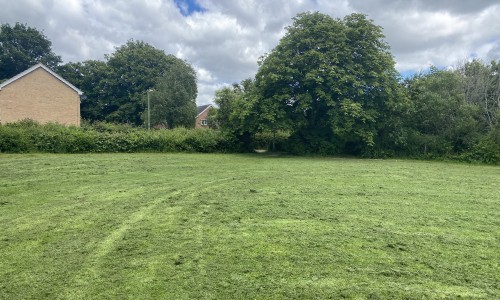
Seafield Park in Fareham was chosen as a site for creating a mini forest. This photo shows the large area of short grass across the park which had low biodiversity. The north-east corner of the park was chosen as it was not used much. Putting a mini forest here would not impact the sports space and would enhance the park for people and nature.