Silvopastoral systems
Silvopastoral systems have a livestock component linked to pasture or swards.
Livestock benefits in a silvopastoral system
For livestock, the provision of shade and shelter from extreme heat and cold is becoming increasingly important with climate shifts. If livestock experience extreme heat or cold, the live weight gain will be adversely affected. In dairy cattle, milk production is affected. As the ambient temperature increases above the Upper Critical Temperature (UCT) which is 25 degrees Celsius, milk yields can fall by as much as 20%. There will also be a reduction in fertility, including an increase in embryonic loss (sheep are also affected by this). There is also evidence of an increase in the risk of clinical mastitis.
There are many nutritional and health benefits from providing browse and fodder from trees and hedges. The figure below shows the nutritional profile of a range of tree species. This can be comparable or better than meadow hay and red clover silage.
Leaf nutrition in tree species compared to herbaceous fodder (%)
| Species | Moisture | Ash | Fat | Sugar | Protein | Fibre |
|---|---|---|---|---|---|---|
| Rowan | 11.9 | 5.9 | 6.5 | 50.4 | 9.9 | 15.4 |
| Goat willow | 11.5 | 6.1 | 3.8 | 50.3 | 11.6 | 16.7 |
| Aspen | 10.8 | 8.5 | 6 | 43.5 | 13.3 | 20.9 |
| Grey alder | 11.9 | 3.9 | 5.9 | 43.6 | 17.6 | 17.4 |
| Birch | 11.7 | 3.9 | 7 | 49.2 | 12 | 16.2 |
| Meadow hay | 15 | 5.4 | 2.2 | 44.4 | 8.5 | 24.6 |
| Red clover | 15.7 | 5.1 | 1.9 | 35.8 | 11 | 28.6 |
Impact of silvopastoral systems
Environmental impacts include land and water decontamination, increased biodiversity, and reduced flooding. Social benefits especially in peri-urban areas include increased access to green space and educational benefits.
Grants for silvopastoral systems
Given the low planting density, most Forestry Commission tree establishment grants would not currently be appropriate. Hampshire Forest Partnership have several funding schemes for farmers and landowners.
If your project involves the local community, Hampshire Forest Partnership have several schemes available. Visit People and communities for further details.
The Woodland Trust is supporting agroforestry establishment and will cover most costs. This is available on a first come first served basis.
Many Environmental Land Management (ELM) payments can be appropriate and if stacked could be attractive. Agroforestry payments will be available as part of the Sustainable Farming Incentive (SFI). These may require Environmental Impact Assessments (EIA). Walnut agroforestry and cricket bat willow agroforestry may be eligible if they are a part of meadow habitat creation under the Biodiversity Net Gain scheme.
Hampshire Forest Partnership may also be able to provide funding support e.g. in relation to their programme 'Shoots Along the Routes'. They can also supply free elm trees as part of a scheme to reintroduce disease resistant hybrids to Hampshire to benefit nature recovery (available each year on a first come first served basis).
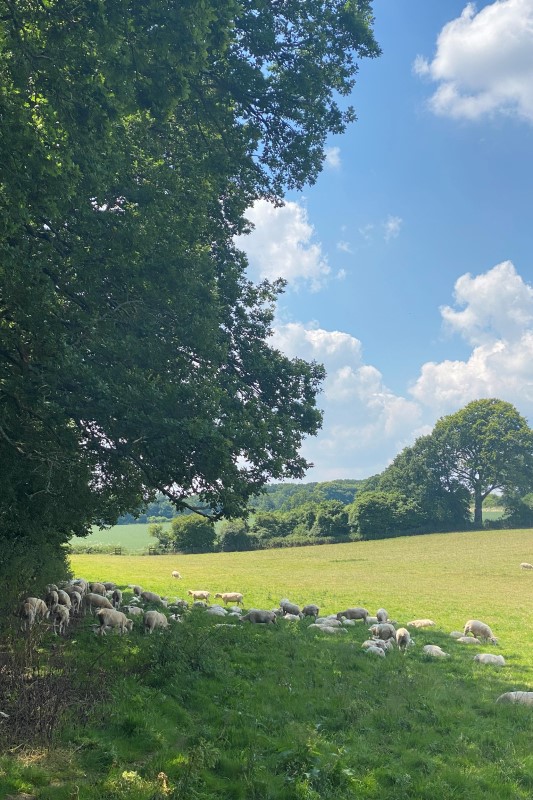
Sheep seeking vital shade on a hot day - the air cooling effect of the trees reduce the risk of heat stress.