

Cricket bat willow silvopastural systems
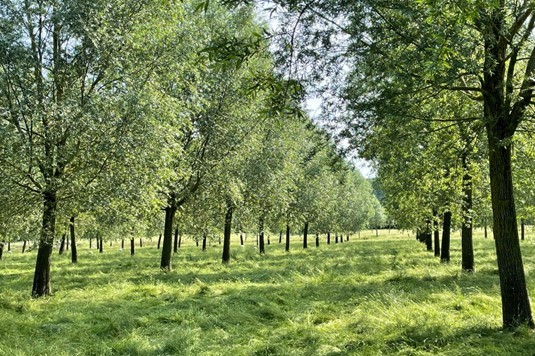
Cricket bats are made from a very special tree; the cricket bat willow Salix alba 'Caerulea'. Trees are planted at 100 stems per hectare on average and harvested after 12 to 20 years.
The game of cricket is gaining popularity in India and the USA and now women’s cricket is expanding rapidly. The demand for the bat blanks or clefts is constantly increasing. UK exports to India of English willow, which is bought by Indian companies to make bats used by players at all levels of the game, were worth over £6 million annually between 2018 and 2020, and are currently subject to a tariff of 10%. A Free Trade Agreement (FTA) could see these taxes cut or even removed entirely, along with a range of duties on other exports that would help UK firms expand into an economy due to become the world’s third largest by 2050.
Advice about growing cricket bat willow trees
Site requirements and critical management
Cricket bat willows appear to grow best next to running water (e.g., river plains, water meadows by streams and rivers) but it is not essential. A site where the water table is about 1m below the surface which does not dry out will help them grow just as well. Soil type is not critical, but they do grow more vigorously on clay soils. Areas of mature trees e.g., oak with a high incidence of honey fungus should be avoided as this can spread to the willow. Planting within 9m of a river may need permission from the Environment Agency. In addition, habitat and wildlife considerations may mean that trees are not appropriate for the site, so carry out appropriate checks prior to planting.
Lighter soils are suitable if the water table stays constant and does not dry out in the summer. Wet field corners are excellent prospects although bat willows do like field drains so care must be taken. As with most trees, planting areas where overhead telephone/electric cables exist should be avoided. Planting in areas near to older native broadleaves, particularly oaks can significantly raise the risk of honey fungus.
Diseases
There are two main diseases affecting cricket bat willows, watermark disease (Erwinia salicis) and honey fungus (Armillaria mellea). In both cases any tree becoming infected should be felled and removed immediately to prevent the disease spreading. Watermark disease is a bacterial disease, and the infection occurs via leaves and leaf scars resulting in leaves appearing shrivelled and scorched, and the timber to have a black watery stain rendering it worthless. Honey fungus attacks the root system and quickly can kill the tree, turning the wood into a grey mass with no value. Presence of mature native broadleaf species in a location, particularly oaks are thought to significantly increase the chances of Armillaria infection.
Outcomes at plot and landscape scale
Most growers would see income from the trees as the main purpose of the venture and this can be substantial. A target income of £70,000 per hectare after 12 years is not unreasonable on a good site with good management. Additional income streams are possible from the grazing, environmental stewardship, and any remaining tree biomass.
Experience shows that 100% grazing income is possible for the whole rotation as at 100 stems per ha, shading is minimal. Benefits to livestock include medicinal effects of using fresh prunings as a fodder and microclimate benefits (shade and shelter).
Willows contain salicylic acid, which is a natural anti-inflammatory. This compound, and tannins found in tree bark and leaves, can significantly help with animal pain relief, tooth, and gut health. It can reduce their internal parasite burdens and new evidence suggests that selenium (from willow) and copper (from hazel) can help with resistance to bovine tuberculosis.
Working at the landscape scale offers the greatest potential for the delivery of optimised ecosystem services. Areas of cricket bat willow agroforestry can be augmented with quince agroforestry and reedbeds to give a more diverse river buffer zone. Conversion of arable areas into silvopastoral systems linked to blocking land drains could help decontaminate land (nitrate and phosphate), increase carbon sequestration, and improve biodiversity linked with meadows and wetlands. Riparian planting could also serve to reduce river pollution. At this scale it is very appropriate to consider forming a tripartite environmental partnership consisting of:
- a grower
- a government agency or utility and
- a private sector philanthropic entrepreneur/broker
A 25-year environmental stewardship contract could deliver decontamination, biodiversity, carbon offsetting, and/or green infrastructure benefits (e.g. reduced flooding).
Advice on cricket bat willow
Several companies advertise in farming and landowners’ journals. They can provide sets, advice, annual maintenance services and provide buy back contracts. It is up to the grower to decide what services they require and if they want to sell the final crop to the highest bidder and not be limited by a contract.
Establishment and management
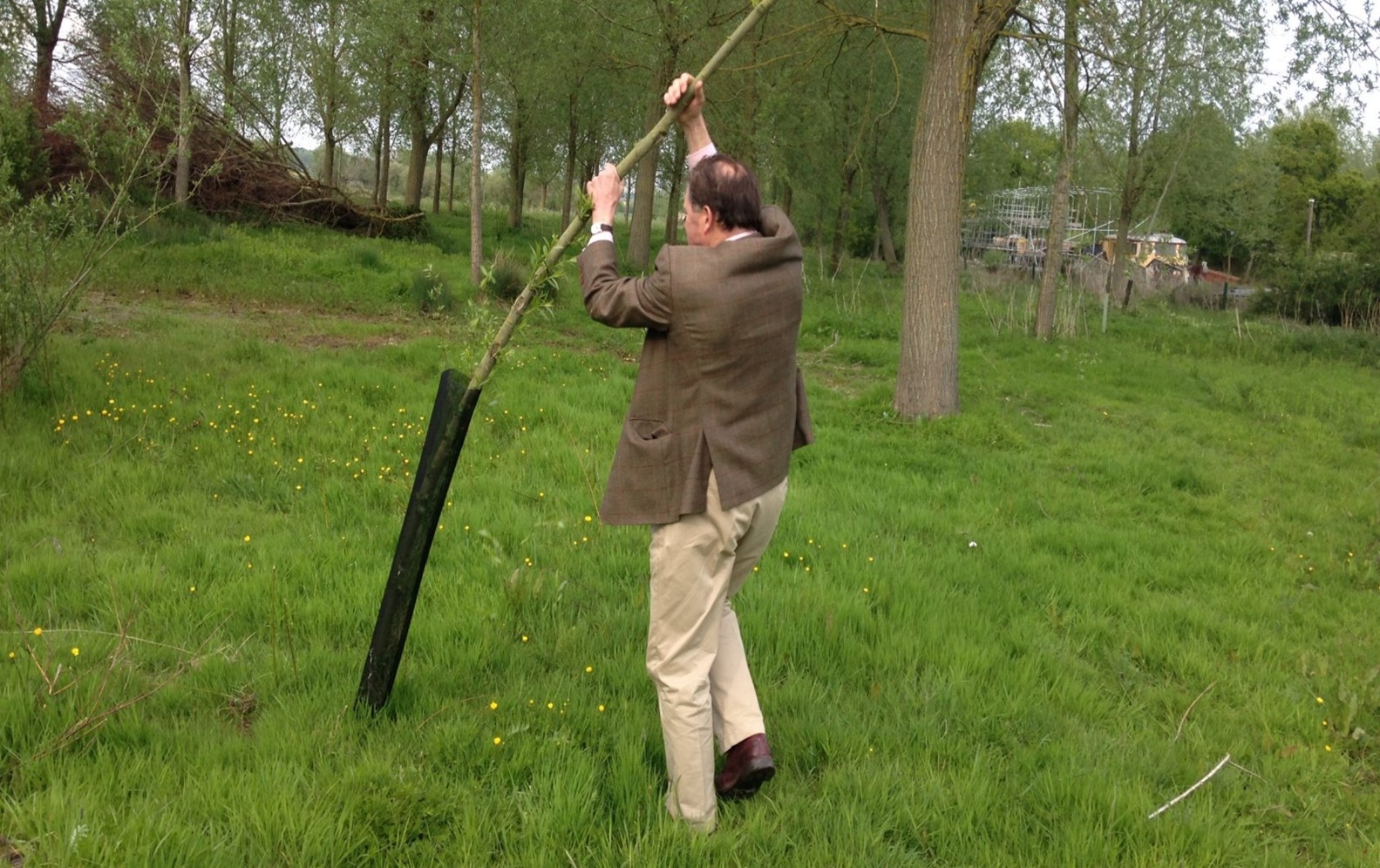
Planting is done using a straight crowbar or post hole borer to make a hole. The set is pushed 0.5m into the bottom of the hole, the ground is then firmed up around the stem. If it is done properly there is no need to stake the tree but individual guard protection against rabbits and deer is essential.
Protection from livestock damage must be in place and maintained. Guards should be perforated / holed type to prevent water retention thus alleviating aerial root growth on stem and they should be pushed about 1 inch into the ground to prevent voles and mice causing damage.
It is important that the guards can be slid up and down the set, to allow removal of side shoots. Failure to remove side shoots would render the timber virtually worthless.
Mulching around the base of the tree for the first 2 years would dramatically improve establishment and growth.
Harvest
The trees are auctioned when they reach the target diameter of 30cm at breast height. Once sold the buyer will fell and remove the trees in a professional manner removing all biomass if required or just taking the main economic part and leaving an estimated 70% of the biomass behind; bole wood, branch wood and material for basket making.
Simple gross margin model
% top grade trees at 100 stems per hectare: 90%
Price per tree after 12 years: £730
Cost per set: -£10
Grant per tree: £0
Tree protection per tree: -£20
Labour for tree establishment: £0
Mulch cost per tree: -£5
Net income per tree: £695
Net income per ha: £69,500
Sources of information
- Birks et al. (1989) ‘The Cultural Landscape: Past, Present and Future, Cambridge University Press
- Crawford M (2016) How to grow your own nuts, Green Books
- Temperate agroforestry systems, CABI Books
- The Agroforestry Handbook, Soil Association