

Apple silvoarable systems
There are many publications on how to grow apples in a domestic and commercial orchard setting so details will not be provided here. Apples planted in silvoarable systems where there is a large distance between the tree rows will experience a very different microclimate than the ones grown in commercial orchards. There will be a far greater circulation between the tree rows, and this may reduce the incidence of fungal disease meaning that a no spray regime may be economic.
In most apple silvoarable systems there will be an interest in using all the fruit and not just grade one apple. There will also be viability in selling apple products at the farm gate. Mechanical harvesting of fruit may be a possibility if appearance is not a key issue as in apple juice and cider. The lower reliance on selling apples to supermarkets and wholesalers also means that heritage varieties may be appropriate and again these may be more resilient in the absence of sprays than modern commercial varieties. Wildflower mixes sown within the tree rows and flowering intercrops such as flax may also attract predators of insect pests and consumers of fungal pathogens.
The science of apple silvoarable systems is in its infancy, so many of the advantages are yet to be fully quantified and/or understood.
Advice about growing apple trees
Site requirements
Apples will benefit from sheltered sunny sites with deep soils e.g., sandy loam with a pH between 6-7. Apple is insect pollinated so adding wildflower mixes to the tree strip can be advantageous.
Varieties
There are hundreds of varieties to choose from if heritage apples are included. Heritage apples may be more resilient to pests and diseases in a no spray regime. Rootstock selection should be linked to ease of picking. The most widely available apple rootstocks are called ‘M27’, ‘M9’ and ‘M26’, and ‘M106’, producing trees of 1.5-1.8m (5-6ft), 2.4-3.6m (8-12ft) and 3.6-5.4m (12-18ft) tall respectively. Fruit yield is similar but big trees give a financial breakeven point later and can be difficult to harvest. Miniature (M27) or dwarf (M9) are not generally recommended, as the root system may be too weak to support the tree weight in later years, when it is in full production. Varieties should be selected so that harvesting time does not interfere with arable operations. It is always better to have more than one variety. Some varieties may need to be cross-pollinated with pollen from the flowers of a different apple variety to produce fruit.
Financial data based on targets
The gross margin data presented focusses on the tree component only. The wide spacing of the trees and the moderate beneficial shade cast means that a target of 100% intercrop yield is expected on average over the life of the system. Beneficial interactions mean that in many cases the loss of the land area under the tree strip is totally compensated for.
Variables per hectare
Tree density: 85
Target average yield (tonnes): 1.7
Price per tonne: £900
Total output: £1,530
Variable cost (£)
Orchard depreciation (establishment): £60 (Over 10 years based on the life of the establishment materials and not the life of the tree)
Pruning/clearing: £50
Organic fertiliser/sprays: £81
Crop sundries e.g. tree ties: £20
Harvesting (labour): £200 (This is the only labour that is contracted. All labour for other operations is assumed to be farm staff which is part of the fixed costs of the operation.)
Processing: £248
Storage/bin hire: £0
Packaging (boxes): £111
Transport: £90
Marketing and sales: £100
Commission/levies: £115
Total variable cost: £1075
Tree crop gross margin: £455
Tree yields - year 1-3 zero; year 4-5 50%; year 6-15 100%; year 16-25 75%
Spacing
In modern commercial orchards, monocultures of dessert apple operate in orchard densities between 850 and 6000 stems per hectare and have an extremely high cost of establishment (e.g., £20,000 per hectare if labour is included). They also require a high intensity spray regime to manage as monocultures. 90% of the crop is sold to supermarkets.
The agroforestry option is not comparable to this approach. It is a low-cost low input approach and typically 80-123 stems per hectare is a reasonable tree planting density.
Given the importance of wild flower mixes in apple pollination, it is recommended that 3m strips are sown. For the management of organic arable crops, an ideal arable alley would be 24m wide. This gives 27m between the rows.
- 85 Vs 850 trees per hectare
- 3m between each tree in the row
- 27m between each row
- 3m pollen rich strip under trees
- 24m working width between rows
Establishment and management
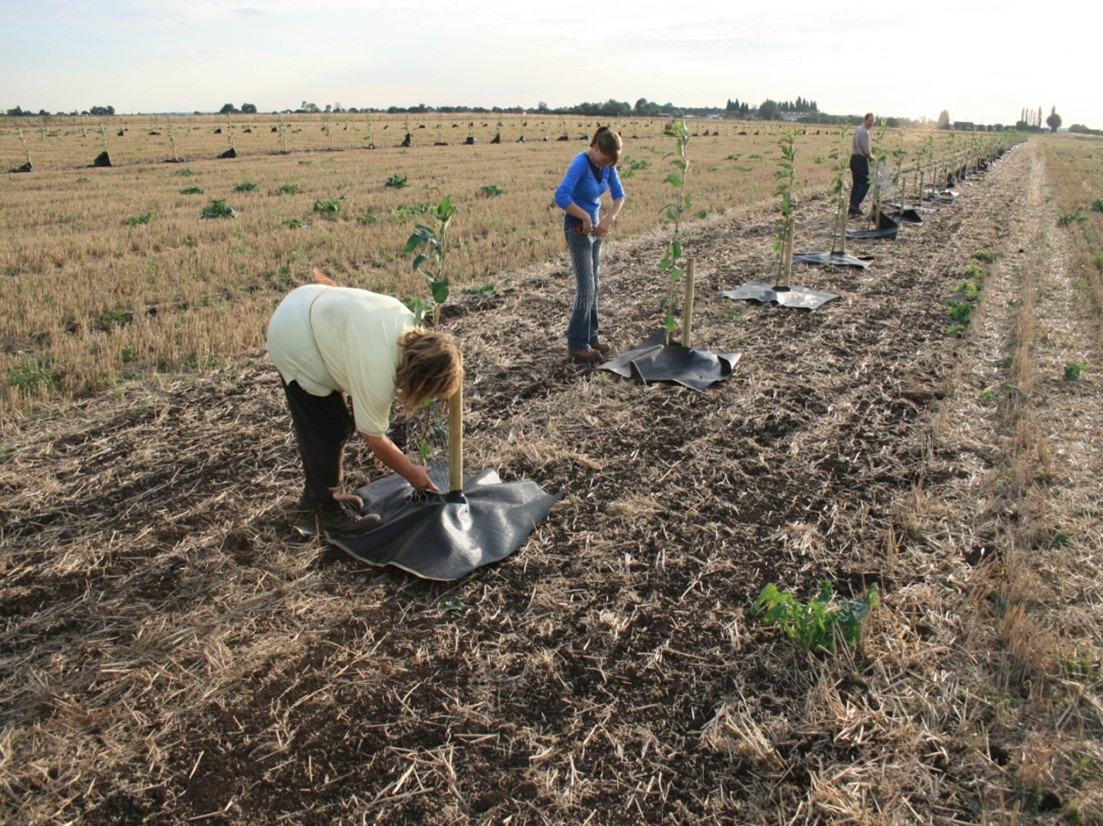
1.5m to 2m trees should be planted with a stake, tree protection and a mulch mat. A bamboo cane should then be inserted as a bird perch, taller than the tree, to stop birds landing on the young tree branches and snapping them off. Birds will tend to land on the highest point.
Sources of information
- Apple Best Practice Guide, NIAB
- The Agroforestry Handbook, Soil Association
Major nurseries sell apple trees and can give advice on varieties.
Apple trees are also suitable for silvopastural systems and forest gardens.