

Walnut silvoarable systems
The two main types of walnut used in agroforestry are Persian walnut, also known as English or common walnut (Juglans regia) and black walnut (Juglans nigra). The former is primarily grown for nuts and the latter for timber.
Research on walnuts for nuts in the UK started in the 1920s in East Malling, before being picked up again in the 1980’s by the Open University. Open University research showed that it is possible to obtain nuts after 1 to 2 years from grafted trees and that the most productive varieties were those that were late leafing/flowering to escape late spring frosts and lateral bearing (producing nuts on both tip and lateral branches).
Advice about growing walnut trees
Varieties
The following varieties show promise in the UK: Lara, Jupiter, Lara, Fernor, Fernette, and Geisenheim 139. It is best to plant a mixture to ensure good pollination. It is also useful to plant Franquette due to its excellent taste and because it is commonly used as a marker for the phenology of flowering e.g. variety X bears female flowers Y weeks after Franquette. For a full list of walnut varieties and characteristics see Crawford (2016).
Establishment and tree protection
Grafted trees 1-2m can be planted.
Trees need to be staked with 2m stakes. Ideally two are used to support the tree. A tree guard is adequate for protection against damage from small deer.
Harvesting
Nuts will fall to the ground and once this starts to happen, the process can be speeded up by using a tractor mounted tree shaker. There are several simple hand-held roller harvesters on the market. Nuts should not be allowed to stay on the ground for more than 48 hours and should be de-husked, cleaned and dried. Harvesting can be mechanised.
Outcomes at the plot scale
Most growers would see income from the trees as the main purpose of the venture and this can be substantial.
A high yield scenario based on global experience of countries with a similar climate gives the start of nut bearing in year 3 with 1kg per tree. At year 10, 10kg per tree is obtained. At year 25, 52kg per tree is obtained as in Crawford (2016). The model is based on 100 stems per hectare.
A conservative and simple target for yields of walnut in agroforestry in the UK could be 3.5 tonnes per hectare averaged over the life of the trees. The productive life of the trees could be over 50 years depending on management and site.
Additional income streams are possible from grazing, environmental stewardship, and any remaining tree biomass. Shell by-products are an exciting area to consider moving forward, with applications in mulching, fertilisers and even hand creams.
Experience shows that 100% arable yield is possible in systems with widely spaced alleys.
Market consideration
It should be noted that most walnut veneer for luxury cars now comes from Juglans regia grown for the nuts in commercial orchards in the USA. Figured timber (interesting grain pattern e.g. for veneer) only occurs however, in about 0.1% of the trees and the reasons for the figuring are not fully understood. Valuable timber is a possible by-product of UK walnut orchards, but any financial assessment should be based on the nuts alone.
Products
It should be noted that most walnut veneer for luxury cars now comes from Juglans regia grown for the nuts in commercial orchards in the USA. Figured timber (interesting grain pattern for using as veneer) only occurs however in about 0.1% of the trees and the reasons for the figuring are not fully understood. Valuable timber is a possible by-product of UK walnut orchards, but any financial assessment should be based on the nuts alone.
Site requirements
Walnuts require sheltered sunny sites (avoid excess shade which can affect the quantity and quality of any nuts produced) with deep soils e.g., sandy loam with a pH between 6-7. Sites should have good drainage. Very wet soils with heavy clay are to be avoided. Avoid valley bottoms or landscape dips as frosts may linger which can damage walnuts in spring.
Spacing
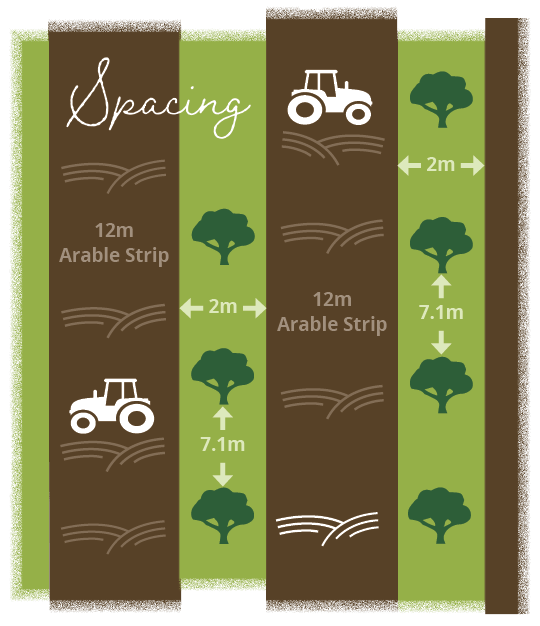
The standard density of planting of commercial nut orchards in France is 100 stems per hectare and this is normally achieved as a monoculture at 10m x 10m spacing. Experience gained in walnut agroforestry in the UK has shown that this spacing is not appropriate for silvoarable systems.
There needs to be space allowed for mechanised management of the understorey crop. The trees will need a minimum of a 2m wide strip so root development can take place. The arable crop alley should be at least 12m and could be 24m or 36m. This gives distances of 14m and 26m between the tree rows respectively. To maintain a density of 100 stems per hectare the within row tree distance is 7.1m (100/14) and 3.8m (100/26) respectively.
The calculation to estimate the number of trees per hectare =
10,000 / (spacing of trees in metres for direction 1 – between rows ) X ( spacing of trees in metres for direction 2 – within rows).
14m x 7.1m = 99.4m
10,000 / 99.4 = 100.6
With this spacing you would achieve c.100 trees per hectare.
For wider arable strips requiring bigger machinery:
26m x 3.8m = 98.8m
10,000 / 98.8 = 101.2
With this spacing you would also achieve c.100 trees per hectare.
Arable strips would be 24m wide. Distance between trees would be 3.8m. Uncropped area around trees would be 2m wide.
Pests and diseases
There are no major insect pests of walnut in the UK and diseases such as leaf blotch Gnomonia leptostyla, blight Xanthomonas arboricola pv. juglandis and honey fungus Armillaria spp can be prevented or reduced by removing leaf land branch litter.
Outcomes at landscape scale
Working at the landscape scale offers the greatest potential for the delivery of optimised ecosystem services. Areas of walnut agroforestry can be used to remove phosphate and nitrate annually as nuts contain high levels of phosphorus and nitrogen.
Riparian planting could serve to reduce river pollution. At this scale it is very appropriate to consider forming a tripartite environmental partnership consisting of (1) a grower, (2) a government agency or utility and (3) a private sector philanthropic entrepreneur/broker. A 25-year environmental stewardship contract could deliver decontamination, biodiversity, carbon offsetting, and or green infrastructure benefits (e.g., reduced flooding).
Financial data based on targets
The gross margin data presented focusses on the tree component only. The wide spacing of the trees and the moderate beneficial shade cast means that a target of 100% intercrop yield is expected on average over the life of the system. Beneficial interactions mean that in many cases the loss of the land area under the tree strip is totally compensated for.
Tree density: 100 per hectare
Target average yield (tonnes): 3.5 per hectare1
Price per tonne: £15,0002
Total Output: £52,500
Variable Cost (£)
Orchard depreciation (establishment): £8403
Pruning/clearing: £50
Organic fertiliser/sprays: £81
Crop sundries e.g. tree ties: £20
Harvesting (labour): £2004
Processing: £500
Storage/ bin hire: 0
Packaging e.g. boxes: £111
Transport: £90
Marketing and sales: £100
Commission/levies: 0
Total variable cost: £1,992
Tree crop gross margin: £50,598
The gross margin of £50,598 per hectare for the walnut component compares to £1,335 for high yields of milling wheat and £13,052 dessert apples as outlined in Nix (2023).
Notes
- Based on full crop data in Crawford averaged over the life of the orchard (2016)
- Assumes a high value product e.g., English walnut oil. It is not a wholesale price and bears no relation to global prices
- Over 5 years based on the life of the establishment materials (tree guards, and stakes etc) and not the life of the tree
- This is the only labour that is contracted. All labour for other operations is assumed to be farm staff which is part of the fixed costs of the operation
Advice on walnut trees
Major nurseries are now selling grafted walnut trees and can give advice on varieties.
Walnut is also suitable for silvopastural systems and forest gardens.
Hampshire County Council have created a new Facebook group, The Hampshire Agroforestry Forum, to enable farmers, growers, and food entrepreneurs to link with each other to facilitate new markets for tree products. If you have products to sell or you are looking for products produced from trees, please add your details to the group. You could also pose any questions and queries about agroforestry for others to answer.
Sources of information
- Birks et al. (1989) ‘The Cultural Landscape: Past, Present and Future, Cambridge University Press.
- Crawford M (2016) How to grow your own nuts. Green Books
- Nix (2023). John Nix pocket book for farm management edited by Graham Redman ISBN 978-1-9196545-1-5
- Temperate agroforestry systems, CABI Books
- The Agroforestry Handbook, Soil Association